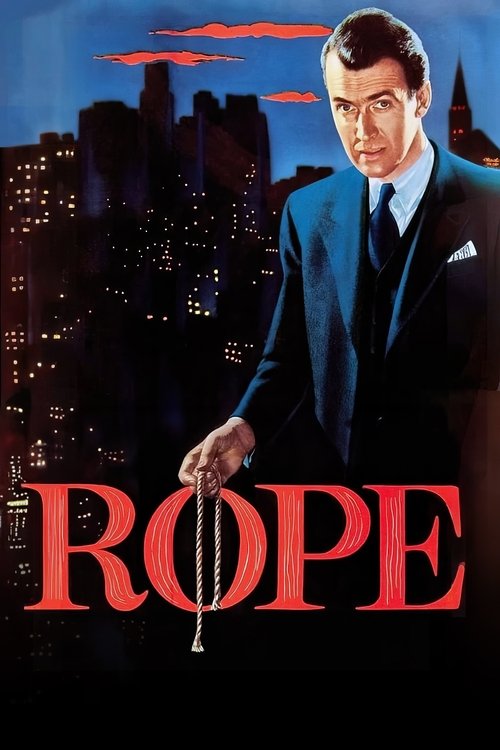
Rope (1948)
Directed by Alfred Hitchcock
No · Ultra Based
How we score movies →Consciousness Markers
Coded homoeroticism exists in the relationship between Brandon and Philip, but this is subtext born of censorship constraints rather than modern progressive representation or advocacy.
No intentional progressive casting or representation messaging. The film reflects standard 1948 Hollywood practices without commentary.
Female characters exist in the narrative but without any feminist messaging or thematic engagement.
No racial consciousness or commentary is present in the film.
Climate themes are entirely absent from this psychological thriller.
No anti-capitalist messaging or class consciousness appears in the film.
Body positivity themes do not appear in this 1948 thriller.
No representation or discussion of neurodivergence is present in the film.
The film is not a historical work and contains no revisionist historical narratives.
Rope is a tightly paced thriller with minimal exposition or preachy moments. It does not lecture the audience.


Synopsis
Two young men attempt to prove they committed the perfect murder by hosting a dinner party for the family of a classmate they just strangled to death.
Why it received this score
Rope presents a curious case study in the archaeology of coded progressive sensibilities. Alfred Hitchcock's 1948 thriller, adapted by gay screenwriter Arthur Laurents and cast with queer actors, hums with homoeroticism beneath its surface, a necessary subterfuge in an era when the Hays Code would not permit explicit acknowledgment of such things. The relationship between Brandon and Philip crackles with an intimacy that contemporary viewers familiar with queer cinema can recognize, yet the film itself makes no claim to be advancing any social consciousness agenda. It is, rather, a masterpiece of constraint and implication, working within the oppressive machinery of its time rather than openly challenging it.
To conflate this subtext with modern progressive representation would be to commit a category error. Rope does not celebrate queer identity or advocate for social change. It does not lecture. It does not announce itself as a statement about anything beyond the psychological thrills of its immediate plot. The film's cultural significance lies precisely in what it could not say, in the ingenuity required to encode meaning through performance and framing when direct expression was forbidden. This is not the same as wokeness, which requires explicit, intentional messaging about social consciousness.
The film remains a technical marvel and a work of artistic achievement, but these qualities are orthogonal to the question of modern progressive sensibilities. Rope predates the entire conceptual apparatus of contemporary social consciousness by generations. To score it as a woke film would be to misunderstand both the film itself and what wokeness actually means. It is instead a historical artifact that reveals how marginalized creators worked within systemic constraints, a different sort of cultural document entirely.
Analysis generated by our Consciousness Algorithm
Critic Reviews
“Rope is not merely a stunt that is justified by the extraordinary career that contains it, but one of the movies that makes that career extraordinary. ”
“One of the cinema's supreme, most outrageously eccentric and audacious technical experiments: the legendary single shot movie.”
“A crime for most, a privilege for some is how Rupert classifies murder, but Hitchcock's eye-am-a-camera technique in Rope is after more than Nazi-superman residue still lurking after WWII.”
“At all events, the picture takes on a dull tone as it goes and finally ends in a fizzle which is forecast almost from the start.”