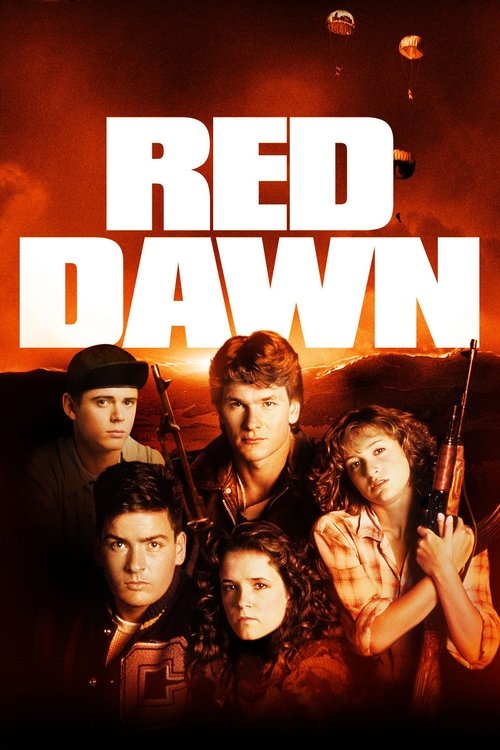
Red Dawn (1984)
Directed by John Milius
No — Red Dawn is not woke, scoring 3 out of 100 on our wokeness meter.
Red Dawn arrives from 1984 with a clear ideological program and almost none of the cultural markers that animate contemporary progressive classification.
Consciousness Markers
Toni and Erica participate in the guerrilla group and survive to the end, but the film offers no feminist critique or agenda; the women are largely defined by their roles within a male-led resistance.
The film closes with a patriotic plaque and jingoistic framing, but this is Cold War rallying cry rather than modern social-justice lecturing.
The cast is overwhelmingly white, with minority actors (e.g., Ron O'Neal as Cuban Colonel Bella) cast primarily as foreign antagonists rather than for progressive representation.
The Soviet-Cuban-Nicaraguan invasion force and Colonel Bella's late disillusionment touch on geopolitics, but the film frames this as Cold War ideology rather than racial consciousness.
No LGBTQ+ characters, themes, or subtext of any kind appear in the film.
No environmental or climate themes are present; the war's cause is a failed Soviet wheat harvest, not ecological crisis.
The film is stridently anti-communist and pro-American; it contains no critique of capitalism or wealth.
No body positivity themes or messaging appear in the film.
No neurodivergent characters or themes are present.
The film presents a fictional World War III scenario rather than reinterpreting or revising actual historical events.
Why it received this score
Red Dawn arrives from 1984 with a clear ideological program and almost none of the cultural markers that animate contemporary progressive classification. The film follows Colorado teenagers who take up arms against a Soviet-led invasion, and its politics are anti-communist, patriotic, and Cold War to the bone. The cast is overwhelmingly white. Minority actors appear chiefly as foreign antagonists, including a Cuban colonel whose late disillusionment is a narrative grace note, not a statement about racial consciousness. Women join the resistance and survive for a while, but the film frames them through the male-led guerrilla group. There is no LGBTQ presence, no feminist critique, and no interest in representation as a value in itself.
The environmental and economic markers are absent. The invasion is triggered by a failed Soviet wheat harvest, not an ecological crisis, and the film has no critique of capital to offer. It is stridently pro-American and anti-Soviet. Body positivity and neurodivergence do not enter the frame. The story is fictional World War III, so it does not revise actual history. Its sermonizing is reserved for the closing plaque, a patriotic monument that identifies the dead as children who fought so the nation shall not perish. That is a rallying cry from a vanished ideological conflict, not a modern social-justice lecture.
Measured against contemporary cultural awareness, Red Dawn is a dry well with a flag planted beside it. The faint traces of female participation and the Cuban colonel's moment of doubt are narrative conveniences. They do not amount to an agenda. The film is loud, earnest, and committed to a Cold War imagination that has since curdled into quotation. It deserves a low classification, delivered with the solemnity such an artifact requires.
Analysis generated by our Consciousness Algorithm


Synopsis
It is the dawn of World War III. In mid-western America, a group of teenagers band together to defend their town—and their country—from invading Soviet forces.
Questions about Red Dawn
Is Red Dawn woke?
No — Red Dawn is not woke, scoring 3 out of 100 on our wokeness meter. That earns it a verdict of Ultra Based.
Does Red Dawn have any woke elements?
Very few. None of the 10 markers reaches 30, the level where a marker counts as present; the highest is Feminist Agenda at 10.
How does Red Dawn compare to other 1984 movies?
It ranks #36 of the 51 films from 1984 we've scored; their average is 7. The wokest is Revenge of the Nerds (30).
How is the Woke Score calculated?
An AI-assisted process researches the film and its reception, scores it 0–100 on ten markers, then combines those into one 0–100 Woke Score. It measures a specific set of 2020s cultural themes, not film quality.