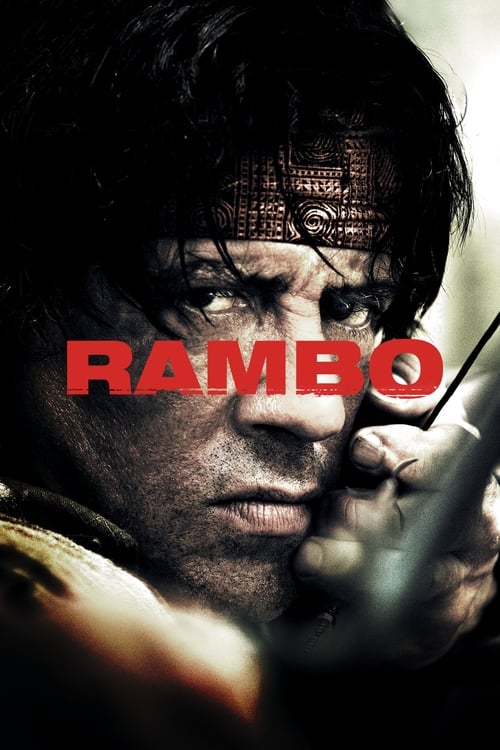
Rambo (2008)
Directed by Sylvester Stallone
No — Rambo is not woke, scoring 15 out of 100 on our wokeness meter.
Rambo arrived in 2008 as the fourth installment in a franchise that had already outlived its Cold War pretext, and it carries itself with the grim satisfaction of a machine that knows exactly what it is for.
Consciousness Markers
The cast is overwhelmingly white and male, with non-white performers (Maung Maung Khin, Tim Kang, Rey Gallegos) mostly filling villain, sidekick, or victim roles. The hiring of a real Karen freedom fighter lends authenticity but is not representation casting in the modern sense.
The graphic depiction of SPDC brutality carries a persistent humanitarian sermon — critics specifically faulted the film's political commentary — but it is delivered through carnage rather than dialogue.
The film dramatizes real atrocities against the Karen people, but its racial politics consist of portraying the Burmese military as uniformly sadistic savages while a white American rescues the locals — the opposite of a 2020s racial-consciousness framework.
Julie Benz's Sarah gets a handful of persuasive lines and a moral function, but she exists chiefly as a hostage to be rescued; the franchise's hyper-masculine ethos is untouched.
No LGBTQ+ characters, themes, or subtext anywhere in the film.
No environmental themes whatsoever; the jungle is a battlefield, not an ecosystem with a message.
No economic critique; the mercenaries are motivated by money and the film treats them with mild amusement rather than indictment.
No body-positivity themes or messaging of any kind.
Rambo's PTSD flashbacks are depicted as a source of lethal dysfunction, not as a neurodivergent identity to be affirmed or destigmatized in the contemporary sense.
The film is a fictional action narrative built on real Burmese atrocities rather than a reinterpretation of history through a modern ideological lens.
Why it received this score
Rambo arrived in 2008 as the fourth installment in a franchise that had already outlived its Cold War pretext, and it carries itself with the grim satisfaction of a machine that knows exactly what it is for. Stallone directs himself as a burned-out snake catcher on the Salween River, drawn back into the world by Christian aid workers who need passage into Burma. What follows is a sustained act of humanitarian outrage expressed almost entirely through dismemberment. The Burmese military razes villages, enslaves women, drafts children, and forces prisoners across minefields for sport. The film's objection to these crimes is sincere and loud, though it arrives via machete instead of dialogue, a delivery system of limited persuasive value.
On the ledger of contemporary social consciousness, the film is nearly empty, and it does not appear to mind. Julie Benz's Sarah gets a handful of firm lines and a moral function, then becomes a hostage to be retrieved. The franchise's masculine architecture remains undisturbed. A real Karen freedom fighter plays the chief villain, lending authenticity without constituting the kind of casting gesture that earns credit in this column. There is no LGBTQ content, no environmental theme, no interest in body image, and no framing of Rambo's PTSD as an identity to be affirmed. The mercenaries chase money, and the film regards them with mild amusement instead of indictment.
Racial politics here are of an older, unexamined sort: Burmese soldiers rendered as uniformly sadistic, a white American as the instrument of rescue. The anger is real. The framework is 1985 with better squibs. Dedicated to Richard Crenna, and to a version of the action picture that requires no permission slip.
Analysis generated by our Consciousness Algorithm
Part of


Synopsis
In Thailand, ex-Green Beret John James Rambo joins a group of mercenaries to venture into war-torn neighboring Myanmar to rescue a group of Christian aid workers who have been kidnapped by a ruthless local infantry unit.
Questions about Rambo
Is Rambo woke?
No — Rambo is not woke, scoring 15 out of 100 on our wokeness meter. That earns it a verdict of Ultra Based.
Does Rambo have any woke elements?
Very few. None of the 10 markers reaches 30, the level where a marker counts as present; the highest is Representation Casting at 25.
How does Rambo compare to other 2008 movies?
It ranks #56 of the 212 films from 2008 we've scored; their average is 12. The wokest is Milk (68).
Is Rambo the most woke Rambo movie?
Yes. It scores highest of the 5 Rambo films we've scored.