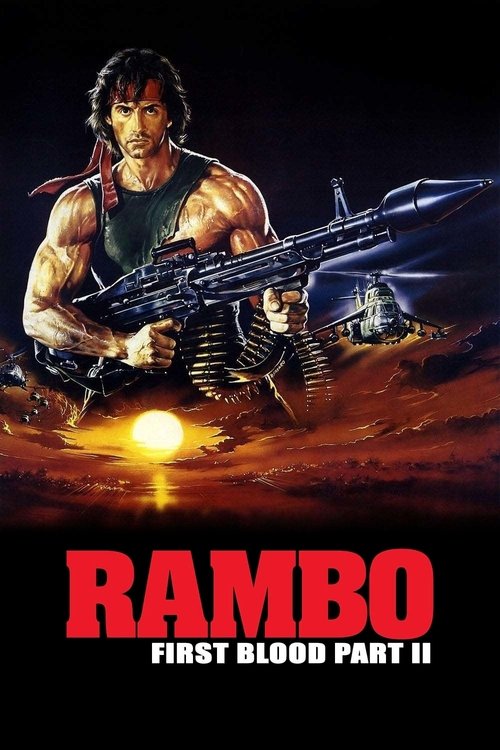
Rambo: First Blood Part II (1985)
Directed by George P. Cosmatos
No · Ultra Based
How we score movies →Consciousness Markers
The film engages in significant historical revisionism by presenting a fantasy scenario where America can retroactively 'win' the Vietnam War through individual heroic action, serving Cold War ideological purposes.
The cast includes Julia Nickson as a Vietnamese ally and George Cheung in a minor role, but these characters exist purely as functional elements supporting the white male protagonist's narrative, with no agency or development.
The film treats Vietnamese people and setting as mere backdrop for American action heroics, reflecting colonial attitudes. Racial consciousness or meaningful engagement with Vietnamese identity is entirely absent.
Julia Nickson's character is subordinate to the male lead and exists primarily to be rescued and protected. She demonstrates some agency in combat but remains fundamentally secondary to Rambo's heroic narrative.
The film contains minimal dialogue and no preachy exposition. It operates through action and spectacle rather than through explanatory monologue or social messaging.
The film celebrates an extremely narrow ideal of masculine physicality, with Rambo's hypermuscular body presented as the ultimate expression of heroic virtue. No alternative body types or inclusive representation of physicality.
No LGBTQ+ themes, characters, or representation present. The film is entirely heteronormative and contains no engagement with queer identity.
No environmental themes, climate messaging, or ecological consciousness appears in the narrative. The jungle setting is purely aesthetic and functional.
The film contains no critique of capitalism, class systems, or economic structures. It functions entirely within Cold War geopolitical frameworks.
No engagement with neurodivergence, mental health representation, or neurological diversity. The protagonist's trauma is not explored with psychological nuance.


Synopsis
John Rambo is released from prison by the government for a top-secret covert mission to the last place on Earth he'd want to return - the jungles of Vietnam.
Why it received this score
Rambo: First Blood Part II operates as a pure Reagan-era wish fulfillment fantasy, concerned primarily with muscular action and Cold War triumphalism rather than any meaningful engagement with social consciousness. The film sends its protagonist back to Vietnam to rescue American prisoners of war and, implicitly, to win the war that America lost in 1975. This narrative serves a specific ideological purpose: the rewriting of a national trauma as a story of individual masculine redemption, a fantasy that appeals to certain sensibilities but contains no pretense toward progressive social awareness.
The supporting cast functions almost entirely as functional elements in Rambo's narrative rather than as developed characters with their own agency or complexity. Julia Nickson appears as a Vietnamese ally, but she exists primarily to be protected and to facilitate the male lead's heroic mission. The film's treatment of Vietnam and Vietnamese characters reflects the colonial attitudes embedded in the genre itself, where foreign locations and peoples serve as mere backdrops for American action heroics. The Soviet antagonists receive similarly cartoonish treatment, reduced to ideological abstractions rather than portrayed with any nuance.
What emerges from the film's worldview is a conviction that individual strength and firepower constitute adequate responses to geopolitical complexity. Social consciousness, representation, or engagement with systemic issues never register as even minor concerns. This is not a moral failing in the film's estimation of itself, but rather a statement about its priorities. For a 1985 action film, this represents the baseline of the genre, and the film makes no moves toward anything beyond that baseline. It is what it is: a straightforward product of its moment, unconcerned with and largely incapable of the cultural conversations that would become central to cinema in subsequent decades.
Analysis generated by our Consciousness Algorithm
Critic Reviews
“If you accept that Rambo is not the same kind of movie as First Blood and watch it on its own merits, it’s a badass action movie.”
“In short, Rambo is very good at what it does, but what it does isn't always that good. [22 May 1985, p.1C]”
“The direction is dynamic, the cutting has verve. To confess, Rambo: First Blood Part II is unexpectedly taut and exciting, despite its sermonizing and predictable conclusion, assuming Stallone is accepted as that impossible creation, the one-man army. [23 May 1985]”
“Cosmatos' constant device of setting up the audience, releasing the tension and then setting up again gives the movie a pacing that is all manipulation. [22 May 1985, p.D1]”