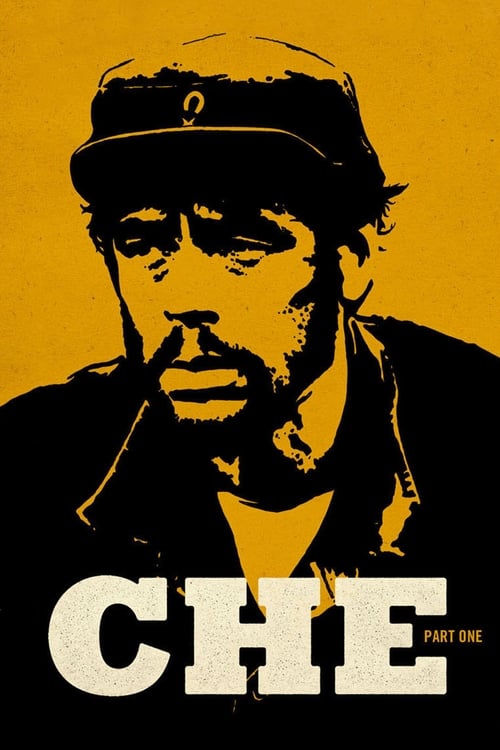
Che: Part One (2008)
Directed by Steven Soderbergh
Partly — Che: Part One is somewhat woke, scoring 42 out of 100 on our wokeness meter.
Steven Soderbergh approaches the Cuban Revolution the way a competent accountant approaches a difficult ledger: patiently, in sequence, and with an eye on the columns.
Consciousness Markers
The film sympathetically depicts Che Guevara's communist revolutionary struggle against the Batista regime and U.S.-backed capitalist interests, making anti-capitalist politics central to its subject.
The film casts Latin American actors in Latin American historical roles and is performed largely in Spanish, giving it a notable degree of authentic representation for its era.
Che's ideological speeches and interviews appear, but the film is largely observational and procedural rather than preachy or lecture-driven.
No LGBTQ+ characters, themes, or subtext are present in this historical war drama.
Women appear in the historical narrative but the film does not advance a feminist agenda or critique patriarchal structures.
The Cuban Revolution's racial dimensions are not foregrounded or examined through a modern racial-consciousness lens.
No environmental or climate-crisis themes appear.
No body-positivity themes or body-diverse messaging.
No neurodivergence themes; Che's asthma is a physical condition, not framed as neurodivergence.
The film is a historical dramatization based on Che's own accounts, not a modern revisionist reinterpretation of history.
Why it received this score
Steven Soderbergh approaches the Cuban Revolution the way a competent accountant approaches a difficult ledger: patiently, in sequence, and with an eye on the columns. The film follows Ernesto Guevara from Mexico through the Sierra Maestra, staging the campaign as a series of small logistical victories and quieter failures. There is no triumphal music swelling under the jungle canopy. There is a man with asthma, a rifle, and a plan, and the camera observes him with the patience of a documentary crew that has been told to keep its opinions to itself. The Spanish-language performances and the casting of Latin American actors in Latin American roles give the proceedings a texture that most Hollywood treatments of this subject would have flattened into accent work and noble silhouettes.
The politics are not buried. Guevara's communism is the engine of the thing, and the film takes his side without much throat-clearing, framing the struggle against Batista and his American patrons as a straightforward matter of the powerful taking from the poor. That is the film's organizing conviction, and it presents it with a straight face and no apology. What keeps the picture from becoming a sermon is Soderbergh's refusal to editorialize. The speeches exist, the ideology is spoken aloud, but the camera keeps drifting back to supply lines, river crossings, and the arithmetic of survival. The result is a revolutionary portrait that trusts the audience to draw its own conclusions about the justice of the cause.
Elsewhere the film is content to be a historical dramatization and little more. It does not interrogate the revolution's racial contours, it does not trouble itself with gender, and it does not ask its subject to answer for anything beyond the immediate tactical problem in front of him. Guevara's asthma is treated as a physical inconvenience, not a metaphor. This is a film about a war, made with discipline and a certain chilly intelligence, and it leaves the larger reckonings to whoever comes after. A sober, well-made piece of work. The sommelier would approve, and then ask for something with more tannin.
Analysis generated by our Consciousness Algorithm


Synopsis
Ernesto Guevara, known as 'Che', leads a group of Cuban exiles under Fidel Castro in a revolution to overthrow Fulgencio Batista, the dictator of Cuba.
Questions about Che: Part One
Is Che: Part One woke?
Partly — Che: Part One is somewhat woke, scoring 42 out of 100 on our wokeness meter. That earns it a verdict of Woke-Adjacent.
What makes Che: Part One woke?
2 of the 10 markers register at 30 or above, led by Eat the Rich (75) and Representation Casting (60). On Eat the Rich: The film sympathetically depicts Che Guevara's communist revolutionary struggle against the Batista regime and U.S.-backed capitalist interests, making anti-capitalist politics central to its subject.
How does Che: Part One compare to other 2008 movies?
It ranks #8 of the 212 films from 2008 we've scored; their average is 12. The wokest is Milk (68).
How is the Woke Score calculated?
An AI-assisted process researches the film and its reception, scores it 0–100 on ten markers, then combines those into one 0–100 Woke Score. It measures a specific set of 2020s cultural themes, not film quality.