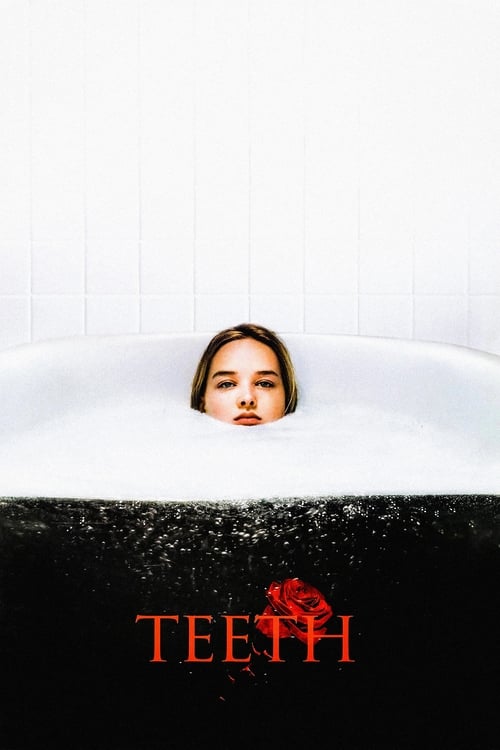
Teeth (2008)
Directed by Mitchell Lichtenstein
Yes — Teeth is woke, scoring 60 out of 100 on our wokeness meter.
Mitchell Lichtenstein's Teeth arrived at Sundance in 2007 with a title that promised anatomical horror and a premise that delivered it.
Consciousness Markers
The film is widely described as a feminist horror comedy, using the vagina dentata myth to literalize female bodily autonomy and revenge against male sexual predation.
The feminist critique is embedded in the horror-comedy plot rather than delivered through direct preaching or lecture-style dialogue.
The cast is predominantly white and the film makes no deliberate effort at diverse or inclusive representation casting.
There are no LGBTQ+ themes, characters, or subtext in the film.
Race is not a thematic concern, and the film does not engage with racial consciousness or systemic racism.
There is no environmental or climate-related messaging in the film.
The film does not critique capitalism, wealth inequality, or class structures.
While the film centers on a monstrous female body, it does not promote modern body positivity or fat-acceptance themes.
No characters are depicted with neurodivergence, and the film does not explore neurodiversity.
The film is not a historical work and does not revise or reinterpret historical events.
Why it received this score
Mitchell Lichtenstein's Teeth arrived at Sundance in 2007 with a title that promised anatomical horror and a premise that delivered it. Dawn O'Keefe, a teenage spokesperson for a Christian abstinence group, discovers she is a living instance of the vagina dentata myth, and the film proceeds to dispatch a series of men who mistake her body for their property. The tone is comedy horror, the budget was two million dollars, and the critical consensus has spent nearly two decades calling it a feminist spin on familiar tropes. That description holds up.
Here the social consciousness is structural, not spoken. Dawn's anatomy functions as a literal enforcement of bodily autonomy, and each man who violates it, the aggressive suitor at the swimming hole, the gynecologist who reaches inside her without a glove, the stepbrother with his own ugly history, receives a consequence proportionate to his crime. The film never stops to explain itself. No monologue about consent, no character drafted in to articulate the thesis. The audience is trusted to connect the dots, a vanishing courtesy. The omissions are equally telling. Race never surfaces as a concern. Class and capital go unexamined. The environment does not enter the frame. The body here is a weapon, not a site of self-acceptance, and the film has no interest in the vocabulary of affirmation. It is a nasty piece of work with a thesis, and it knows better than to lecture.
Teeth remains a curio of the late 2000s, a horror comedy that made its argument through viscera and let the audience do the moral arithmetic. Its feminist content is real and unmistakable, yet it arrives without a pamphlet, which is why it still plays as provocation instead of homework. The film has since been adapted into a stage musical, which suggests the culture has decided the premise was always about more than shock. The classification is straightforward. This is a film of one idea, executed with conviction, and it never once asks for our approval.
Analysis generated by our Consciousness Algorithm


Synopsis
Dawn is an active member of her high-school chastity club but, when she meets Tobey, nature takes its course, and the pair answer the call. They suddenly learn she is a living example of the vagina dentata myth, when the encounter takes a grisly turn.
Questions about Teeth
Is Teeth woke?
Yes — Teeth is woke, scoring 60 out of 100 on our wokeness meter. That earns it a verdict of Woke.
What makes Teeth woke?
1 of the 10 markers register at 30 or above, led by Feminist Agenda (80). On Feminist Agenda: The film is widely described as a feminist horror comedy, using the vagina dentata myth to literalize female bodily autonomy and revenge against male sexual predation.
How does Teeth compare to other 2008 movies?
It ranks #2 of the 212 films from 2008 we've scored; their average is 12. The wokest is Milk (68).
How is the Woke Score calculated?
An AI-assisted process researches the film and its reception, scores it 0–100 on ten markers, then combines those into one 0–100 Woke Score. It measures a specific set of 2020s cultural themes, not film quality.