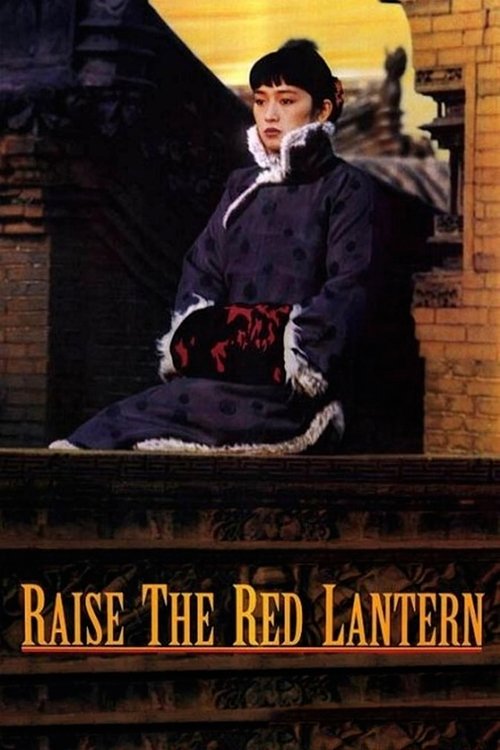
Raise the Red Lantern (1991)
Directed by Zhang Yimou
No — Raise the Red Lantern is not woke, scoring 18 out of 100 on our wokeness meter.
Zhang Yimou's 1991 adaptation of Su Tong's novella arrives in a compound of grey walls and red lanterns, and it conducts itself with the patience of a household that has all the time in the world.
Consciousness Markers
The film is a sustained, devastating portrait of women destroyed by a patriarchal concubinage system, though it operates as tragic art rather than a modern feminist polemic.
The wealthy Master Chen's household is depicted as a machine of exploitation and cruelty, but the critique is of feudal patriarchy rather than modern capitalism or 'eat the rich' sentiment.
The film is famously restrained and visual, showing rather than telling; any critique is embedded in imagery and tragedy rather than delivered as a sermon.
The entirely Chinese cast is simply authentic to a film set in 1920s China, not a deliberate diversity-casting gesture in the modern sense.
No LGBTQ+ characters or themes appear anywhere in the narrative.
The film concerns class and gender within a Chinese household, not racial identity or racial justice in any modern sense.
No environmental or climate themes are present.
No body-positivity themes; the body is instead a site of control and punishment.
Songlian's descent into madness is a tragic consequence of oppression, not a depiction of neurodivergence as identity.
The 1920s Warlord Era setting is rendered as period drama, not a revisionist reframing of historical events.
Why it received this score
Zhang Yimou's 1991 adaptation of Su Tong's novella arrives in a compound of grey walls and red lanterns, and it conducts itself with the patience of a household that has all the time in the world. Gong Li plays Songlian, a nineteen-year-old who becomes the fourth wife of a faceless master and learns that affection here is dispensed by lottery. The lanterns are lit or they are not. The foot massage is granted or it is withheld. It is a film of courtyards, snow, and the slow arithmetic of humiliation, and it never once raises its voice to make sure we are following along.
There is a case to be made for the film as a study of women ground down by a concubinage system, and the case is a strong one. The three mistresses scheme, betray, and destroy one another because the structure leaves them no other arena. But this is tragedy, not advocacy. The camera observes the machinery; it does not step in front of it to explain. The critique of the wealthy Chen household is real, and it is aimed at feudal patriarchy, at a master whose face we never quite see. The reading of it as a parable about modern wealth and its cruelties requires a certain generosity of interpretation.
The film's omissions are instructive. It offers no sermon, no glossary, no moment where a character turns to the audience and clarifies the theme. The body here is a site of punishment, not celebration. Madness arrives as consequence, not as identity. The 1920s setting is rendered as period, not as argument. We are left with beauty and cruelty arranged in the same frame, which is the oldest trick in the medium and still the most effective. A sober piece of work. It trusts the audience, and in this house, that is a rare commodity.
Analysis generated by our Consciousness Algorithm
Synopsis
In 1920s China, 19-year-old Songlian becomes a concubine of a powerful lord and is forced to compete with his three wives for the privileges gained.
Questions about Raise the Red Lantern
Is Raise the Red Lantern woke?
No — Raise the Red Lantern is not woke, scoring 18 out of 100 on our wokeness meter. That earns it a verdict of Ultra Based.
Does Raise the Red Lantern have any woke elements?
1 of the 10 markers register at 30 or above, led by Feminist Agenda (35). On Feminist Agenda: The film is a sustained, devastating portrait of women destroyed by a patriarchal concubinage system, though it operates as tragic art rather than a modern feminist polemic.
How does Raise the Red Lantern compare to other 1991 movies?
It ranks #15 of the 68 films from 1991 we've scored; their average is 14. The wokest is Paris Is Burning (77).
How is the Woke Score calculated?
An AI-assisted process researches the film and its reception, scores it 0–100 on ten markers, then combines those into one 0–100 Woke Score. It measures a specific set of 2020s cultural themes, not film quality.