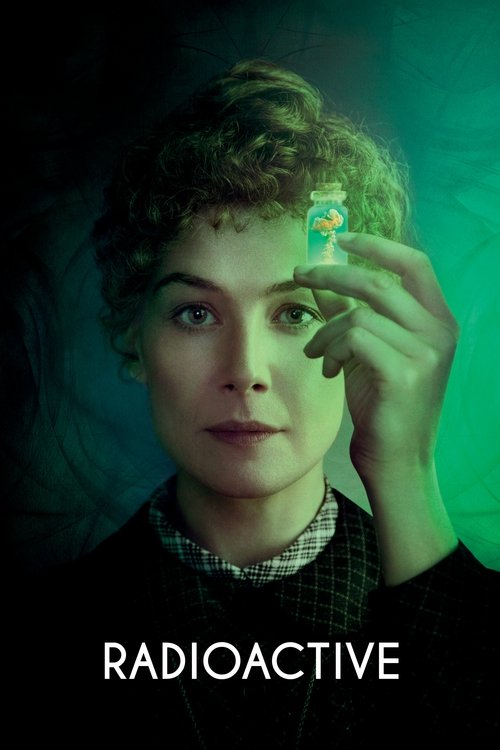
Radioactive (2020)
Directed by Marjane Satrapi
No — Radioactive is not especially woke, scoring 24 out of 100 on our wokeness meter.
Radioactive is a British biographical drama directed by Marjane Satrapi and adapted by Jack Thorne from Lauren Redniss's graphic novel.
Consciousness Markers
The narrative foregrounds Curie's battle against a male academic establishment that denies her funding and credit, the sexual double standard applied to her affair with Langevin, and her defiance of the Nobel committee's instructions—a genuine feminist throughline, though largely inherent to the historical subject.
Critics noted 'on-the-nose writing' in which characters ceremoniously announce the film's themes and motivations, and the interwoven Hiroshima/Chernobyl vignettes function as explicit moral instruction on the consequences of discovery.
The film briefly indicts the commercial rush to market radium in consumer products and the profit-driven disregard for its lethal effects, but this critique is a minor thread rather than a sustained economic argument.
The cast is a period-appropriate ensemble of predominantly white British actors, with Polish-born Marie Curie played by English actress Rosamund Pike; there is no colorblind or diversity-driven casting agenda at work.
The film takes dramatic liberties with the historical record (e.g., misrepresenting Curie's attendance at the 1905 Nobel ceremony), but these are conventional biopic embellishments rather than ideologically motivated historical revisionism.
The film contains no LGBTQ+ characters, relationships, or themes whatsoever.
The xenophobic harassment Curie faces concerns her Polish nationality, not race, and the film engages no modern racial-consciousness framework.
There is no environmental or climate-themed content; radiation's dangers are framed as a scientific and human tragedy, not an ecological crusade.
No body-positivity themes or messaging appear in the film.
The film does not engage with neurodivergence or neurodiversity as a theme.
Why it received this score
Radioactive is a British biographical drama directed by Marjane Satrapi and adapted by Jack Thorne from Lauren Redniss's graphic novel. Rosamund Pike plays Marie Curie with a stern, luminous intensity, and the supporting cast is a period-appropriate ensemble of white British actors. There is no colorblind casting agenda here, and no LGBTQ characters or themes. The film's progressive pulse is almost entirely historical: Curie fights a male academic establishment for funding and credit, endures a sexual double standard over her affair with Paul Langevin, and defies the Nobel committee's instructions. That is a genuine feminist throughline, though it belongs to the subject more than to the filmmakers. The xenophobic mobs harass Curie for being Polish, not for her race, so the film engages no modern racial-consciousness framework.
The most conspicuous modern habit is the lecture energy. Characters ceremoniously announce their themes and motivations, and the interwoven vignettes of Hiroshima, Chernobyl, and a Nevada bomb test function as explicit moral instruction on the consequences of discovery. The anti-capitalist thread is brief: radium is rushed into consumer products, and profit outruns safety. It is a minor indictment, not a sustained economic argument. There is no climate crusade, no body positivity, no neurodivergence. Radiation is framed as a scientific and human tragedy. Historical liberties, such as misrepresenting Curie's attendance at the 1905 Nobel ceremony, are conventional biopic embellishments, not ideologically motivated revisionism.
The result is a respectable, middlebrow biopic with a strong central performance and a script that never met a subtext it could not turn into dialogue. Its cultural awareness is modest and mostly inherited from the historical record. We are not conscripted into a contemporary cause; we are invited to admire a brilliant woman and then gently warned about the atom. The film's progressive sensibilities are real but mild, the sort that can be acknowledged and then filed away. It is serious, well-intentioned, and content to let the audience connect the dots after the characters have already connected them out loud.
Analysis generated by our Consciousness Algorithm

Synopsis
The story of Nobel Prize winner Maria Skłodowska-Curie and her extraordinary scientific discoveries—through the prism of her marriage to husband Pierre—and the seismic and transformative effects their discovery of radium had on the 20th century.
Questions about Radioactive
Is Radioactive woke?
No — Radioactive is not especially woke, scoring 24 out of 100 on our wokeness meter. That earns it a verdict of Based.
Does Radioactive have any woke elements?
2 of the 10 markers register at 30 or above, led by Feminist Agenda (50) and Lecture Energy (45). On Feminist Agenda: The narrative foregrounds Curie's battle against a male academic establishment that denies her funding and credit, the sexual double standard applied to her affair with Langevin, and her defiance of the Nobel committee's instructions—a genuine feminist throughline, though largely inherent to the historical subject.
How does Radioactive compare to other 2020 movies?
It ranks #68 of the 227 films from 2020 we've scored; their average is 21. The wokest is One Night in Miami... (83).
How is the Woke Score calculated?
An AI-assisted process researches the film and its reception, scores it 0–100 on ten markers, then combines those into one 0–100 Woke Score. It measures a specific set of 2020s cultural themes, not film quality.