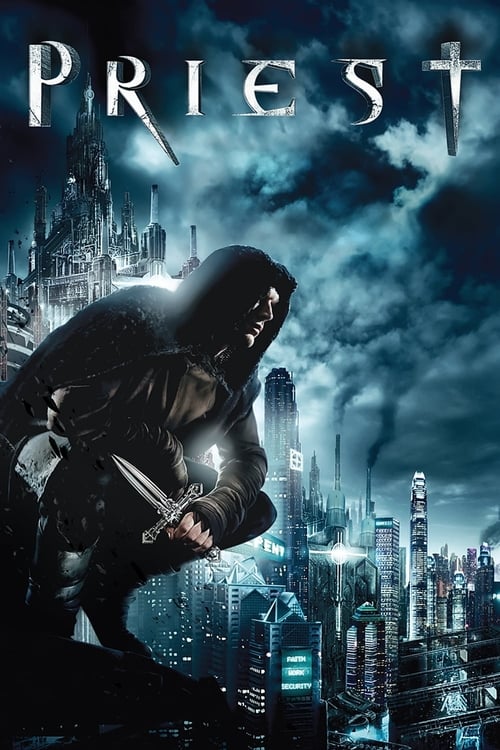
Priest (2011)
Directed by Scott Stewart
No — Priest is not woke, scoring 13 out of 100 on our wokeness meter.
Priest arrives from 2011, a year when the culture still permitted a vampire film to concern itself chiefly with vampires.
Consciousness Markers
Maggie Q's Priestess is a prominent warrior role and the cast is somewhat multiethnic, but the film makes no comment on representation and the leads remain predominantly white.
The Priestess is a capable fighter who defies the Church, but she functions as a standard action ally rather than a vehicle for any feminist argument.
There is mild thematic friction with the Church's authoritarian control, but the film is an action-horror romp that never stops to preach.
No LGBTQ+ characters, themes, or subtext appear anywhere in the film.
The film features no racial themes, commentary, or consciousness of any kind.
The post-apocalyptic wasteland is a genre backdrop, not an environmental parable; climate is never a subject.
The villain is a totalitarian theocracy, not a capitalist system; there is no economic critique whatsoever.
No body-positive themes or messaging are present.
No neurodivergent characters or themes are depicted.
The film is a loose adaptation of a comic, not a revisionist retelling of history.
Why it received this score
Priest arrives from 2011, a year when the culture still permitted a vampire film to concern itself chiefly with vampires. Paul Bettany plays a warrior cleric in an alternate world where humanity spent centuries losing a war to photosensitive albino cave-dwellers, and where the Church, having won, retired its holy assassins to lives of quiet irrelevance. His niece is taken. He breaks his vows, collects a wasteland sheriff and a former comrade in arms, and rides out. It is a lean, grim, handsomely art-directed exercise in the post-apocalyptic western, adapted loosely from a Korean comic and owing more to John Ford than to any contemporary moral program.
The cast is more polyglot than the genre usually bothers with, and Maggie Q's Priestess is given genuine competence, a motorcycle, and a suicide run at a locomotive she somehow survives on foot. The film declines to make anything of this. She is a capable ally, not an argument. Nor does the picture have any interest in the racial, economic, or environmental readings available to it. The villain is a theocratic tyrant in a black hat, the vampire reservations are set dressing, and the ash-clouded sky is a tactical problem, never a parable. There are no queer characters, no sermons on the body, no neurodivergent arcs. The only thematic friction on offer targets ecclesiastical authoritarianism, and it lasts about as long as it takes to throw a severed vampire head onto a cathedral floor.
Critics were unkind, citing clichés, and they were not wrong, though the film's visual discipline deserved better than it got. It remains a relic of a moment before every genre picture was expected to carry a thesis. We classify it accordingly: a handsome, derivative, largely harmless entertainment that asks nothing of its audience but ninety minutes and a tolerance for slow motion. The sommelier's verdict is a thin vintage. Pleasant enough. Nearly free of the cultural sediment we have trained ourselves to detect.
Analysis generated by our Consciousness Algorithm


Synopsis
In an alternate world, humanity and vampires have warred for centuries. After the last Vampire War, the veteran Warrior Priest lives in obscurity with other humans inside one of the Church's walled cities. When the Priest's niece is kidnapped by vampires, the Priest breaks his vows to hunt them down. He is accompanied by the niece's boyfriend, who is a wasteland sheriff, and a former Warrior Priestess.
Questions about Priest
Is Priest woke?
No — Priest is not woke, scoring 13 out of 100 on our wokeness meter. That earns it a verdict of Ultra Based.
Does Priest have any woke elements?
1 of the 10 markers register at 30 or above, led by Representation Casting (30). On Representation Casting: Maggie Q's Priestess is a prominent warrior role and the cast is somewhat multiethnic, but the film makes no comment on representation and the leads remain predominantly white.
How does Priest compare to other 2011 movies?
It ranks #68 of the 245 films from 2011 we've scored; their average is 11. The wokest is Paul (68).
How is the Woke Score calculated?
An AI-assisted process researches the film and its reception, scores it 0–100 on ten markers, then combines those into one 0–100 Woke Score. It measures a specific set of 2020s cultural themes, not film quality.