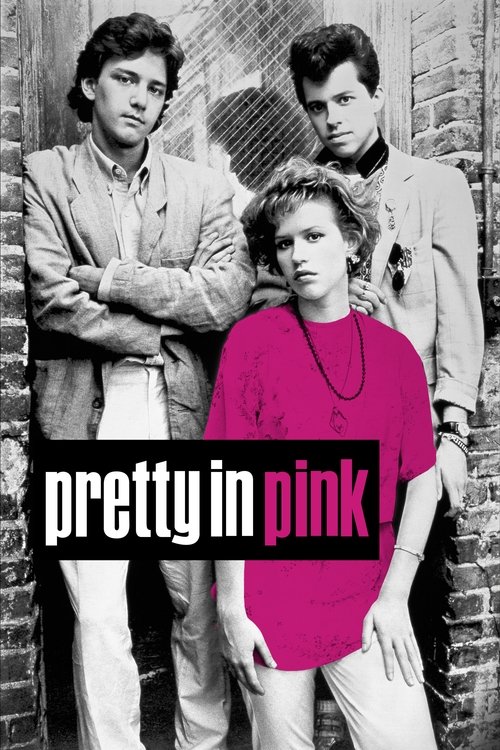
Pretty in Pink (1986)
Directed by Howard Deutch
No — Pretty in Pink is not woke, scoring 10 out of 100 on our wokeness meter.
Pretty in Pink arrives from 1986 as a specimen of the Brat Pack teen romance, a Cinderella story set in the Chicago suburbs and powered by New Wave songs and mall-adjacent melancholy.
Consciousness Markers
The film contrasts Andie's working-class poverty against the entitled 'richies,' and Blane ultimately denounces Steff's spoiled attitude. This is a mild class critique, not an eat-the-rich polemic.
Andie is a self-possessed working-class protagonist who sews her own prom dress and rejects Steff's advances, giving her modest agency. However, the plot remains a conventional Cinderella romance resolved by a boy's apology, not a feminist statement.
The film gestures at a moral about class prejudice and not judging people by their wealth, but it delivers this gently through drama rather than preachy monologue.
The cast is overwhelmingly white, with no meaningful minority representation in the principal or supporting roles. This is a standard 1986 Brat Pack ensemble with no diversity-conscious casting.
No LGBTQ+ characters or themes appear in the film. Ringwald's later remark that Duckie was inspired by her gay best friend is external trivia, not content in the film itself.
The film's social conflict is entirely about class and cliques among white suburban teens; race is never addressed or represented.
No environmental or climate themes whatsoever.
No body-positivity themes; the film's aesthetic focus is on fashion and prom appearance in a conventional teen-movie manner.
Duckie is quirky and eccentric, but the film frames this as comic personality rather than any neurodivergent identity or advocacy.
A contemporary-set teen romance with no historical subject matter to revise.
Why it received this score
Pretty in Pink arrives from 1986 as a specimen of the Brat Pack teen romance, a Cinderella story set in the Chicago suburbs and powered by New Wave songs and mall-adjacent melancholy. Andie Walsh works at a record store, sews her own clothes, and navigates the cruelty of rich classmates. The film has a working-class heroine and a plot about crossing social lines. That is the extent of its social program. The cast is white, the milieu is white, and the movie treats race as something outside its frame. No LGBTQ characters appear. No environmental themes. No body-positive messaging. Duckie is eccentric, but the film presents him as a comic type, not as a portrait of neurodivergence. The historical record remains untouched because there is no history here to revise.
Andie has a certain self-possession. She rejects Steff, sews her prom dress, and speaks plainly about shame and money. This gives the film a modest feminist pulse, though the narrative still resolves through a boy's apology and a parking-lot kiss. The class critique is similarly mild. The rich kids are snobs, Blane denounces Steff's entitlement, and the script suggests that wealth can make people cruel. That is not an eat-the-rich polemic. It is a teen movie with a moral about not judging people by their bank accounts. The lesson arrives through drama, not sermonizing. There is no lecture, no monologue about systems, no call to action. Just a rich boy, a poor girl, and a prom.
What remains is a sweet, conventional film that has been retroactively asked to carry cultural weight it never sought. Its pleasures are real: Ringwald's performance, the soundtrack, the ache of adolescent insecurity. Its politics are the politics of 1986 mainstream Hollywood, which is to say they are mostly about class as a backdrop for romance. The film does not interrogate race, sexuality, climate, or disability. It does not propose a new social order. It proposes that a decent rich boy might apologize and that a girl might forgive him. That is a small thing. In the taxonomy of signifiers, it is a small thing.
Analysis generated by our Consciousness Algorithm
Part of


Synopsis
Andie is an outcast, hanging out either with her older boss, who owns the record store where she works, or her quirky high school classmate Duckie, who has a crush on her. When one of the rich and popular kids at school, Blane, asks Andie out, it seems too good to be true. As Andie starts falling for Blane, she begins to realize that dating someone from a different social sphere is not easy.
Questions about Pretty in Pink
Is Pretty in Pink woke?
No — Pretty in Pink is not woke, scoring 10 out of 100 on our wokeness meter. That earns it a verdict of Ultra Based.
Does Pretty in Pink have any woke elements?
Very few. None of the 10 markers reaches 30, the level where a marker counts as present; the highest is Eat the Rich at 15.
How does Pretty in Pink compare to other 1986 movies?
It ranks #15 of the 62 films from 1986 we've scored; their average is 7. The wokest is Star Trek IV: The Voyage Home (42).
How is the Woke Score calculated?
An AI-assisted process researches the film and its reception, scores it 0–100 on ten markers, then combines those into one 0–100 Woke Score. It measures a specific set of 2020s cultural themes, not film quality.