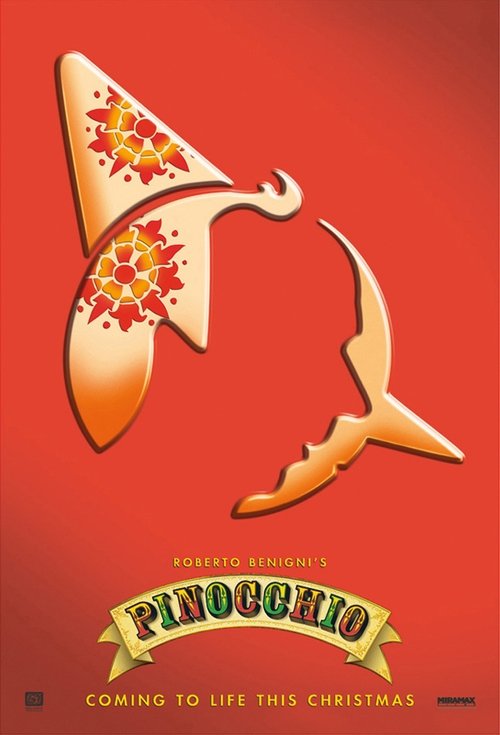
Pinocchio (2002)
Directed by Roberto Benigni
No — Pinocchio is not woke, scoring 0 out of 100 on our wokeness meter.
Roberto Benigni’s adaptation of Carlo Collodi’s Pinocchio arrives as a monument to tradition, a cinematic exercise in faithful translation.
Consciousness Markers
The moralizing about obedience, honesty, and schooling is the original book's didacticism, not modern lecture energy; it is delivered as fable rather than sermon.
The cast is entirely Italian and white, drawn from Benigni's regular collaborators; no diversity-conscious casting is present.
No LGBTQ+ characters, themes, or subtext appear in this faithful Collodi adaptation.
The Blue Fairy exists as a maternal moral guide straight from the 1883 source; no feminist reframing or gender politics are present.
No engagement with racial identity, systemic racism, or racial justice themes.
No environmental or climate themes whatsoever.
The film's satire of foolish judges and tricksters is inherited from the novel's moral fable, not a modern anti-capitalist critique.
No body-positivity messaging; the donkey transformation and physical comedy carry no such framing.
No neurodivergence themes or characters.
The film is a linear, faithful translation of Collodi's novel rather than a revisionist retelling of history.
Why it received this score
Roberto Benigni’s adaptation of Carlo Collodi’s Pinocchio arrives as a monument to tradition, a cinematic exercise in faithful translation. We approach this narrative not as a groundbreaking piece of social commentary, but as a meticulously rendered example of a classic moral fable. The film offers a deliberate immersion into the source material, resisting the urge to apply contemporary progressive sensibilities. Its cultural DNA is strictly rooted in the early twentieth century, which means it satisfies none of the specific requirements for modern social consciousness.
We observe a complete absence of modern progressive sensibilities throughout the narrative. There is zero engagement with contemporary issues such as systemic inequality, climate change, or diverse lived experiences. The core narrative functions as a straightforward cautionary tale about obedience and honesty, delivered through the established mechanics of a children's story. The moralizing about consequence and education is present, but it reads as traditional preachy guidance rather than a modern, high-energy lecture on progressive ideals.
Ultimately, this is a work of craftsmanship. While the production design and costume work warrant serious academic attention, the film’s thematic ambition remains firmly planted in the realm of the inherited classic. It provides a linear, richly textured interpretation of a beloved book. It is a charming, if somewhat predictable, exercise in visual storytelling. It exists outside the current discourse on identity and cultural representation, operating purely within the well-worn parameters of the original literary text.
Analysis generated by our Consciousness Algorithm


Synopsis
Roberto Benigni adapts the classic children's tale by Carlo Collodi for the big-budget family-oriented comedy Pinocchio.
Questions about Pinocchio
Is Pinocchio woke?
No — Pinocchio is not woke, scoring 0 out of 100 on our wokeness meter. That earns it a verdict of Ultra Based.
Does Pinocchio have any woke elements?
Very few. None of the 10 markers reaches 30, the level where a marker counts as present; the highest is Lecture Energy at 5.
How does Pinocchio compare to other 2002 movies?
It ranks #129 of the 150 films from 2002 we've scored; their average is 12. The wokest is Far from Heaven (78).
How is the Woke Score calculated?
An AI-assisted process researches the film and its reception, scores it 0–100 on ten markers, then combines those into one 0–100 Woke Score. It measures a specific set of 2020s cultural themes, not film quality.