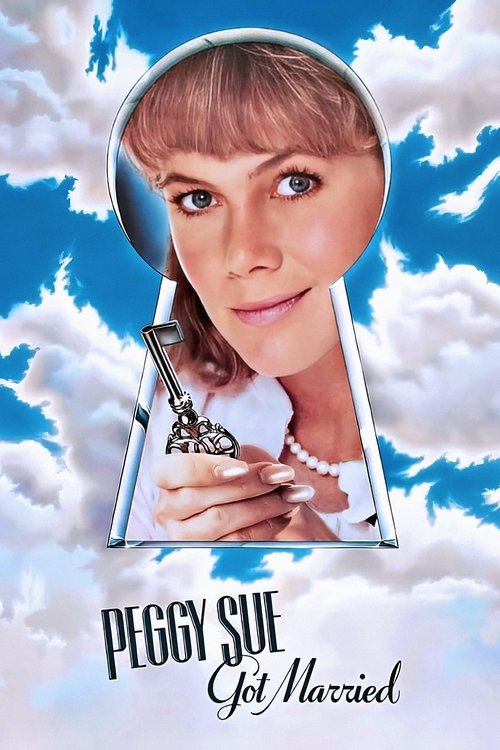
Peggy Sue Got Married (1986)
Directed by Francis Ford Coppola
No — Peggy Sue Got Married is not woke, scoring 9 out of 100 on our wokeness meter.
Francis Ford Coppola's Peggy Sue Got Married arrives from 1986 with a modest proposition: a woman on the verge of divorce faints at her twenty-fifth high school reunion and wakes in 1960 with her senior year still ahead of her.
Consciousness Markers
The story centers a woman reassessing the marriage and pregnancy that derailed her youth, giving it a soft proto-feminist concern with female regret and agency, though without any explicit political framing.
The cast is overwhelmingly white, with no evident effort at inclusive or color-conscious casting; minority presence is essentially absent from the ensemble.
The film's tone is wistful and comedic, offering no preaching or social messaging to the audience.
The film contains no LGBTQ+ characters, relationships, or themes; the romantic plot is entirely heterosexual.
Race is not a thematic concern; the film's conflicts are generational and marital rather than racial.
No environmental or climate themes appear anywhere in the narrative.
The presence of a billionaire inventor character is incidental and uncritical; there is no anti-capitalist argument or class critique.
Body image and body positivity are not addressed in the film.
No neurodivergent characters or themes of neurodiversity are present.
The 1960 setting is treated as gentle nostalgia rather than reinterpreted for political revision; it is a fictional time-travel premise, not historical revisionism.
Why it received this score
Francis Ford Coppola's Peggy Sue Got Married arrives from 1986 with a modest proposition: a woman on the verge of divorce faints at her twenty-fifth high school reunion and wakes in 1960 with her senior year still ahead of her. Kathleen Turner carries the whole contraption on her shoulders, and she does so with a weariness that suggests she has already lived the disappointment twice. The time-travel machinery is a pretext. The real subject is regret, and the film treats it with a gentleness that stops short of argument.
A soft current of female self-examination runs through the picture. Peggy Sue looks at the pregnancy that ended her youth, the marriage that followed, and the singing career her husband abandoned, and she weighs them without ever announcing a thesis. She declines the billionaire's proposal, declines a poet's invitation to Utah, and eventually chooses the life she already chose, which is either resignation or grace depending on the viewer's appetite. The film never frames this as politics. It frames it as a woman deciding what she can live with, a quieter and older kind of story.
Elsewhere the picture is content to be a comedy of nostalgia. Race is not on its mind. Neither is climate, body image, or the neurodivergent experience. Charlie, played by Nicolas Cage behind false teeth and a nasal fry, is a cartoon rather than a critique. The billionaire inventor appears and departs without a single jab at the class structure. Nobody lectures anybody. The film ends with a strudel recipe and a reconciliation, the most 1986 resolution imaginable, and it offers no apology for that.
Analysis generated by our Consciousness Algorithm


Synopsis
At her 25th high school reunion, Peggy Sue faints and awakens in 1960—back in her senior year, before her marriage and all her regrets. Given a second chance to relive her youth, she must decide whether to change the choices that shaped her life or embrace the past that made her who she is.
Questions about Peggy Sue Got Married
Is Peggy Sue Got Married woke?
No — Peggy Sue Got Married is not woke, scoring 9 out of 100 on our wokeness meter. That earns it a verdict of Ultra Based.
Does Peggy Sue Got Married have any woke elements?
Very few. None of the 10 markers reaches 30, the level where a marker counts as present; the highest is Feminist Agenda at 25.
How does Peggy Sue Got Married compare to other 1986 movies?
It ranks #16 of the 62 films from 1986 we've scored; their average is 7. The wokest is Star Trek IV: The Voyage Home (42).
How is the Woke Score calculated?
An AI-assisted process researches the film and its reception, scores it 0–100 on ten markers, then combines those into one 0–100 Woke Score. It measures a specific set of 2020s cultural themes, not film quality.