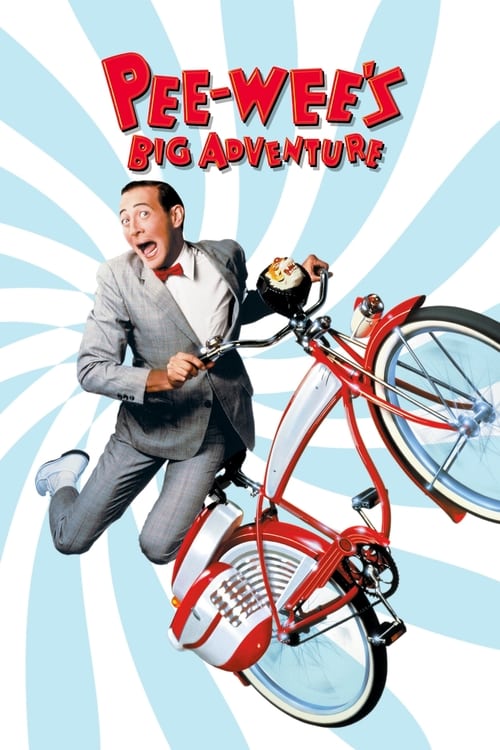
Pee-wee's Big Adventure (1985)
Directed by Tim Burton
No — Pee-wee's Big Adventure is not woke, scoring 0 out of 100 on our wokeness meter.
Pee-wee's Big Adventure arrives from 1985 as a feature-length sketch of a man-child and his bicycle, directed by Tim Burton in his debut and written by Paul Reubens with Phil Hartman and Michael Varhol.
Consciousness Markers
The cast is overwhelmingly white and assembled from Reubens' comedy troupe and character actors, with no evident intent toward inclusive or representative casting.
Pee-wee's campy persona may invite later queer readings, but the film contains no explicit LGBTQ+ themes, characters, or advocacy.
Dottie and Simone have modest arcs, but the film is not structured around feminist critique or gender-equity messaging.
Race is not a thematic concern in the film, and no racial consciousness or commentary is present.
There is no environmental or climate-crisis theme in the story.
The film gently satirizes Warner Bros. and features a spoiled rich neighbor, but it does not advance an anti-capitalist or eat-the-rich thesis.
The film does not engage with body-positivity themes or size-diversity messaging.
Pee-wee is eccentric and childlike, but the film does not frame him through neurodivergence or disability advocacy.
The film is a surreal comedy with no historical revisionism or reclamation of historical narratives.
The film is silly, playful, and absurdist rather than preachy or message-driven.
Why it received this score
Pee-wee's Big Adventure arrives from 1985 as a feature-length sketch of a man-child and his bicycle, directed by Tim Burton in his debut and written by Paul Reubens with Phil Hartman and Michael Varhol. The plot sends Pee-wee across California and Texas, through a phony psychic, a ghost trucker, a rodeo, a biker bar, and the Warner Bros. backlot. It is a farce, a road movie, and a live-action cartoon. The cast is drawn largely from the Groundlings and Reubens's stage show, and the film makes no effort toward representative or inclusive casting. Pee-wee's campy manner is a comic performance tradition, not an argument about sexuality or identity. Dottie and Simone have small romantic and aspirational arcs, but the film never organizes itself around gender-equity critique. Race is not a subject. The environment is not a subject.
The film glances at wealth through Francis, the spoiled neighbor who wants the bike, and it puts Warner Bros. itself on screen as a mildly absurd institution. This is satire of property and studio manners, not an anti-capitalist thesis. There is no body-positivity message, no size-diversity framing, and no engagement with disability or neurodivergence, even if Pee-wee behaves in ways that later audiences might interpret through those lenses. The Alamo sequence is a joke about a missing basement, not a revisionist account of history. The tone is playful and absurdist. There is no sermon, no lesson, no finger wagging.
The film remains a curious artifact of mid-1980s studio comedy, memorable for Danny Elfman's score, the Large Marge claymation, and Burton's eye for production design. It asks nothing of its audience beyond attention to a man chasing a stolen bicycle. By the standards of modern social consciousness, the film registers as a blank. It is not hostile to progressive values. It simply has no interest in them. The sommelier sets down the glass, finds no contemporary notes, and records the verdict with the gravity such a vintage deserves.
Analysis generated by our Consciousness Algorithm
Part of


Synopsis
The eccentric and childish Pee-wee Herman embarks on a big adventure when his beloved bicycle is stolen. Armed with information from a fortune-teller and a relentless obsession with his prized possession, Pee-wee encounters a host of odd characters and bizarre situations as he treks across the country to recover his bike.
Questions about Pee-wee's Big Adventure
Is Pee-wee's Big Adventure woke?
No — Pee-wee's Big Adventure is not woke, scoring 0 out of 100 on our wokeness meter. That earns it a verdict of Ultra Based.
Does Pee-wee's Big Adventure have any woke elements?
No. All 10 markers score zero.
How does Pee-wee's Big Adventure compare to other 1985 movies?
It ranks #51 of the 68 films from 1985 we've scored; their average is 8. The wokest is The Color Purple (62).
How is the Woke Score calculated?
An AI-assisted process researches the film and its reception, scores it 0–100 on ten markers, then combines those into one 0–100 Woke Score. It measures a specific set of 2020s cultural themes, not film quality.