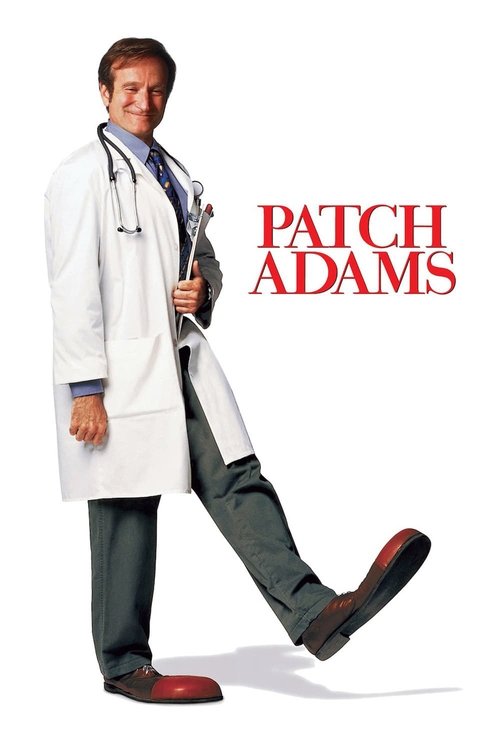
Patch Adams (1998)
Directed by Tom Shadyac
No — Patch Adams is not woke, scoring 12 out of 100 on our wokeness meter.
Patch Adams arrived in December of 1998 with the full weight of Universal's holiday machinery behind it, and it made a great deal of money.
Consciousness Markers
The film is didactic about its 'humor is the best medicine' thesis, culminating in a courtroom speech to the medical board, though the preaching is sentimental rather than ideological.
The Gesundheit Institute treats patients without medical insurance and the film critiques profit-driven, soulless institutional medicine, though the message stays humanist rather than explicitly anti-capitalist.
The cast is overwhelmingly white, with Irma P. Hall as a supporting Black nurse being the only notable exception; diversity is incidental rather than a casting statement.
Monica Potter's Carin Fisher exists largely as a romantic interest and is fridged (murdered) to fuel the male protagonist's emotional arc, a textbook anti-feminist trope.
No LGBTQ+ characters, themes, or subtext appear anywhere in the film.
The film engages no racial themes or commentary; its medical-establishment critique is entirely colorblind.
No environmental or climate content whatsoever.
No body-positivity themes; the film's humor occasionally trades on physical gags rather than body acceptance.
The psychiatric-hospital setting and suicidal ideation are treated as plot devices for the protagonist's redemption, not as neurodivergence advocacy.
It is a loose, sentimentalized biopic, but it does not reinterpret history through a modern progressive lens; the real Adams himself condemned its inaccuracy.
Why it received this score
Patch Adams arrived in December of 1998 with the full weight of Universal's holiday machinery behind it, and it made a great deal of money. Critics were less enthusiastic. Roger Ebert suggested the screen required disinfecting. The film endures as a case study in the sentimental biopic, a genre that asks us to weep on schedule and then rewards us with a standing ovation in a hearing room.
The film's cultural awareness is thin and largely incidental. Irma P. Hall appears as a nurse, the only notable non-white face in a cast otherwise composed of earnest white medical students, and the story makes no comment on her presence. Race is simply not a subject the screenplay wishes to raise. Nor does it raise questions of sexuality, environment, or bodily self-acceptance. Those are absent entirely. The treatment of Monica Potter's Carin Fisher is the more instructive failure. She exists to be romanced and then murdered, a woman's death converted into fuel for a man's spiritual crisis, a narrative transaction so old it creaks.
Where the film does lean toward a message, it concerns medicine itself. The Gesundheit Institute treats patients without insurance and the screenplay sneers at profit-driven hospitals, though the critique remains a matter of warm humanism instead of economic argument. The preaching is relentless and soft: humor as the best medicine, stated early, restated often, finally delivered as a courtroom address to a panel of stern physicians. It is sermonizing in a cardigan. The real Hunter Adams has spent decades distancing himself from the result, which is its own kind of review.
Analysis generated by our Consciousness Algorithm
Part of


Synopsis
The true story of Dr. Hunter "Patch" Adams, who in the 1970s found that humor is the best medicine, and was willing to do just anything to make his patients laugh—even if it meant risking his own career.
Questions about Patch Adams
Is Patch Adams woke?
No — Patch Adams is not woke, scoring 12 out of 100 on our wokeness meter. That earns it a verdict of Ultra Based.
Does Patch Adams have any woke elements?
1 of the 10 markers register at 30 or above, led by Lecture Energy (30). On Lecture Energy: The film is didactic about its 'humor is the best medicine' thesis, culminating in a courtroom speech to the medical board, though the preaching is sentimental rather than ideological.
How does Patch Adams compare to other 1998 movies?
It ranks #38 of the 118 films from 1998 we've scored; their average is 12. The wokest is Show Me Love (60).
How is the Woke Score calculated?
An AI-assisted process researches the film and its reception, scores it 0–100 on ten markers, then combines those into one 0–100 Woke Score. It measures a specific set of 2020s cultural themes, not film quality.