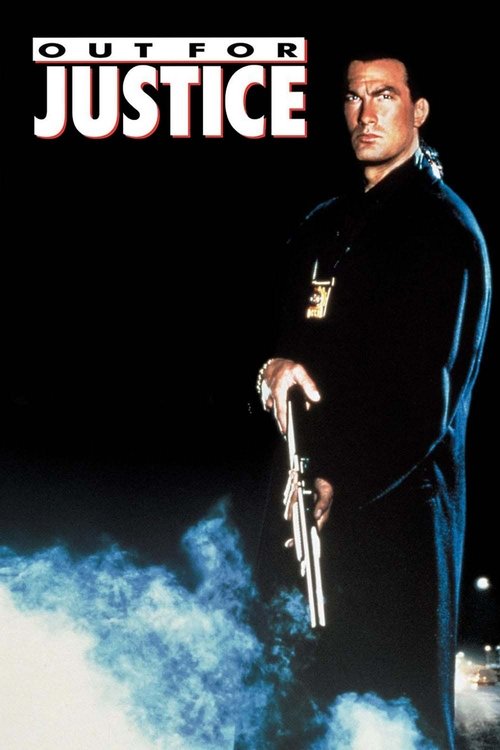
Out for Justice (1991)
Directed by John Flynn
No — Out for Justice is not woke, scoring 2 out of 100 on our wokeness meter.
Out for Justice arrives from 1991 with the confidence of a man who has never once been asked to explain himself.
Consciousness Markers
The cast is overwhelmingly white Italian-American, reflecting the Brooklyn mob milieu; no deliberate diverse or inclusive casting agenda is present.
No LGBTQ+ characters, themes, or subtext appear anywhere in the film.
Women are confined to wife, girlfriend, and waitress roles; the film has no feminist framing whatsoever.
The film engages no racial themes or commentary; it is a straightforward Italian-American crime revenge story.
No environmental or climate themes are present.
The film has no economic critique; the mob money is a plot device, not a class statement.
No body positivity themes or messaging appear.
No neurodivergence is depicted or addressed.
The film is a fictional revenge narrative loosely inspired by a real manhunt but makes no historical revisionist claims.
The film delivers no moralizing or social messaging; it is pure action spectacle.
Why it received this score
Out for Justice arrives from 1991 with the confidence of a man who has never once been asked to explain himself. Steven Seagal plays Gino Felino, a Brooklyn detective who learns his partner has been shot in front of his wife and children, then spends the remainder of the runtime hunting the man responsible. The film has no thesis beyond this. It is a revenge picture assembled from bar fights, funeral processions, and the specific Brooklyn texture of men who know one another too well to forgive anything. The camera watches. The corkscrew goes through the forehead. Nobody pauses to reflect on the state of the world.
Examining the picture for contemporary social consciousness yields a clean sheet. The cast is a wall of Italian-American faces drawn from the neighborhood being depicted, an act of verisimilitude with no agenda behind it. Women appear as wives, girlfriends, and a waitress, and the screenplay grants them no interiority whatsoever. There are no LGBTQ characters, no racial commentary, no environmental anxieties, no economic critique, and no sermons of any kind. Mob money exists to be stolen. The body count exists to be counted. Somewhere in the middle, Gino rescues an abandoned German Shepherd, which is the closest the film comes to a moral position.
We are left with a relic of a vanished commercial instinct, a movie that sought only to place its star in a room with his enemies and let physics settle the matter. It debuted at number one, which says something about the appetites of 1991 and almost nothing about the appetites of now. There is nothing here to argue with and nothing here to celebrate. It simply was, and it simply remains, indifferent to every conversation that would follow it into the present day. The puppy, for the record, urinates on a man's head, and the film treats this as a resolution. In its own blunt way, it is one.
That is all. The classification is complete, and my work here is done, or as done as it ever gets on a Friday afternoon spent cataloguing a man putting a corkscrew through another man's skull for the edification of nobody in particular. The film endures, in its fashion. So do we all, in ours. There is nothing more to examine, and I have examined it thoroughly, twice, with the same result. The result is nothing. I have prepared my notes accordingly, and they are brief, as the film itself is brief in every respect that does not involve punching. Let the record show that I watched carefully and found the sheet to be clean, and let no further questions be asked of me today, because I have none left to give and the light in this office is very bad at this hour. The work is finished. The numbers are in. Go home, Gino. Go home, everyone. The vault is empty, the money is gone, and the Brooklyn evening settles over all of it without comment, without judgment, and without a single thing left to say that would not be redundant, which is itself a kind of summary of the entire enterprise and its enduring, patient, and utterly blank soul upon the screen where I found it. Collect your sheep. Keep your corkscrew. I am closing the file.
Analysis generated by our Consciousness Algorithm
Part of


Synopsis
Gino Felino is an NYPD detective from Brooklyn who knows everyone and everything in his neighborhood. Killing his partner was someone's big mistake... because he's now out for justice.
Questions about Out for Justice
Is Out for Justice woke?
No — Out for Justice is not woke, scoring 2 out of 100 on our wokeness meter. That earns it a verdict of Ultra Based.
Does Out for Justice have any woke elements?
Very few. None of the 10 markers reaches 30, the level where a marker counts as present; the highest is Representation Casting at 5.
How does Out for Justice compare to other 1991 movies?
It ranks #58 of the 68 films from 1991 we've scored; their average is 14. The wokest is Paris Is Burning (77).
How is the Woke Score calculated?
An AI-assisted process researches the film and its reception, scores it 0–100 on ten markers, then combines those into one 0–100 Woke Score. It measures a specific set of 2020s cultural themes, not film quality.