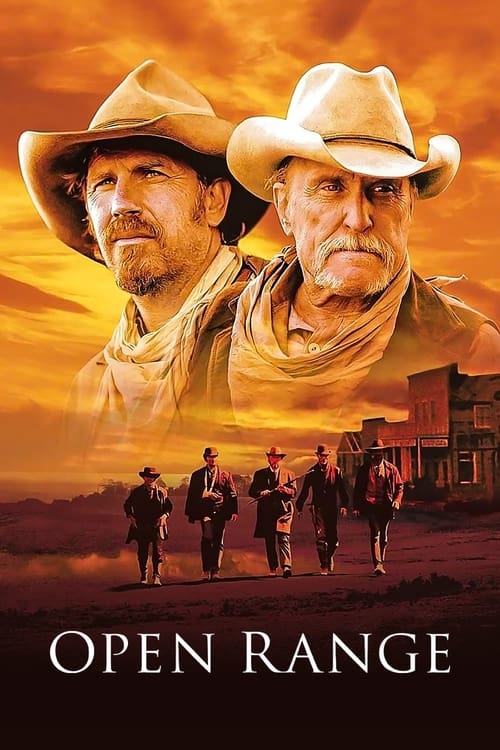
Open Range (2003)
Directed by Kevin Costner
No — Open Range is not woke, scoring 6 out of 100 on our wokeness meter.
Open Range arrives in 2003 with the confidence of a man who has made this trip before.
Consciousness Markers
The cast is overwhelmingly white, with Diego Luna as the notable exception in a supporting role; his presence is unremarked and incidental to the story.
The villain is a ruthless cattle baron who controls the town, giving a faint 'little men versus the powerful rancher' flavor, but this is a classic Western trope rather than an economic critique.
Annette Bening's Sue is given a measure of independence and is jokingly called 'the brains of the outfit,' but she remains a conventional romantic reward within a male-driven frontier narrative.
The film is a character-driven drama that shows rather than preaches; there is virtually no didactic messaging directed at the audience.
No LGBTQ+ characters, themes, or subtext of any kind appear in this traditional Western.
The film engages no racial themes or commentary; its 1882 Montana setting is presented without any interrogation of race.
No environmental or climate concerns are present; the open range is simply a backdrop for a land dispute between herders and a baron.
No body-positivity themes or messaging are present.
Charley's wartime flashbacks read as trauma and guilt rather than any depiction of neurodivergence.
Though labeled a 'revisionist Western' as a genre term, the film is a fictional tale and makes no ideological rewriting of historical events.
Why it received this score
Open Range arrives in 2003 with the confidence of a man who has made this trip before. Kevin Costner directs himself and Robert Duvall as free-grazing cattlemen whose herd wanders into the Montana territory of Denton Baxter, a land baron who owns the town, the saloon, and the local marshal. The resulting range war is a familiar arrangement, executed with wide, patient shots and a final gunfight that critics have spent two decades praising. It is a sturdy piece of work. The film is based on Lauran Paine's novel, and it carries the dust of that source material without apology.
On the matter of social consciousness, the film is a period piece in more than setting. The cast is almost entirely white, with Diego Luna appearing in a supporting role whose heritage is never acknowledged and never asked to be. Annette Bening's Sue is granted a measure of independence and a teasing line about being the brains of the outfit, though the narrative positions her as the reward waiting at the end of a man's violent errand. The villain is a wealthy rancher who controls a town, which lends a faint little-men-against-the-powerful flavor, but that is a Western convention stretching back a century, not an economic argument.
The remaining categories register as silence. There is no LGBTQ presence, no racial commentary, no environmental concern beyond the weather, no body politics, no neurodivergence. Charley's wartime flashbacks read as guilt and trauma, full stop. The film shows its themes and preaches none of them, which leaves it with almost nothing to lecture us about. We are left with a well-made Western that has no interest in the present tense, and there is a strange relief in that.
Analysis generated by our Consciousness Algorithm


Synopsis
A former gunslinger is forced to take up arms again when he and his cattle crew are threatened by a corrupt lawman.
Questions about Open Range
Is Open Range woke?
No — Open Range is not woke, scoring 6 out of 100 on our wokeness meter. That earns it a verdict of Ultra Based.
Does Open Range have any woke elements?
Very few. None of the 10 markers reaches 30, the level where a marker counts as present; the highest is Eat the Rich at 12.
How does Open Range compare to other 2003 movies?
It ranks #93 of the 150 films from 2003 we've scored; their average is 12. The wokest is Mona Lisa Smile (60).
How is the Woke Score calculated?
An AI-assisted process researches the film and its reception, scores it 0–100 on ten markers, then combines those into one 0–100 Woke Score. It measures a specific set of 2020s cultural themes, not film quality.