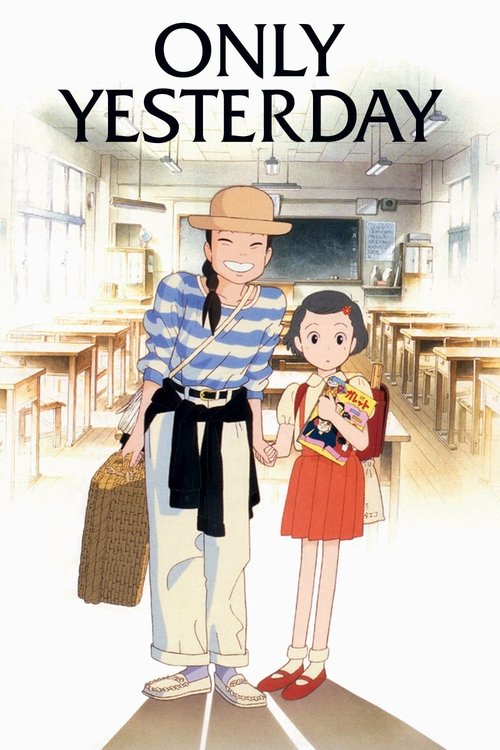
Only Yesterday (1991)
Directed by Isao Takahata
No — Only Yesterday is not woke, scoring 18 out of 100 on our wokeness meter.
Isao Takahata's Only Yesterday arrives from 1991 carrying the soft weight of a memory play, and it moves at the pace of a sleeper train crossing Yamagata at night.
Consciousness Markers
The film centers on an unmarried 27-year-old woman reflecting on a childhood in which her father crushed her acting ambitions and quietly resists the marriage expectations placed on her. It is a woman's inner life given full weight, though it never frames itself as a feminist polemic.
A subtle critique surfaces in the contrast between city and declining rural community, Toshio's musings on the vanishing farm industry, and the sense that farmers built the landscape for the aesthetic luxury of others. It is subtext rather than a rallying cry.
Environmental and agrarian themes run through the film — the dying farming industry, the satoyama as sustainable stewardship, and Taeko's reconnection with the countryside — but these are elegiac and nostalgic rather than an activist climate crusade.
The tone is reflective and gently observational rather than preachy, with its themes of memory and self-acceptance emerging through mood and imagery rather than direct moralizing.
A Studio Ghibli production with an entirely Japanese cast voicing Japanese characters, which is natural to the setting rather than a deliberate diversity-casting effort. The female protagonist and adult-oriented casting add only a marginal note.
There is no LGBTQ+ content, subtext, or character in the film whatsoever.
The film depicts a homogeneous postwar Japanese society with no racial themes, commentary, or dynamics of any kind.
The film handles Taeko's childhood puberty and menstruation matter-of-factly, but it makes no arguments about body image or bodily acceptance in the modern sense.
No character is framed through neurodivergence or mental-health-identity themes.
The film is a nostalgic period portrait of 1966 and 1982 Japan, not a reinterpretation or correction of recorded history.
Why it received this score
Isao Takahata's Only Yesterday arrives from 1991 carrying the soft weight of a memory play, and it moves at the pace of a sleeper train crossing Yamagata at night. Taeko, twenty-seven and unmarried, leaves her Tokyo office life for a safflower harvest and finds her ten-year-old self tagging along in the margins of every scene. The film's structural gamble, a present rendered in crisp lines and a past rendered in faded watercolor, holds up as one of the more patient formal experiments to come out of Studio Ghibli. It is a film about remembering, and it never mistakes remembering for an argument.
The social consciousness here is quiet and mostly inherited from the material. Taeko is a woman whose interior life is granted full narrative authority, and her father's blunt dismissal of her childhood acting ambitions sits in the film without commentary, letting the disappointment speak for itself. Her resistance to the marriage expectations circling her is real but unstated. The countryside carries its own politics: the vanishing farm economy, Toshio's insistence that farmers built a landscape they no longer own, the satoyama as a model of stewardship that is slipping away. These are elegiac observations, not a platform. The film mourns a way of life instead of campaigning for it.
What keeps the proceedings from drifting into sermonizing is Takahata's refusal to explain himself. There is no lecture, no lesson, no character drafted in to state the theme aloud. The film handles Taeko's puberty with a matter-of-factness that predates any modern vocabulary for it, then simply moves on. It offers no racial dynamics, no identity politics, no body-image discourse, no revisionist reckoning, because 1982 Japan as Takahata renders it contains none of those concerns. What remains is nostalgia, gently examined, and a woman deciding, wordlessly, to stay. The result is a film of uncommon tenderness that asks nothing of its audience except attention, which is its own quiet rebuke to the era we now inhabit.
The classification is straightforward: adapted from a manga, a domestic box office champion in its native country, and otherwise innocent of the cultural markers that dominate contemporary production. It is a relic of a gentler mode, and it wears that gently. For the sommelier of these matters, it is a light-bodied vintage, faintly floral, with almost no tannin. Recommended for those who wish to be moved without being instructed. The cellar is full of louder bottles. This one keeps.
Let me also provide the thematic tags.
{"review": "...", "thematic_tags": ["book_adaptation"]}
Analysis generated by our Consciousness Algorithm


Synopsis
In lyrical switches between the present and the past, Taeko contemplates the arc of her life, and wonders if she has been true to the dreams of her childhood self.
Questions about Only Yesterday
Is Only Yesterday woke?
No — Only Yesterday is not woke, scoring 18 out of 100 on our wokeness meter. That earns it a verdict of Ultra Based.
Does Only Yesterday have any woke elements?
1 of the 10 markers register at 30 or above, led by Feminist Agenda (30). On Feminist Agenda: The film centers on an unmarried 27-year-old woman reflecting on a childhood in which her father crushed her acting ambitions and quietly resists the marriage expectations placed on her.
How does Only Yesterday compare to other 1991 movies?
It ranks #15 of the 68 films from 1991 we've scored; their average is 14. The wokest is Paris Is Burning (77).
How is the Woke Score calculated?
An AI-assisted process researches the film and its reception, scores it 0–100 on ten markers, then combines those into one 0–100 Woke Score. It measures a specific set of 2020s cultural themes, not film quality.