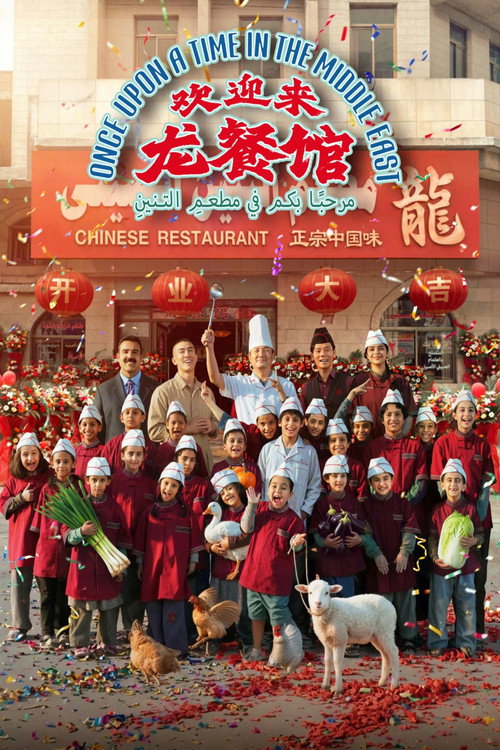
Once Upon a Time in the Middle East (2026)
Directed by Wen Muye
Partly — Once Upon a Time in the Middle East is somewhat woke, scoring 52 out of 100 on our wokeness meter.
Wen Muye's Once Upon a Time in the Middle East arrives bearing the considerable weight of its own good intentions, which is to say it is a film that knows exactly what it thinks and is not shy about letting you know too.
Consciousness Markers
The film makes a self-conscious effort to cast Egyptian and Iraqi actors in roles with genuine agency and interiority, explicitly positioning itself against Hollywood's reductive treatment of Arab characters. The multilingual production (Mandarin, Arabic, English) and China-Egypt collaboration are presented as a corrective cultural statement, not merely a logistical reality.
The film explicitly frames its depiction of Middle Eastern civilians as a counter-narrative to Western (specifically Hollywood) racial and ethnic stereotyping, making the corrective representation a conscious thematic gesture. This is not incidental diversity but a stated artistic and cultural project.
Director Wen Muye has a documented preference for socially instructive filmmaking, and the film's central thesis, that feeding people and protecting children matters more than geopolitics, is delivered via explicit dialogue and a social media slogan. The humanitarian message is sincere but arrives with the gentle insistence of a motivational poster hung in a warzone.
The film depicts the 2003 U.S. invasion of Iraq as a catastrophic act of destruction visited upon civilians, framing American military action as the primary agent of destabilization. This is a pointed historical interpretation delivered through dramatic spectacle, though it hews closer to an established critical-left consensus than to genuinely novel revisionism.
The protagonist is a debt-burdened working-class chef, and the film's sympathies lie firmly with economic precarity over accumulation. However, the restaurant itself is framed as a triumph of entrepreneurial community-building, which complicates any straightforward anti-capitalist reading.
The narrative centers on male protagonists and male-coded themes of labor, debt, and protection. Female characters appear in supporting or civilian roles without a feminist framing evident in the research.
No LGBTQ+ themes, characters, or subtext are present in any available research or metadata.
No climate themes, environmental messaging, or ecological subtext appear anywhere in the film's documented content or reception.
No body positivity themes or messaging are present in any available evidence.
No neurodivergent characters, themes, or related framing appear in the film's documented content.
Why it received this score
Wen Muye's Once Upon a Time in the Middle East arrives bearing the considerable weight of its own good intentions, which is to say it is a film that knows exactly what it thinks and is not shy about letting you know too. A debt-ridden Chinese chef transforms a failing restaurant in a fictionalized Baghdad into a sanctuary of dumplings and cross-cultural solidarity, just in time for the 2003 American invasion to render the entire enterprise a humanitarian metaphor. The film grossed 2.36 billion RMB. Clearly, the world was hungry for this particular meal.
The film's most legible cultural project is its casting, which functions as a corrective memo addressed directly to Hollywood. Egyptian and Iraqi actors are granted interiority, agency, and screen time in a genre that has historically offered them neither. This is genuinely commendable and also, in 2026, a fairly low bar to clear. The multilingual production, spanning Mandarin, Arabic, and English, gives the film an authentic texture that its more operatic emotional beats occasionally undermine. Wen stages American airstrikes with the visual grammar of tragedy and the moral clarity of a verdict already rendered. The Americans bomb. The chef feeds children. The geometry is not complicated.
Where the film earns its progressive credentials most honestly is in its lecture energy, delivered not through sermonizing speeches but through the quiet persistence of its thesis: that cooking for people is a political act, that hospitality is resistance, that "may all the fires in the world be used only for cooking" is a slogan worth a social media campaign. This is progressive humanitarianism with a production budget and a state-adjacent distribution apparatus, which gives it a curious double valence. The film critiques empire while operating comfortably within the soft-power logic of a different empire entirely. A sommelier would call this a complex finish. A critic simply notes the aftertaste.
Analysis generated by our Consciousness Algorithm
Synopsis
Seeking a fresh start, chef Xu Fu travels to the Middle East to support his family and repay his debts. Alongside restaurant manager Ma Junsheng, he transforms the struggling Dragon Restaurant into a thriving business. But when war engulfs the city, their hard-won success is shattered and the restaurant becomes a refuge for those caught in the conflict. As danger closes in, Xu Fu must risk everything to protect his newfound community and preserve a small beacon of hope amid the devastation.
Questions about Once Upon a Time in the Middle East
Is Once Upon a Time in the Middle East woke?
Partly — Once Upon a Time in the Middle East is somewhat woke, scoring 52 out of 100 on our wokeness meter. That earns it a verdict of Woke-Adjacent.
What makes Once Upon a Time in the Middle East woke?
4 of the 10 markers register at 30 or above, led by Representation Casting (62), Racial Consciousness (55) and Lecture Energy (50). On Representation Casting: The film makes a self-conscious effort to cast Egyptian and Iraqi actors in roles with genuine agency and interiority, explicitly positioning itself against Hollywood's reductive treatment of Arab characters.
How does Once Upon a Time in the Middle East compare to other 2026 movies?
It ranks #118 of the 800 films from 2026 we've scored; their average is 23. The wokest is Between Us (89).
How is the Woke Score calculated?
An AI-assisted process researches the film and its reception, scores it 0–100 on ten markers, then combines those into one 0–100 Woke Score. It measures a specific set of 2020s cultural themes, not film quality.