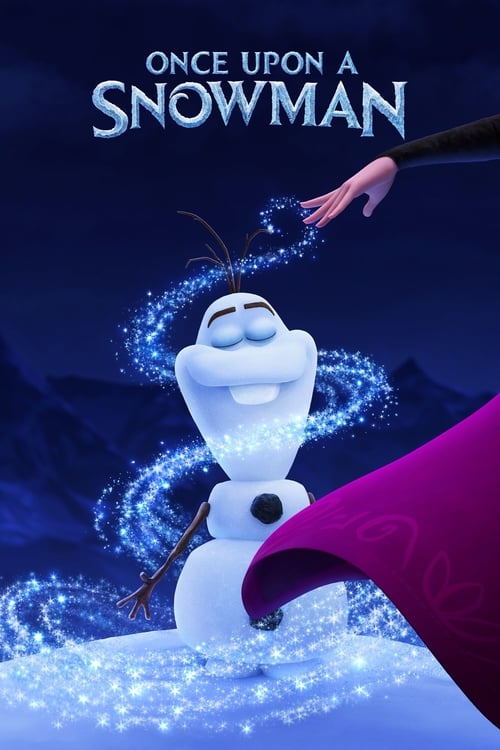
Once Upon a Snowman (2020)
Directed by Dan Abraham
No — Once Upon a Snowman is not woke, scoring 2 out of 100 on our wokeness meter.
Once Upon a Snowman arrives from Walt Disney Animation Studios as a 2020 Disney+ short, roughly eight minutes of Olaf learning that he exists.
Consciousness Markers
The short features no deliberate race-conscious or diverse casting choices; the cast and characters are the established white-coded Frozen ensemble.
There are no LGBTQ+ characters, themes, or subtext in the short.
The story focuses on Olaf's identity and self-discovery, with no feminist agenda or commentary on gender roles.
The short does not engage with racial consciousness, systemic racism, or racial identity.
There is no environmental or climate-change messaging in the short.
The short contains no anti-capitalist or eat-the-rich themes; Oaken's trading post is played for light comedy.
There is no body-positivity messaging or challenge to conventional beauty standards.
The short does not depict or discuss neurodivergence.
The short is a lighthearted side story within Frozen continuity, not a revisionist historical narrative.
The short aims to entertain rather than lecture; it contains no preachy social or political messaging.
Why it received this score
Once Upon a Snowman arrives from Walt Disney Animation Studios as a 2020 Disney+ short, roughly eight minutes of Olaf learning that he exists. The premise is modest and honestly stated: a snowman is born on the North Mountain, is knocked loose by a departing cloak, and wanders into Wandering Oaken's Trading Post in search of a nose. He finds a View-Master full of summer, a sausage, and a pack of wolves. The film is a continuity exercise, stitching itself into the gaps of Frozen with the diligence of a museum docent filling in a diorama.
As a cultural document, the short is remarkably inert. The cast is the established ensemble, deployed without comment. There is no engagement with gender politics, no meditation on race or history, no environmental sermon tucked into the snowfall. Oaken's trading post operates as a joke about retail, not as an indictment of commerce. Olaf's quest for a nose touches on identity in the vaguest possible way, the sort of self-discovery that Pinocchio handled with more bite in 1940. The short wants only to be charming, and it largely succeeds. Charm is not a social program.
We could argue that a children's short about a snowman has no obligation to carry ideological freight, and we would be right. The film's ambitions are small and clean: explain a gap, reuse some assets, land a few gags about sausages. Its Emmy nomination for Outstanding Short Form Animated Program suggests the industry found this sufficient. We concur. Some artifacts resist classification because they contain nothing to classify. This is one. A snowman rolls downhill, gives away his nose, and remembers a warm hug. The ledger stays empty, and the snow stays white.
Analysis generated by our Consciousness Algorithm
Part of
Studio · Disney Animation
Are Disney Animation Movies Woke?
43 films across two labels, average 26 (Based). This film is 24 points below the Disney Animation average.
Studio · Disney
Are Disney Movies Woke?
391 films across nine labels, average 19 (Ultra Based). This film is 17 points below the Disney average.

Synopsis
The previously untold origins of Olaf, the innocent and insightful, summer-loving snowman are revealed as we follow Olaf’s first steps as he comes to life and searches for his identity in the snowy mountains outside Arendelle.
Questions about Once Upon a Snowman
Is Once Upon a Snowman woke?
No — Once Upon a Snowman is not woke, scoring 2 out of 100 on our wokeness meter. That earns it a verdict of Ultra Based.
Does Once Upon a Snowman have any woke elements?
No. All 10 markers score zero.
How does Once Upon a Snowman compare to other 2020 movies?
It ranks #205 of the 227 films from 2020 we've scored; their average is 21. The wokest is One Night in Miami... (83).
How is the Woke Score calculated?
An AI-assisted process researches the film and its reception, scores it 0–100 on ten markers, then combines those into one 0–100 Woke Score. It measures a specific set of 2020s cultural themes, not film quality.