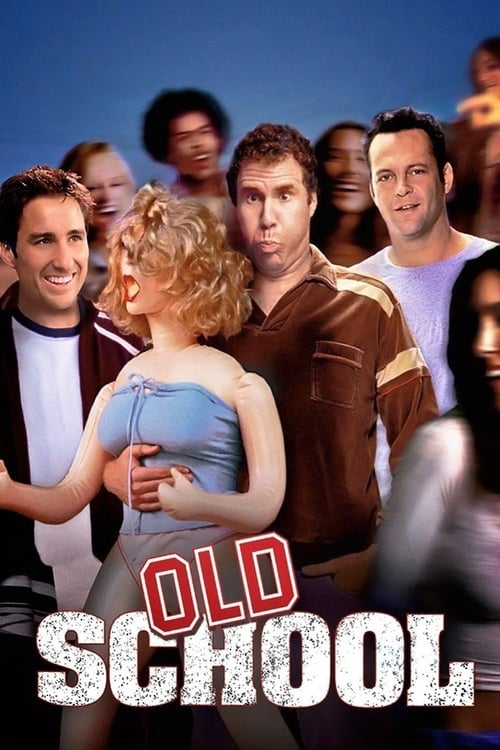
Old School (2003)
Directed by Todd Phillips
No — Old School is not woke, scoring 4 out of 100 on our wokeness meter.
Old School arrives from 2003, a Todd Phillips comedy about three men in their thirties who cannot locate their lost youth and so build a fraternity around the absence.
Consciousness Markers
The cast is overwhelmingly white, with Sara Tanaka's Megan Huang and a Snoop Dogg cameo as the only notable minority presences, neither of which is framed as a statement about representation.
The obese pledge Weensie executing a flawless vault is a faint, throwaway nod to the idea that body type doesn't dictate athletic ability, but it is played for a laugh rather than as a message.
Women exist almost exclusively as girlfriends, conquests, or objects of the fraternity's gaze; the film's comedic engine runs on retrograde gender dynamics rather than any feminist critique.
No LGBTQ+ characters, themes, or subtext of any kind; the film's sexual politics are aggressively hetero and bro-centric.
Race is never a subject of the film; minority characters appear incidentally with no commentary or consciousness-raising.
No environmental themes whatsoever; the film's concerns are beer, hazing, and midlife malaise.
The dean's bribery subplot is a plot device, not a critique of capital; the film is cheerfully indifferent to economics.
No neurodivergent characters or themes are present or addressed.
The film makes no historical claims to revise; it is a contemporary frat comedy with no interest in reframing the past.
Old School has no interest in instructing its audience; it is a raunchy comedy that never pauses to deliver a moral lesson.
Why it received this score
Old School arrives from 2003, a Todd Phillips comedy about three men in their thirties who cannot locate their lost youth and so build a fraternity around the absence. The premise is thin, the beer is plentiful, and the film's ambitions extend no further than the next gag. It opened at number two behind Daredevil, which tells us something about the American appetite that February. Critics were mixed. Roger Ebert gave it one star. The film shrugged.
On the matter of social consciousness, the record is sparse. The cast is white to a degree that reads less like a decision than an oversight, with Sara Tanaka appearing as the student council president who is bribed with a law school admission, a plot function wearing a character's clothes. Snoop Dogg performs at a party. Neither presence carries any argument about representation, and the film would be baffled to hear otherwise. Women are girlfriends, conquests, or the objects of a fraternity's gaze, and the comedy depends entirely on that arrangement. Weensie, the overweight pledge, lands a vault, a fleeting acknowledgment that bodies vary in capability, played for a laugh and then abandoned. The sexual politics are aggressively heterosexual. No other reading is available.
Where the film proves instructive is nowhere. It lectures no one. It holds no thesis about capital, no interest in the climate, no historical claims to revise. It wants only to be funny, and it is funny roughly sixty percent of the time, a figure the tomato website reached independently. There is something almost restful about a comedy this uninterested in improving its audience. We classify it accordingly: a period piece, and not the kind anyone intended to make.
Analysis generated by our Consciousness Algorithm


Synopsis
Three friends attempt to recapture their glory days by opening up a fraternity near their alma mater.
Questions about Old School
Is Old School woke?
No — Old School is not woke, scoring 4 out of 100 on our wokeness meter. That earns it a verdict of Ultra Based.
Does Old School have any woke elements?
Very few. None of the 10 markers reaches 30, the level where a marker counts as present; the highest is Body Positivity at 10.
How does Old School compare to other 2003 movies?
It ranks #105 of the 150 films from 2003 we've scored; their average is 12. The wokest is Mona Lisa Smile (60).
How is the Woke Score calculated?
An AI-assisted process researches the film and its reception, scores it 0–100 on ten markers, then combines those into one 0–100 Woke Score. It measures a specific set of 2020s cultural themes, not film quality.