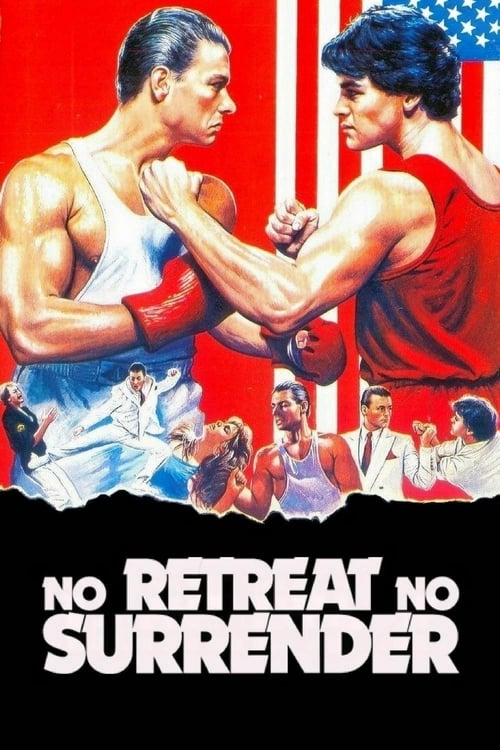
No Retreat, No Surrender (1986)
Directed by Corey Yuen
No — No Retreat, No Surrender is not woke, scoring 0 out of 100 on our wokeness meter.
"No Retreat, No Surrender" arrives from 1986 with the serene confidence of a film that believes it has invented the training montage.
Consciousness Markers
The cast is overwhelmingly white American, with a Korean actor (Kim Tai-chung) cast as Bruce Lee's ghost and a Belgian (Van Damme) as the Soviet villain — both choices driven by martial-arts skill and resemblance, not any representational intent.
No LGBTQ+ characters, themes, or subtext of any kind appear in this 1986 karate programmer.
Kelly Riley exists as a girlfriend and a damsel to be grabbed by the hair; the film's gender politics are purely of their era with no feminist framing.
The Bruce Lee ghost is a Bruceploitation gimmick, not a vehicle for racial commentary; the film engages no questions of race or identity.
No environmental themes whatsoever; the stakes are dojos, bullies, and a Soviet kickboxer.
The antagonists are a generic organized-crime syndicate strongarming dojos — a mob plot, not a critique of capitalism or class.
The one heavier character, Scott, is written as a gluttonous bully to be mocked and headbutted; the film is if anything hostile to body positivity.
No neurodivergent characters or themes are present or implied.
The film is pure fiction with no historical subject matter to revise.
The father's 'fighting is not the answer' moral is a stock genre beat, not a social lecture aimed at the audience.
Why it received this score
"No Retreat, No Surrender" arrives from 1986 with the serene confidence of a film that believes it has invented the training montage. A mob syndicate wishes to absorb every dojo in America. When a father refuses, a Soviet kickboxer named Ivan breaks his leg, and the family decamps to Seattle, where the teenage son summons the ghost of Bruce Lee for private instruction. That is the plot, offered without irony and delivered without apology. The production cast a Belgian as the Russian and a Korean taekwondo specialist as the spirit of a Chinese-American icon, selections made on the basis of who could kick hardest and who resembled the departed. No representational arithmetic was performed in the making of this motion picture, and none is visible on screen.
The women in the film are furnishings. Kelly exists to be a girlfriend in the first act and a hostage by the hair in the last. The heavyset boy, Scott, is written as a glutton, mocked in dialogue and neutralized with a headbutt, which places the picture somewhere south of enlightened on questions of the body. Nobody discusses race, class, sexuality, or the environment. The antagonists are gangsters, which is a crime problem, not a capital problem. The father's weary insistence that fighting is not the answer is a genre beat inherited from a hundred Saturday matinees. It is not a sermon aimed at us.
What remains is choreography, earnestness, and a young Jean-Claude Van Damme snarling through his first real role. The picture was mocked on release, revived as a cult object, and eventually riffed by professionals for money. It instructs no one and corrects nothing. It simply kicks.
Analysis generated by our Consciousness Algorithm
Synopsis
The mob is trying to strongarm local martial arts schools, forcing young Jason Stillwell and his family to move after his father is injured defending their dojo. With his father now rejecting violence, Jason is forced to train on his own to protect himself and his best friend from the members of a rival karate school.
Questions about No Retreat, No Surrender
Is No Retreat, No Surrender woke?
No — No Retreat, No Surrender is not woke, scoring 0 out of 100 on our wokeness meter. That earns it a verdict of Ultra Based.
Does No Retreat, No Surrender have any woke elements?
No. All 10 markers score zero.
How does No Retreat, No Surrender compare to other 1986 movies?
It ranks #47 of the 62 films from 1986 we've scored; their average is 7. The wokest is Star Trek IV: The Voyage Home (42).
How is the Woke Score calculated?
An AI-assisted process researches the film and its reception, scores it 0–100 on ten markers, then combines those into one 0–100 Woke Score. It measures a specific set of 2020s cultural themes, not film quality.