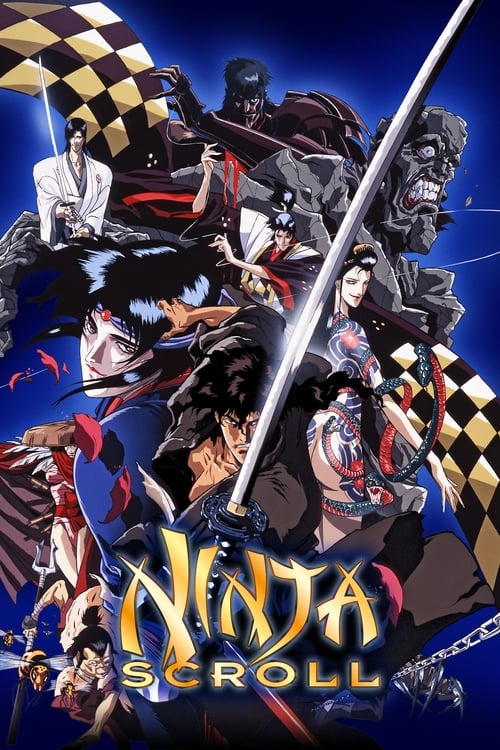
Ninja Scroll (1993)
Directed by Yoshiaki Kawajiri
Yoshiaki Kawajiri's 1993 animated feature arrives from a cultural moment that predates the very concept of social consciousness as a cinematic virtue, and it wears this fact with the serene indifference of a man who has already drawn his sword.
Consciousness Markers
The cast is uniformly Japanese in a film set in feudal Japan, which is simply accurate period geography rather than progressive casting philosophy. Kagero exists as a prominent female character, though her role is framed through victimhood tropes that no modern sensitivity reader would approve without extensive notes.
The villain's scheme involves cornering Japan's gold supply to fund a coup against the Tokugawa government, which is broadly anti-establishment rather than anti-capitalist in any modern ideological sense. Jubei himself works for money, which is a notably un-woke economic arrangement.
The Tokugawa government is portrayed as corrupt and complicit in a gold-smuggling conspiracy, which is not standard celebratory history. The film does not undertake any systematic reframing of historical power structures through a modern social justice lens. It is revisionist only in the sense that the Tokugawa shogunate is the bad guys, which is a fairly modest historical position.
Kagero is a skilled kunoichi who occasionally does things competently, which is the ceiling of her feminist credentials. Her narrative function is largely to be endangered, assaulted, and ultimately sacrificed, a set of choices that would generate a great deal of online discourse if the film were released today.
There are no LGBTQ+ themes, characters, or subtext present. The film is too busy depicting graphic violence and body horror to address sexual identity in any register.
The film contains no racial consciousness in the modern sense. It is a Japanese film about Japanese characters in feudal Japan, and the topic never arises.
No climate themes are present. The natural environment serves as backdrop for sword fights, not as an imperiled subject requiring our advocacy.
Every body in this film is either a weapon or a casualty. The concept of affirming one's physical form in a spirit of self-acceptance does not enter the picture.
No characters are framed through a lens of neurodivergence. The closest the film gets is a stone-skinned demon, who is not offered accommodations.
Ninja Scroll has precisely zero interest in lecturing the viewer about anything. It has places to be, people to dismember, and no patience for moral instruction.
Why it received this score
Yoshiaki Kawajiri's 1993 animated feature arrives from a cultural moment that predates the very concept of social consciousness as a cinematic virtue, and it wears this fact with the serene indifference of a man who has already drawn his sword. The film follows Jubei Kibagami, a ronin who sells his skills to the highest bidder and reports to no institutional authority, through a supernatural conspiracy involving the Eight Devils of Kimon and enough severed limbs to stock a modest ossuary. It is, by any measurable standard, a film about a cool man doing violent things in feudal Japan. The progressive sensibilities of the 2020s are not merely absent here. They are structurally impossible. The film does not know they exist, and it does not miss them.
The most culturally complex element the film offers is Kagero, the female lead, whose narrative situation would require several paragraphs of content warning were it released today. She is a capable warrior whose entire character design is organized around sexual violence and lethal untouchability, a combination that modern criticism has correctly identified as a layered problem. This is not subversive feminist coding. It is grindhouse anime from a studio that also made Wicked City, and it should be classified accordingly. The film does gesture, faintly, toward anti-establishment politics by casting the Tokugawa government as corrupt conspirators, but this is less a structural critique of power than a convenient reason for the third act. Jubei's proud refusal to serve any master reads less as a political statement and more as a personality type.
What the film achieves is a vision of kinetic violence so fluid and inventive that it directly inspired the Wachowskis, which means it is indirectly responsible for a great deal of subsequent cinema that scores considerably higher on this instrument. For that contribution to the cultural ecosystem, we note it without further comment. Ninja Scroll is not a film that wants to teach us anything. It is a film that wants to show us a man fight a man made of bees. In 1993, this was enough. In some important respects, it still is.
Analysis generated by our Consciousness Algorithm


Synopsis
Jubei is a masterless ninja who travels the land alone, lending his services to those with gold—or a worthy cause. His fearsome abilities have served him well, but a plot to overthrow the government threatens to end his wandering ways—and possibly his life.