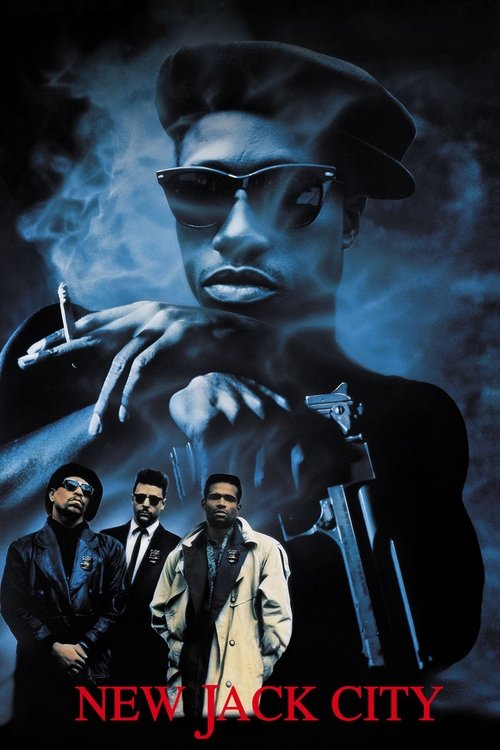
New Jack City (1991)
Directed by Mario Van Peebles
No — New Jack City is not especially woke, scoring 27 out of 100 on our wokeness meter.
New Jack City arrives from 1991, a neo-noir gangster picture that Warner Bros.
Consciousness Markers
The film features a predominantly Black cast and was directed by Mario Van Peebles, a Black filmmaker, providing significant representation for Black talent in a major studio release in 1991.
The film depicts the crack epidemic's impact on Harlem's Black community, but it does not explicitly engage with systemic racism or racial justice in a modern sense.
The film includes a brief epilogue about the ongoing crack epidemic, but it is not preachy or lecture-driven throughout.
No LGBTQ+ themes or characters are present in the film.
The film is male-dominated and does not advance feminist themes; female characters are largely peripheral.
No climate or environmental themes are present.
The film is a crime drama about drug trafficking and does not critique capitalism or wealth inequality.
No body positivity themes are present.
No neurodivergence themes are present.
The film is a fictionalized account inspired by real events but does not revise history to fit a progressive narrative.
Why it received this score
New Jack City arrives from 1991, a neo-noir gangster picture that Warner Bros. released with an estimated eight million dollar budget and a confidence that proved justified. Mario Van Peebles directs and appears, and the cast is led by Wesley Snipes, Ice-T, Allen Payne, and Chris Rock. That a major studio handed a film of this scale to a Black director with a predominantly Black ensemble was not a small thing in 1991. The representation is real and it is substantial. It is also simply the film doing its job, casting the right actors for a Harlem crime saga, with no commentary attached to the choices.
The story follows Nino Brown and the Cash Money Brothers as crack reshapes their neighborhood, and a detective named Scotty Appleton goes undercover to bring them down. The film watches the drug trade hollow out a community, and it does so without much editorializing. Crime is crime here. The villains are villains. There is no structural critique of policing, no meditation on systemic forces, and no gestures toward the social causes that would become standard in later decades. Women appear mostly at the margins, and their fates are grim. The picture has no interest in the other cultural questions that a later era would insist upon.
What lingers is the epilogue, a few lines of text noting that the crack epidemic continues and that decisive action is required. It is a brief sermon, delivered at the exit, and the film earns the right to it. Otherwise this is a genre piece from a specific moment, and it carries the sensibilities of that moment. The sommelier notes a clean, unfortified vintage. It has aged into a document of what 1991 looked like, and that is its own quiet value.
That the screenplay drew on the real Harlem kingpin Nicky Barnes and on investigative reporting about the drug war lends the picture a documentary weight, though it never claims to be a chronicle. It is a feverish fiction built from true fragments, and it knows the difference. The film does not lecture. It shows a man falling from a balcony and lets the audience sit with the silence that follows. There are worse ways to spend two hours, and few cleaner ones to observe a culture at a particular crossroads, before the vocabulary changed and every genre picture was asked to carry a thesis. New Jack City carries only its own story, and it carries it well. The classification is straightforward: a product of its era, largely untouched by the progressive markers that would define a later generation of studio releases, and all the more coherent for it. The score reflects a film of modest social consciousness and considerable craft, which is a respectable combination in any decade. I have no further notes. The cellar is closed for the evening.
That is the verdict, delivered without ceremony, as the job requires. The picture stands as a genre exercise with a single moral postscript, and we may now file it accordingly, dust off our hands, and move to the next screening with the grim patience that this profession demands of us all. The end.
Analysis generated by our Consciousness Algorithm
Part of


Synopsis
A gangster, Nino, is in the Cash Money Brothers, making a million dollars every week selling crack. A cop, Scotty, discovers that the only way to infiltrate the gang is to become a dealer himself.
Questions about New Jack City
Is New Jack City woke?
No — New Jack City is not especially woke, scoring 27 out of 100 on our wokeness meter. That earns it a verdict of Based.
Does New Jack City have any woke elements?
2 of the 10 markers register at 30 or above, led by Representation Casting (65) and Racial Consciousness (30). On Representation Casting: The film features a predominantly Black cast and was directed by Mario Van Peebles, a Black filmmaker, providing significant representation for Black talent in a major studio release in 1991.
How does New Jack City compare to other 1991 movies?
It ranks #10 of the 68 films from 1991 we've scored; their average is 14. The wokest is Paris Is Burning (77).
How is the Woke Score calculated?
An AI-assisted process researches the film and its reception, scores it 0–100 on ten markers, then combines those into one 0–100 Woke Score. It measures a specific set of 2020s cultural themes, not film quality.