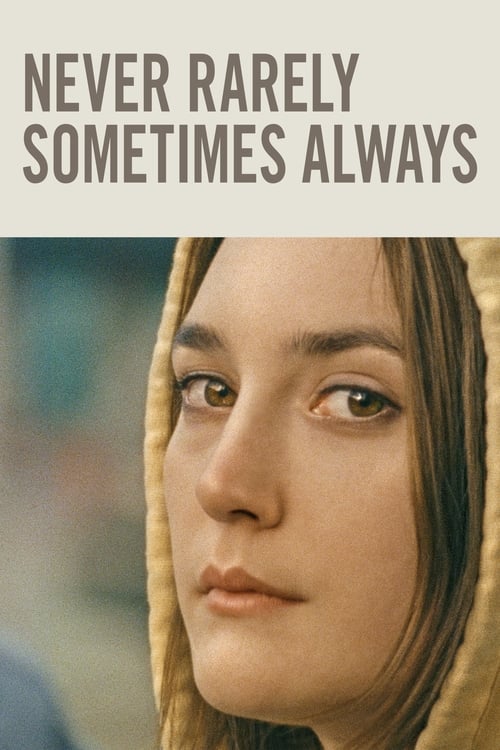
Never Rarely Sometimes Always (2020)
Directed by Eliza Hittman
Yes — Never Rarely Sometimes Always is woke, scoring 60 out of 100 on our wokeness meter.
Eliza Hittman's Never Rarely Sometimes Always follows a seventeen-year-old from rural Pennsylvania to New York City in search of a procedure she cannot legally obtain at home.
Consciousness Markers
The film is centrally concerned with reproductive rights, bodily autonomy, and the bond between two young women, making it a distinctly feminist work.
The film features two female leads and a female director, but the cast is otherwise predominantly white and lacks notable racial or ethnic diversity.
The film is deliberately understated and avoids didacticism, focusing on naturalistic observation rather than lecturing the audience.
There are no explicit LGBTQ+ themes, characters, or relationships in the film.
The film does not engage with racial themes or racial consciousness; its characters and conflicts are not framed through a racial lens.
There is no environmental or climate-related content in the film.
The film depicts financial hardship and barriers to healthcare access, but it does not advance an explicit anti-capitalist or eat-the-rich critique.
The film does not address body positivity or related themes.
There is no exploration of neurodivergence in the film.
The film is a fictional narrative and does not attempt to revise or reinterpret historical events.
Why it received this score
Eliza Hittman's Never Rarely Sometimes Always follows a seventeen-year-old from rural Pennsylvania to New York City in search of a procedure she cannot legally obtain at home. The film observes instead of arguing. Autumn punches herself in the stomach in a bathroom, rides a bus, sleeps on a subway, and says almost nothing about how she feels. The camera stays close and the score stays silent. It is a study in exhaustion, and the exhaustion is the point.
On the matter of social consciousness, this is a serious specimen. Its concerns are bodily autonomy, reproductive access, and the quiet alliance between two young women who have learned that the world will extract something from them either way. The title refers to a questionnaire at a clinic, and the scene where it is read aloud lands harder than any speech could. That is the film's method: no speeches. A crisis pregnancy center lies to Autumn, a clinic corrects the record, and the audience is left to do the arithmetic. There is no villain monologue, no montage of outrage, no character turning to the camera to explain the stakes. Hittman trusts us to be appalled on our own time, and the trust is earned.
What the film declines to do is broaden its lens. The cast is white, the politics stay personal, and the financial hardship on display is never framed as a systemic indictment. No lecture arrives. No lesson is delivered. The result is a work unmistakably of its moment that nevertheless refuses the standard toolkit of that moment. We are left with two girls on a bus, holding hands, going home. The restraint is either the film's greatest virtue or its narrowest limitation, and the sommelier's verdict is still pending.
Analysis generated by our Consciousness Algorithm


Synopsis
A pair of teenage girls in rural Pennsylvania travel to New York City to seek out medical help after an unintended pregnancy.
Questions about Never Rarely Sometimes Always
Is Never Rarely Sometimes Always woke?
Yes — Never Rarely Sometimes Always is woke, scoring 60 out of 100 on our wokeness meter. That earns it a verdict of Woke.
What makes Never Rarely Sometimes Always woke?
1 of the 10 markers register at 30 or above, led by Feminist Agenda (85). On Feminist Agenda: The film is centrally concerned with reproductive rights, bodily autonomy, and the bond between two young women, making it a distinctly feminist work.
How does Never Rarely Sometimes Always compare to other 2020 movies?
It ranks #14 of the 227 films from 2020 we've scored; their average is 21. The wokest is One Night in Miami... (83).
How is the Woke Score calculated?
An AI-assisted process researches the film and its reception, scores it 0–100 on ten markers, then combines those into one 0–100 Woke Score. It measures a specific set of 2020s cultural themes, not film quality.