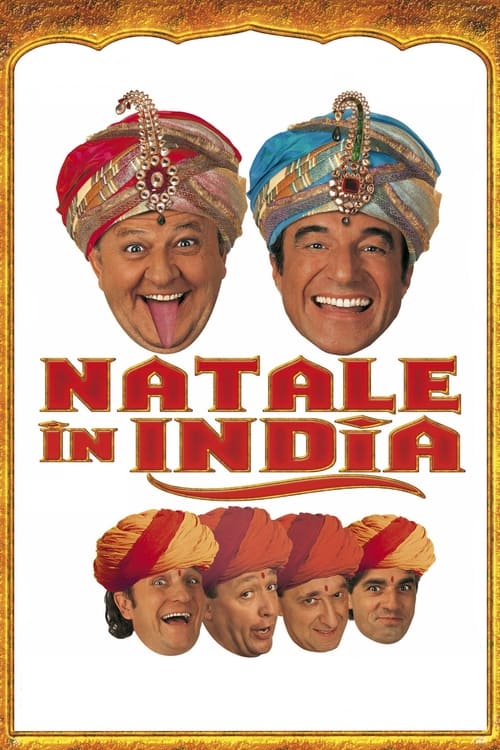
Natale in India (2003)
Directed by Neri Parenti
No — Natale in India is not woke, scoring 2 out of 100 on our wokeness meter.
Italian cinema has long maintained a holiday tradition of the cinepanettone, a seasonal confection of low comedy, sunburned locations, and actors who return each December like migratory birds.
Consciousness Markers
The cast is entirely Italian/white, and the Indian setting serves only as a backdrop for comic misunderstandings with no inclusive representation.
No LGBTQ+ characters, themes, or subtext appear in this heterosexual sex comedy.
The film is a bawdy sex comedy built on scatological and stereotyped humor; it offers no feminist critique or meaningful female agency.
It uses India and culture shock for broad, stereotyped humor rather than progressive racial consciousness or anti-racist commentary.
Environmental concerns are entirely absent.
There is no critique of wealth, capitalism, or class structures; the comedy is purely situational.
Bodies are used for slapstick and scatological jokes, not body-positive messaging.
No neurodivergent characters or themes are present.
No historical revisionism; it is a contemporary holiday comedy.
It aims for laughs, not moral instruction or social lecturing.
Why it received this score
Italian cinema has long maintained a holiday tradition of the cinepanettone, a seasonal confection of low comedy, sunburned locations, and actors who return each December like migratory birds. Natale in India, directed by Neri Parenti in 2003, deposits Massimo Boldi and Christian De Sica in the subcontinent for a series of misunderstandings involving culture shock, bodily functions, and the broadest possible readings of local custom. The plot, such as it is, concerns two antithetical travelers whose destinies intertwine during a trip abroad. The film has no interest in India beyond its usefulness as a colorful backdrop against which Italian men can behave badly.
Viewed through the lens of contemporary social consciousness, the film offers nothing at all. The cast is uniformly Italian, and the Indian setting exists to generate comedy from confusion and stereotype. There is no LGBTQ+ presence, no feminist critique, no engagement with race that rises above the level of a punchline. The humor is scatological and physical. Bodies are instruments of slapstick, not vehicles for any message about self-acceptance. Environmental concerns do not appear. Class and capital go unexamined. No character is neurodivergent, no history is revised, and no lesson is delivered to anyone.
The film wants only to make its audience laugh on a December evening, and it pursues that goal with a single-mindedness that borders on the admirable. There is no sermon here, no moral instruction, no attempt to improve the viewer. That absence is not a virtue, exactly. It is simply a fact of the production, a document of a comedy tradition that predates the current cultural conversation and shows no awareness of it. We are left to classify it accordingly: a curiosity of Italian popular cinema, frozen in its moment, asking nothing of us but a willingness to chuckle.
Analysis generated by our Consciousness Algorithm
Synopsis
Destinies intertwined for two antithetical people who meet during a trip to India, where lots of misunderstandings and funny situations will take place.
Questions about Natale in India
Is Natale in India woke?
No — Natale in India is not woke, scoring 2 out of 100 on our wokeness meter. That earns it a verdict of Ultra Based.
Does Natale in India have any woke elements?
No. All 10 markers score zero.
How does Natale in India compare to other 2003 movies?
It ranks #125 of the 150 films from 2003 we've scored; their average is 12. The wokest is Mona Lisa Smile (60).
How is the Woke Score calculated?
An AI-assisted process researches the film and its reception, scores it 0–100 on ten markers, then combines those into one 0–100 Woke Score. It measures a specific set of 2020s cultural themes, not film quality.