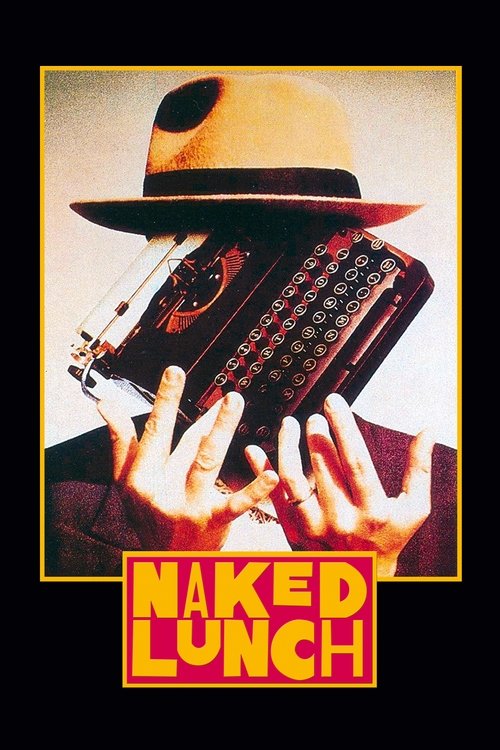
Naked Lunch (1991)
Directed by David Cronenberg
No — Naked Lunch is not woke, scoring 12 out of 100 on our wokeness meter.
Cronenberg's Naked Lunch arrives from 1991, a year when a film could still be strange without being asked to explain itself to anyone.
Consciousness Markers
Burroughs's homosexuality and the 'gay theme' keyword inform the film, and the character Yves Cloquet is explicitly gay, but the treatment is oblique, aestheticized, and filtered through Cronenberg's hallucinatory lens rather than presented as identity politics.
The cast is overwhelmingly white and drawn from the usual 1991 art-house pool; the only nod to diversity is the presence of a gay supporting character, which is a thematic element rather than a casting statement.
Cronenberg's film is deliberately opaque and experiential; it offers no moral instruction or social sermon, only a clammy aesthetic of disgust.
Women exist here as doppelgangers, victims, and objects of a William Tell parlor trick; Judy Davis's dual role is a performance showcase, not a feminist statement.
The film is steeped in drug-induced hallucination and altered mental states, but these are rendered as psychedelic surrealism rather than a modern neurodivergence narrative.
The Tangier setting provides exotic backdrop but the film engages no racial themes or consciousness whatsoever.
No environmental content of any kind.
The narcotics operation and Interzone intrigue are surrealist plot machinery, not economic critique.
No body-positivity themes present.
The film fictionalizes Burroughs's biography and the Joan Vollmer shooting, but as surrealist autobiography, not as historical revisionism.
Why it received this score
Cronenberg's Naked Lunch arrives from 1991, a year when a film could still be strange without being asked to explain itself to anyone. It follows Bill Lee, an exterminator who graduates from bug powder to talking typewriters, then flees to a hallucinated Tangier where his dead wife keeps reappearing under a different name. The film is a clammy, deliberate puzzle, more interested in the aesthetics of disgust than in the instruction of an audience. It does not lecture. It does not moralize. It simply sits there being repulsive, which in its era counted as entertainment.
The progressive content is present but muted, and mostly of the older art-house variety. Burroughs's homosexuality shadows the proceedings, and one supporting figure is openly gay, though the film treats this as texture and hallucination instead of identity. The Tangier setting supplies exotic wallpaper but no racial consciousness, and the narcotics intrigue is surrealist machinery, not a critique of capital. Judy Davis performs double duty as two iterations of the same doomed woman, a showcase for her range and not a statement about anything. Women here are doppelgangers, victims, and targets for a William Tell trick, which the film regards as tragedy rather than commentary.
What remains is a work of altered states, rendered as psychedelic spectacle. The hallucinating mind is the subject, not a modern vocabulary of neurodivergence. There is no environmental sermon, no body-positivity gesture, no revisionist history, only a fictionalized Burroughs drifting through his own mythology. It won awards in Canada and baffled the box office, which feels correct. A film this committed to its own clammy interiority was never going to carry a banner.
Analysis generated by our Consciousness Algorithm
Synopsis
Blank-faced bug killer Bill Lee and his dead-eyed wife, Joan, like to get high on Bill's pest poisons while lounging with Beat poet pals. After meeting the devilish Dr. Benway, Bill gets a drug made from a centipede. Upon indulging, he accidentally kills Joan, takes orders from his typewriter-turned-cockroach, ends up in a constantly mutating Mediterranean city and learns that his hip friends have published his work -- which he doesn't remember writing.
Questions about Naked Lunch
Is Naked Lunch woke?
No — Naked Lunch is not woke, scoring 12 out of 100 on our wokeness meter. That earns it a verdict of Ultra Based.
Does Naked Lunch have any woke elements?
1 of the 10 markers register at 30 or above, led by LGBTQ+ Themes (40). On LGBTQ+ Themes: Burroughs's homosexuality and the 'gay theme' keyword inform the film, and the character Yves Cloquet is explicitly gay, but the treatment is oblique, aestheticized, and filtered through Cronenberg's hallucinatory lens rather than presented as identity politics.
How does Naked Lunch compare to other 1991 movies?
It ranks #24 of the 68 films from 1991 we've scored; their average is 14. The wokest is Paris Is Burning (77).
How is the Woke Score calculated?
An AI-assisted process researches the film and its reception, scores it 0–100 on ten markers, then combines those into one 0–100 Woke Score. It measures a specific set of 2020s cultural themes, not film quality.