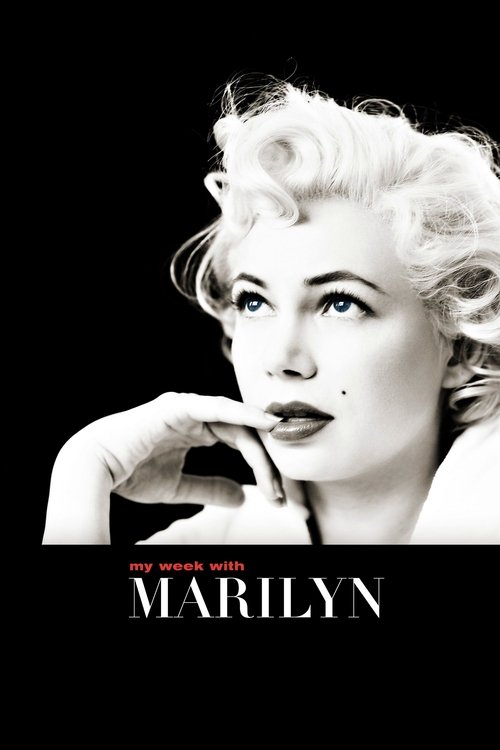
My Week with Marilyn (2011)
Directed by Simon Curtis
No — My Week with Marilyn is not woke, scoring 11 out of 100 on our wokeness meter.
The film is a backstage period piece, 1956 London, Colin Clark, Olivier, Monroe.
Consciousness Markers
The film centers on Marilyn Monroe and gestures at how a brilliant woman is dismissed and condescended to by Olivier and the male-dominated industry, with Sybil Thorndike and Vivien Leigh defending her, but it remains a male-perspective infatuation narrative rather than a feminist statement.
The film is a gentle, character-driven drama that observes rather than preaches; it contains no overt moralizing or message-delivery.
The cast is almost entirely white performers portraying white historical figures of 1950s British and American cinema; no diverse or color-conscious casting choices are present.
There are no LGBTQ+ characters, relationships, or themes anywhere in the film.
Race is entirely absent as a subject; the film depicts an all-white milieu without any commentary on racial dynamics.
No environmental or climate themes appear in this backstage period drama.
The film has no critique of capitalism, wealth, or class exploitation; it is a nostalgic showbiz character study.
While Michelle Williams gained weight to embody Monroe, the film does not engage body-positivity themes or challenge beauty standards as a message.
No neurodivergent characters or themes are present or explored.
The film adapts Colin Clark's memoirs of real events without reinterpreting history through a modern ideological lens.
Why it received this score
The film is a backstage period piece, 1956 London, Colin Clark, Olivier, Monroe. It is a gentle nostalgic showbiz character study. The camera adores Monroe but through Colin's eyes. It notices how men condescend to her, Olivier frustrated, Sybil Thorndike and Vivien Leigh defend her. This is a flicker of social awareness, but the engine is infatuation, not argument. The film has no interest in broader representation, race, sexuality, or class. The cast is white historical figures, and the film treats that as the natural order of 1950s British cinema. No comment, no critique.
The film does not crusade about climate, capitalism, body image, neurodivergence, or historical revision. Michelle Williams gained weight to play Monroe, but the film never turns that into a statement about beauty standards. It is too busy recreating dresses and the texture of Pinewood. The rich are not eaten. The environment is not saved. History is not re-litigated. It is a memoir adaptation, faithful to its sources and its milieu. The only faint progressive pulse is the recognition that Monroe was a serious artist dismissed by a male establishment. Sybil and Vivien say as much. But the movie keeps returning to Colin's wistful crush, which softens the critique into a sigh.
The film observes. It does not lecture. There is no sermon, no moral instruction, no fourth wall break to explain what we should think. It is content to be a well-mannered drama about famous people behaving sadly. The result is pleasant, minor, and culturally quiet. It has the social consciousness of a vintage postcard. We are left with Michelle Williams doing an uncanny impersonation, Kenneth Branagh harrumphing, and a young man learning that Marilyn breaks hearts. The film does not ask us to change society. It asks us to feel briefly sorry for everyone involved. That is not nothing, but it is not a movement.
Analysis generated by our Consciousness Algorithm


Synopsis
London, 1956. Genius actor and film director Laurence Olivier is about to begin the shooting of his upcoming movie, premiered in 1957 as The Prince and the Showgirl, starring Marilyn Monroe. Young Colin Clark, who dreams on having a career in movie business, manages to get a job on the set as third assistant director.
Questions about My Week with Marilyn
Is My Week with Marilyn woke?
No — My Week with Marilyn is not woke, scoring 11 out of 100 on our wokeness meter. That earns it a verdict of Ultra Based.
Does My Week with Marilyn have any woke elements?
Very few. None of the 10 markers reaches 30, the level where a marker counts as present; the highest is Feminist Agenda at 18.
How does My Week with Marilyn compare to other 2011 movies?
It ranks #81 of the 245 films from 2011 we've scored; their average is 11. The wokest is Paul (68).
How is the Woke Score calculated?
An AI-assisted process researches the film and its reception, scores it 0–100 on ten markers, then combines those into one 0–100 Woke Score. It measures a specific set of 2020s cultural themes, not film quality.