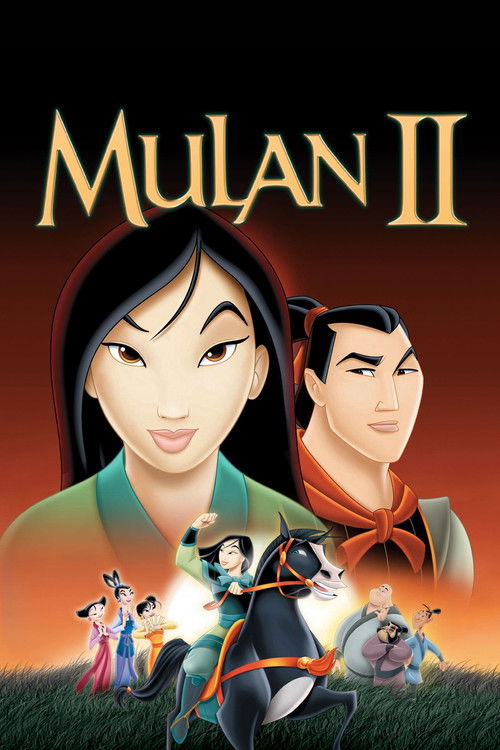
Mulan II (2004)
Directed by Darrell Rooney
No — Mulan II is not especially woke, scoring 24 out of 100 on our wokeness meter.
The sequel to Disney's 1998 animated feature arrives as a direct-to-video title, a format that announces its ambitions with modesty.
Consciousness Markers
The voice cast is entirely Asian and Asian-American for the Chinese characters, including Ming-Na Wen, BD Wong, Lucy Liu, Sandra Oh, and Pat Morita. This is notable representation, though it is natural to the setting rather than a modern diversity initiative.
Mulan is a capable female warrior and the princesses reject arranged marriages to follow their hearts, but the film frames this as romantic destiny rather than a systemic feminist critique.
The film delivers gentle moral lessons about following one's heart and the importance of love over duty, but it does so through song and story rather than preachy modern lecturing.
There are no LGBTQ+ characters, themes, or subtext in the film.
The film is set in China with Chinese characters, but it does not comment on race, racism, or racial identity in any conscious way.
There is no environmental or climate-related theme in the film.
The film contains no critique of capitalism, wealth inequality, or economic systems.
There is no body positivity theme or challenge to conventional beauty standards.
No neurodivergent characters or themes are present.
The film is a fictional legend and does not engage in historical revisionism.
Why it received this score
The sequel to Disney's 1998 animated feature arrives as a direct-to-video title, a format that announces its ambitions with modesty. Mulan II returns Ming-Na Wen, BD Wong, and other voices from the original, while adding Lucy Liu, Sandra Oh, and Pat Morita. The cast is entirely Asian and Asian-American for the Chinese characters. This is representation of a natural, setting-specific kind, not a modern diversity initiative, and we record it at a moderate level. The film has no interest in making a spectacle of its casting, which is to its credit.
The story sends Mulan and her fiancé, General Li Shang, to escort three princesses toward arranged marriages. Mulan remains a capable warrior, and the princesses reject their predetermined unions to follow their hearts. The film treats this as romantic destiny, not a systemic feminist critique, so the progressive content stays mild. A dragon named Mushu sabotages the relationship for reasons of job security. The moral lessons about love and duty arrive through song and slapstick, which keeps the lecturing gentle and intermittent. There is no climate crusade, no eat-the-rich argument, no body positivity, no neurodivergence, and no revisionist history. The film is a fictional legend and shows no interest in those modern markers.
No LGBTQ characters appear. No racial consciousness is engaged. The result is a thin vintage, serviceable for a family evening. A 0% Rotten Tomatoes rating from five critics is noted without glee. The cultural awareness on display is modest and mostly casting-deep, which is not a crime, only a classification. We finish the glass and mark the bottle accordingly.
Analysis generated by our Consciousness Algorithm


Synopsis
Fa Mulan gets the surprise of her young life when her love, Captain Li Shang asks for her hand in marriage. Before the two can have their happily ever after, the Emperor assigns them a secret mission, to escort three princesses to Chang'an, China. Mushu is determined to drive a wedge between the couple after he learns that he will lose his guardian job if Mulan marries into the Li family.
Questions about Mulan II
Is Mulan II woke?
No — Mulan II is not especially woke, scoring 24 out of 100 on our wokeness meter. That earns it a verdict of Based.
Does Mulan II have any woke elements?
2 of the 10 markers register at 30 or above, led by Representation Casting (45) and Feminist Agenda (35). On Representation Casting: The voice cast is entirely Asian and Asian-American for the Chinese characters, including Ming-Na Wen, BD Wong, Lucy Liu, Sandra Oh, and Pat Morita.
How does Mulan II compare to other 2004 movies?
It ranks #25 of the 178 films from 2004 we've scored; their average is 12. The wokest is Tropical Malady (62).
How is the Woke Score calculated?
An AI-assisted process researches the film and its reception, scores it 0–100 on ten markers, then combines those into one 0–100 Woke Score. It measures a specific set of 2020s cultural themes, not film quality.