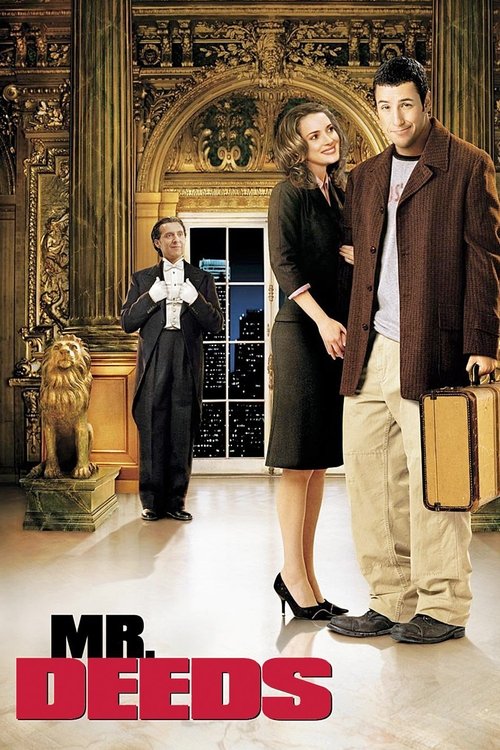
Mr. Deeds (2002)
Directed by Steven Brill
No — Mr. Deeds is not woke, scoring 12 out of 100 on our wokeness meter.
Mr. Deeds arrives in 2002 as a remake of a 1936 Frank Capra picture, which is to say it inherits a Depression-era populism and dresses it in Adam Sandler's hoodie.
Consciousness Markers
The villain is a greedy CEO scheming to gut a company and lay off thousands, and Deeds rallies shareholders to do the right thing — but this is classic Capra-style populism, not modern anti-capitalist critique.
Deeds delivers a mild shareholders'-meeting appeal about loyalty and decency, but the film's moralizing stays light and comedic rather than preachy.
The cast is overwhelmingly white, with minority performers (J.B. Smoove, Al Sharpton, George Wallace, Aloma Wright) appearing incidentally in minor roles with no commentary on their presence. There is no deliberate diversity casting agenda at work.
Deeds asks to donate his fortune to the United Negro College Fund and Al Sharpton appears as himself, but these are throwaway gags rather than any examination of racial justice.
Winona Ryder's Babe is a capable tabloid reporter and Jan is a brawling ex-rodeo clown, but the romance follows a thoroughly traditional damsel-and-hero structure and advances no feminist argument.
There are no LGBTQ+ characters, themes, or subtext anywhere in the film.
The environment is never a subject of the film; a Mount Everest opening is played purely for comedy.
No body-positivity themes or messaging of any kind are present.
The character 'Crazy Eyes' has amblyopia and is described as mentally unstable, but his condition is played purely for slapstick laughs rather than as neurodivergent representation.
The film is a straightforward modern-day update rather than any revisionist reframing of history.
Why it received this score
Mr. Deeds arrives in 2002 as a remake of a 1936 Frank Capra picture, which is to say it inherits a Depression-era populism and dresses it in Adam Sandler's hoodie. The premise is sturdy: a small-town pizzeria owner inherits forty billion dollars, moves to Manhattan, and discovers that everyone wants a piece of him. The film's moral universe is gentle and old-fashioned. Kindness wins. Greed loses. The shareholders' meeting ends with a speech about decency and a round of applause.
The social consciousness on display is of an earlier vintage. A greedy chief executive schemes to gut the company and lay off thousands, which is the oldest villain in the American catalog, and Deeds thwarts him with an appeal to loyalty. There is a passing request to donate the fortune to the United Negro College Fund, and Al Sharpton appears twice as himself, once to preside over a funeral. These are gags, not arguments. Winona Ryder's tabloid reporter is competent and quick, and Jan the retired rodeo clown throws a respectable punch, but the romance runs on a damsel-and-hero chassis that no amount of brawling disrupts. A running character with amblyopia exists to be laughed at, and the film does not pause to consider him otherwise.
This is a comedy that predates the current cultural vocabulary almost entirely. It moralizes lightly, in the Capra tradition, and then gets out of the way. The result sits near the bottom of the scale, not from any hostility to progressive ideas, but from simple disinterest. It wants to be liked. It is not trying to teach anybody anything, which in this taxonomy is its own quiet distinction.
Analysis generated by our Consciousness Algorithm


Synopsis
When Longfellow Deeds, a small-town pizzeria owner and poet, inherits $40 billion from his deceased uncle, he quickly begins rolling in a different kind of dough. Moving to the big city, Deeds finds himself besieged by opportunists all gunning for their piece of the pie. Babe, a television tabloid reporter, poses as an innocent small-town girl to do an exposé on Deeds.
Questions about Mr. Deeds
Is Mr. Deeds woke?
No — Mr. Deeds is not woke, scoring 12 out of 100 on our wokeness meter. That earns it a verdict of Ultra Based.
Does Mr. Deeds have any woke elements?
Very few. None of the 10 markers reaches 30, the level where a marker counts as present; the highest is Eat the Rich at 28.
How does Mr. Deeds compare to other 2002 movies?
It ranks #45 of the 150 films from 2002 we've scored; their average is 12. The wokest is Far from Heaven (78).
How is the Woke Score calculated?
An AI-assisted process researches the film and its reception, scores it 0–100 on ten markers, then combines those into one 0–100 Woke Score. It measures a specific set of 2020s cultural themes, not film quality.