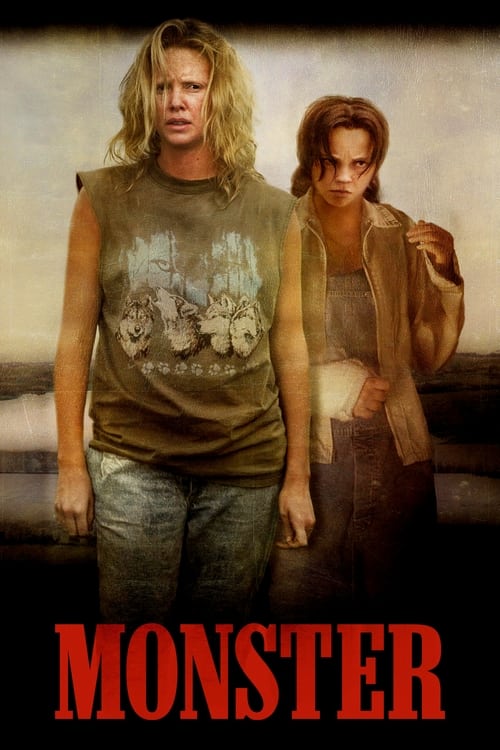
Monster (2003)
Directed by Patty Jenkins
No — Monster is not especially woke, scoring 32 out of 100 on our wokeness meter.
Patty Jenkins arrived in 2003 with a debut that refuses the usual comforts.
Consciousness Markers
The film centers on a romantic relationship between two women, Aileen and Selby, making LGBTQ+ themes a major component.
Directed by a woman and focusing on a female protagonist's struggle, the film has feminist undertones but lacks explicit ideological messaging.
The film depicts poverty and the lack of economic opportunity that drives Aileen to prostitution, but it is not an explicit anti-capitalist critique.
The film takes creative liberties with the true story, humanizing a serial killer, but does not explicitly revise history for a progressive agenda.
The film is a character-driven drama and does not preach or lecture the audience on social issues.
The cast is entirely white, with no significant racial diversity or representation casting.
No racial themes or commentary are present; the story focuses on white characters.
No climate or environmental themes are present.
No body positivity themes; Charlize Theron's weight gain was for character accuracy, not a message.
While Aileen has mental health issues, the film does not frame them as neurodivergence or promote neurodiversity.
Why it received this score
Patty Jenkins arrived in 2003 with a debut that refuses the usual comforts. Monster follows Aileen Wuornos from a Daytona Beach bar to a Florida execution chamber, and it does so with the patience of a coroner. Charlize Theron gained thirty pounds, shaved her eyebrows, and wore prosthetic teeth to disappear into the role, a transformation the industry rewarded with an Academy Award. The performance is the engine. Everything else is weather.
The relationship between Aileen and Selby Wall sits at the center of the film, and the film treats it as love, not pathology. Two women meet in a gay bar, skate, kiss, and build a fragile domestic arrangement on stolen money and motel carpet. That romance carries real weight here, and the story never flinches from it. Jenkins, directing her own script, keeps the camera close to a woman the world has already discarded. The poverty is relentless, the job rejections are relentless, and the film lets us feel the economic trap without ever stopping to explain it to us. Wuornos becomes a victim in this telling, which is a choice, and a contested one among people who knew her. The men she kills are drawn as predators. That is the film's argument, and it makes it quietly.
What Monster does not do is sermonize. There is no lecture, no slow zoom on a newspaper headline to tell us how to feel. The cast is white, the concerns are personal, and the climate is nowhere in evidence. Theron's physical transformation serves accuracy, not a message about bodies. Aileen's diagnosed disorders are portrayed as damage, not as a celebration of different minds. This is a character study from an earlier, less anxious era of American filmmaking. It wants us to watch one woman fall. It succeeds, and it never once asks for our approval.
Analysis generated by our Consciousness Algorithm


Synopsis
In 1989, prostitute Aileen Wuornos befriends and enters a relationship with a young woman named Selby. Determined to straighten out her life, Aileen's limited education lands her back on the corner. She's raped by a trick, who she kills. A string of murder and robbery follows that ultimately leads Aileen to becoming America's first female serial killer.
Questions about Monster
Is Monster woke?
No — Monster is not especially woke, scoring 32 out of 100 on our wokeness meter. That earns it a verdict of Based.
Does Monster have any woke elements?
2 of the 10 markers register at 30 or above, led by LGBTQ+ Themes (75) and Feminist Agenda (40). On LGBTQ+ Themes: The film centers on a romantic relationship between two women, Aileen and Selby, making LGBTQ+ themes a major component.
How does Monster compare to other 2003 movies?
It ranks #8 of the 150 films from 2003 we've scored; their average is 12. The wokest is Mona Lisa Smile (60).
How is the Woke Score calculated?
An AI-assisted process researches the film and its reception, scores it 0–100 on ten markers, then combines those into one 0–100 Woke Score. It measures a specific set of 2020s cultural themes, not film quality.