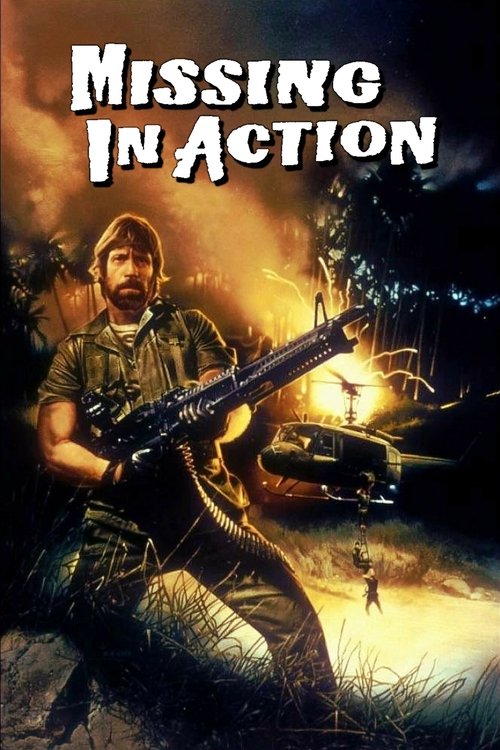
Missing in Action (1984)
Directed by Joseph Zito
No — Missing in Action is not woke, scoring 0 out of 100 on our wokeness meter.
Missing in Action arrived in 1984 as the Cannon Group's opening bid in a small arms race with Rambo, and it conducts its business with the efficiency of a supply drop.
Consciousness Markers
The cast is led by Chuck Norris and populated largely by white American actors, with Asian actors primarily cast as Vietnamese antagonists. There is no modern inclusive casting agenda at work.
The film contains no LGBTQ+ characters, themes, or subtext.
Women appear marginally, including in Bangkok bar/nudity contexts, and the film has no feminist perspective or female agency as a theme.
The film does not engage with racial justice or progressive racial consciousness; its portrayal of Vietnamese characters is widely criticized as xenophobic and stereotypical.
There is no environmental or climate-related content.
The film is a pro-military, anti-communist action fantasy with no critique of capitalism or wealth inequality.
The film does not address body image, body positivity, or related themes.
There is no depiction or discussion of neurodivergence.
While the film dramatizes the POW/MIA issue in a historically dubious and jingoistic way, it does not engage in the modern progressive revisionist-history marker.
The film has a patriotic, anti-bureaucratic message, but it is delivered through action-movie tropes rather than modern social-justice lecturing.
Why it received this score
Missing in Action arrived in 1984 as the Cannon Group's opening bid in a small arms race with Rambo, and it conducts its business with the efficiency of a supply drop. Chuck Norris plays Colonel James Braddock, a man who escaped a North Vietnamese prison camp a decade earlier and now returns to finish the paperwork, which is to say he returns to shoot people and bring home prisoners the government has misplaced. The plot is a straight line. The dialogue is sparse. The helicopter does most of the emotional labor.
The film's politics belong to the Reagan years, a flag-waving, anti-bureaucratic strain that treats Washington as an obstacle and the jungle as a filing cabinet of unfinished business. Vietnamese characters are drawn as sadistic brutes, and reviewers at the time reached for words like xenophobic. None of this registers on the modern progressive scale. There is no inclusive casting design, no queer presence, no feminist viewpoint, and the women who appear are largely decorative fixtures of Bangkok nightlife. Climate anxiety, wealth critique, body positivity, and neurodivergence are absent entirely. The film has no interest in any of them.
Its distortions of history are real. They serve a patriotic fantasy, not a progressive revision of the record. The message arrives through fists, firepower, and a triumphant Saigon conference, never through sermonizing. The result is a lean, jingoistic B-picture that became a hit and spawned two more. On the markers of contemporary cultural awareness, it is a clean sheet. Zero. The sommelier finds nothing in the glass but gasoline.
Analysis generated by our Consciousness Algorithm


Synopsis
American servicemen are still being held captive in Vietnam and it's up to one man to bring them home in this blistering, fast-paced action/adventure starring martial arts superstar Chuck Norris. Following a daring escape from a Vietnamese POW camp, Special Forces Colonel James Braddock (Norris) is on a mission to locate and save remaining MIAs.
Questions about Missing in Action
Is Missing in Action woke?
No — Missing in Action is not woke, scoring 0 out of 100 on our wokeness meter. That earns it a verdict of Ultra Based.
Does Missing in Action have any woke elements?
No. All 10 markers score zero.
How does Missing in Action compare to other 1984 movies?
It ranks #43 of the 51 films from 1984 we've scored; their average is 7. The wokest is Revenge of the Nerds (30).
How is the Woke Score calculated?
An AI-assisted process researches the film and its reception, scores it 0–100 on ten markers, then combines those into one 0–100 Woke Score. It measures a specific set of 2020s cultural themes, not film quality.