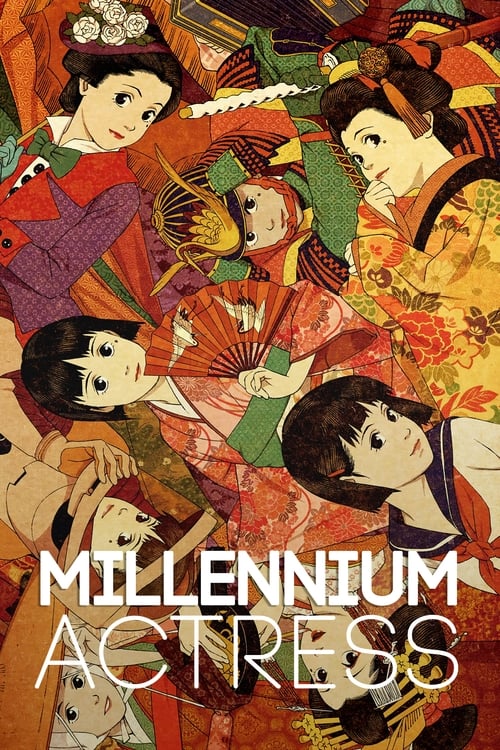
Millennium Actress (2002)
Directed by Satoshi Kon
No — Millennium Actress is not woke, scoring 0 out of 100 on our wokeness meter.
Satoshi Kon's second feature follows a documentary crew into the home of a vanished screen legend, and then follows her out of it again, through Manchuria, the Edo period, a burning castle, and the rubble of a Tokyo air raid.
Consciousness Markers
The cast and characters are entirely Japanese, reflecting the film's Japanese setting and production; there is no modern diversity-casting agenda.
No LGBTQ+ characters, relationships, or themes are present.
Although the protagonist is a woman, the film is a poetic meditation on memory and pursuit rather than a feminist critique or agenda.
The historical Japanese and Manchurian settings are narrative backdrop, not vehicles for modern racial-consciousness commentary.
Earthquakes appear as historical and personal disruptions, not as climate-crisis advocacy.
The film industry setting is explored for memory and illusion, not as an anti-capitalist or eat-the-rich polemic.
No body-positivity themes or messaging are present.
No neurodivergence themes or representation are present.
The film blends historical periods and film genres surrealistically, but it does not revise history for modern ideological purposes.
The film is lyrical, ambiguous, and emotionally driven rather than preachy or lecture-like.
Why it received this score
Satoshi Kon's second feature follows a documentary crew into the home of a vanished screen legend, and then follows her out of it again, through Manchuria, the Edo period, a burning castle, and the rubble of a Tokyo air raid. The conceit is that memory and film have stopped being separate substances. Chiyoko Fujiwara recounts her life, and her life arrives dressed as the movies she made in it. This is a structural gambit, executed with a precision that borders on cruelty to the audience's sense of chronology, and it remains the most elegant thing Kon ever assembled.
The picture has no interest in instructing anybody. Its heroine is a woman chasing a man she met once and can no longer picture, and the film declines to convert that into an argument about anything. There is no thesis tucked into the third act, no closing card explaining what we should have felt. History appears as weather: an earthquake here, a war there, a studio demolished for condominiums. The decades pass through the frame without being conscripted into commentary. Even the film industry, that reliable target for sermons about commerce and art, is treated as a place where illusions happen to be manufactured, not as a villain.
What lingers is the ending, in which Chiyoko decides the pursuit itself was the object of her love. Kon reportedly delighted in the betrayal audiences felt at that line. It is a strange, generous, unteachable conclusion, and it resists every attempt to extract a lesson from it. A film this beautiful and this uninterested in telling us how to live is a rare vintage. We should drink it slowly and stop asking it questions it has no intention of answering.
Analysis generated by our Consciousness Algorithm


Synopsis
Documentary filmmaker Genya Tachibana has tracked down the legendary actress Chiyoko Fujiwara, who mysteriously vanished at the height of her career. When he presents her with a key she had lost and thought was gone forever, the filmmaker could not have imagined that it would not only unlock the long-held secrets of Chiyoko’s life... but also his own.
Questions about Millennium Actress
Is Millennium Actress woke?
No — Millennium Actress is not woke, scoring 0 out of 100 on our wokeness meter. That earns it a verdict of Ultra Based.
Does Millennium Actress have any woke elements?
No. All 10 markers score zero.
How does Millennium Actress compare to other 2002 movies?
It ranks #129 of the 150 films from 2002 we've scored; their average is 12. The wokest is Far from Heaven (78).
How is the Woke Score calculated?
An AI-assisted process researches the film and its reception, scores it 0–100 on ten markers, then combines those into one 0–100 Woke Score. It measures a specific set of 2020s cultural themes, not film quality.