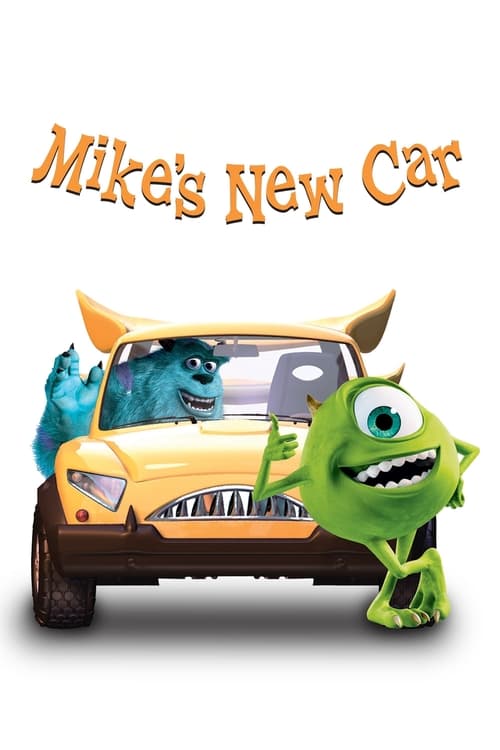
Mike's New Car (2002)
Directed by Pete Docter
No — Mike's New Car is not woke, scoring 4 out of 100 on our wokeness meter.
"Mike's New Car" arrives with the full weight of the Pixar apparatus behind it: a 2002 short directed by Pete Docter and Roger L. Gould, attached to the Monsters, Inc.
Consciousness Markers
The central conflict revolves around Mike's consumerism and subsequent buyer's remorse, offering a very mild,slapstick-driven critique of material wealth.
The film relies entirely on established, non-human Pixar characters, offering no commentary on modern casting or representation.
There are no discernible LGBTQ+ themes or representation within the narrative or character interactions.
The plot focuses on male characters and mechanical mishaps, lacking any feminist agenda or critique of gender roles.
The film does not engage with racial dynamics or offer any commentary on racial issues.
The destruction of the car is a comedic plot point, not a commentary on environmental degradation or climate change.
The characters are monstrous and their physical forms are not used to promote body positivity or diversity.
No characters exhibit traits related to neurodivergence, and no such themes are explored.
As a short comedy, the film does not attempt to challenge or revise any established historical narratives.
The film is pure slapstick comedy and contains no didactic social commentary or 'lecture' moments.
Why it received this score
"Mike's New Car" arrives with the full weight of the Pixar apparatus behind it: a 2002 short directed by Pete Docter and Roger L. Gould, attached to the Monsters, Inc. home release, nominated for an Academy Award, and boasting the first dialogue ever recorded for a Pixar short. What it does with that pedigree is show a green eyeball with legs being flung into an engine compartment. We are in the realm of slapstick, and the film knows it, committing to a single joke about dashboard buttons and the impossibility of reading an owner's manual.
The cultural research here returns almost nothing, and that absence is itself the finding. There is no representation agenda, no gender critique, no racial commentary, no environmental sermon, no celebration of physical difference, no examination of neurological variance. The characters are monsters, and their monstrousness is not deployed as metaphor. The seatbelt reminder chime is not a metaphor either. It is a chime. The Latin music that erupts from an errant button press is a gag, not a statement on cultural exchange. Mike and Sulley exist to fall over, and they fall over with a professionalism that predates any expectation that a six-minute cartoon carry ideological freight.
What the short does offer, faintly, is a cautionary note about consumption. Mike's six-wheel-drive purchase, loaded with gadgets he cannot operate, reads as a small parable of acquisitive optimism and its immediate collapse. He ends the film walking to work, nostalgic for the cheaper car. That is a critique of material striving so gentle it barely registers as one, and it is delivered through physical comedy instead of a monologue. For a work this brief and this unserious, that is the whole of its social conscience.
Analysis generated by our Consciousness Algorithm
Part of

Synopsis
Mike discovers that being the top-ranking laugh collector at Monsters, Inc. has its benefits – in particular, earning enough money to buy a six-wheel-drive car that's loaded with gadgets. That new-car smell doesn't last long enough, however, as Sulley jump-starts an ill-fated road test that teaches Mike the true meaning of buyer's remorse.
Questions about Mike's New Car
Is Mike's New Car woke?
No — Mike's New Car is not woke, scoring 4 out of 100 on our wokeness meter. That earns it a verdict of Ultra Based.
Does Mike's New Car have any woke elements?
Very few. None of the 10 markers reaches 30, the level where a marker counts as present; the highest is Eat the Rich at 10.
How does Mike's New Car compare to other 2002 movies?
It ranks #108 of the 150 films from 2002 we've scored; their average is 12. The wokest is Far from Heaven (78).
How is the Woke Score calculated?
An AI-assisted process researches the film and its reception, scores it 0–100 on ten markers, then combines those into one 0–100 Woke Score. It measures a specific set of 2020s cultural themes, not film quality.