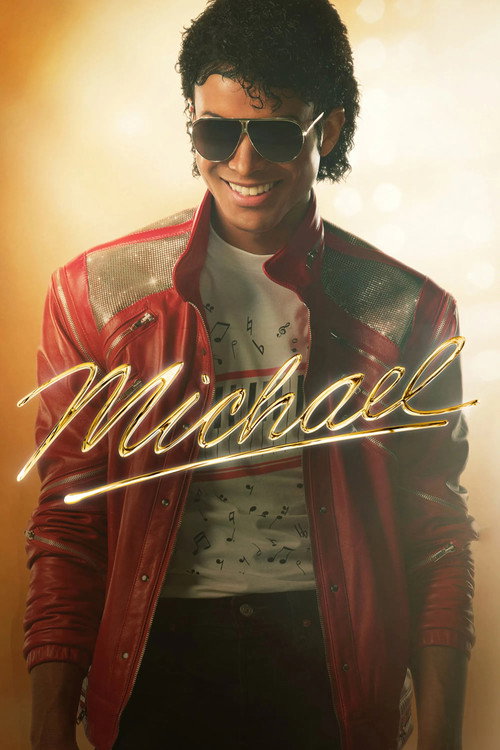
Michael (2026)
Directed by Antoine Fuqua
Partly — Michael is somewhat woke, scoring 49 out of 100 on our wokeness meter.
Antoine Fuqua's Michael arrives as a $200 million act of estate management, a three-and-a-half-hour ascent narrative that stops precisely where the difficult questions begin.
Consciousness Markers
The film was explicitly rewritten to remove all references to the 1993 child sexual abuse allegations, ending before they arose and presenting a sanitized, heroic narrative of a real person's life.
The film explicitly dramatizes racial barriers in the music industry, including the campaign to force MTV to play videos by Black artists and the hiring of Crips and Bloods gang members for the 'Beat It' video.
The film features a predominantly Black ensemble cast, including Jaafar Jackson as Michael and Colman Domingo, Nia Long, and Larenz Tate in supporting roles, though this representation is organic to the subject matter rather than a deliberate diversity initiative.
The film carries some mild messaging about breaking racial barriers in the music industry, but it is primarily a celebratory jukebox biopic rather than a preachy sermon.
Women such as Katherine Jackson, Suzanne de Passe, and La Toya appear in the story, but the film is squarely a male-centered biopic with no feminist framing or commentary.
The film gestures at industry exploitation and Joseph Jackson's controlling greed, but it remains a celebratory, estate-approved product that largely glorifies commercial success rather than critiquing it.
Jackson's insecurities about his appearance, vitiligo, and rhinoplasty are depicted, but as personal tragedy rather than any body-positive advocacy or message.
The film contains no LGBTQ+ themes or characters; Jackson's ambiguous sexuality is not explored in this sanitized rise-to-fame narrative.
There is no environmental or climate-related content anywhere in the film.
No neurodivergent characters or themes are present in the film.
Why it received this score
Antoine Fuqua's Michael arrives as a $200 million act of estate management, a three-and-a-half-hour ascent narrative that stops precisely where the difficult questions begin. The third act was rewritten after a legal clause surfaced, and the finished film ends with the Bad World Tour, before the 1993 allegations existed in its timeline. This is not an oversight. It is architecture. The picture was built to be a monument, and monuments do not include their own cracks.
What the film does engage, it engages with some conviction. The campaign to force MTV to air videos by Black artists gets a full dramatic scene, and the hiring of Crips and Bloods for the Beat It video is played as a small act of civic imagination. The cast is predominantly Black and largely excellent, though that representation flows from the subject rather than from any casting mandate. Colman Domingo's Joseph is a controlling, grasping presence, and the film permits itself a few sour notes about industry exploitation before returning to the celebration.
Elsewhere the ledger is thin. There is no climate content, no neurodivergent character, no queer reading of a man whose sexuality has been debated for four decades. Jackson's distress over his nose and his vitiligo is rendered as private tragedy, never as anything resembling a body-positive argument. Women appear as mothers, sisters, and Motown assistants, and the camera keeps its attention on the men. The messaging about breaking racial barriers is present but gentle, a hand on the shoulder instead of a sermon. The result is a handsome, well-sung piece of authorized mythology that flatters its subject and its audience in equal measure.
Analysis generated by our Consciousness Algorithm
Part of


Synopsis
The story of Michael Jackson, one of the most influential artists the world has ever known, and his life beyond the music. His journey from the discovery of his extraordinary talent as the lead of the Jackson Five, to the visionary artist whose creative ambition fueled a relentless pursuit to become the biggest entertainer in the world, highlighting both his life off-stage and some of the most iconic performances from his early solo career.
Questions about Michael
Is Michael woke?
Partly — Michael is somewhat woke, scoring 49 out of 100 on our wokeness meter. That earns it a verdict of Woke-Adjacent.
What makes Michael woke?
3 of the 10 markers register at 30 or above, led by Revisionist History (75), Racial Consciousness (60) and Representation Casting (55). On Revisionist History: The film was explicitly rewritten to remove all references to the 1993 child sexual abuse allegations, ending before they arose and presenting a sanitized, heroic narrative of a real person's life.
How does Michael compare to other 2026 movies?
It ranks #129 of the 800 films from 2026 we've scored; their average is 23. The wokest is Between Us (89).
How is the Woke Score calculated?
An AI-assisted process researches the film and its reception, scores it 0–100 on ten markers, then combines those into one 0–100 Woke Score. It measures a specific set of 2020s cultural themes, not film quality.