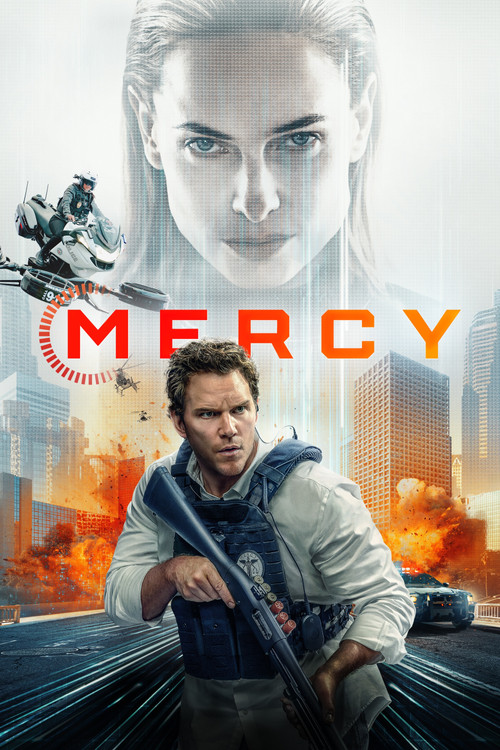
Mercy (2026)
Directed by Timur Bekmambetov
No — Mercy is not woke, scoring 13 out of 100 on our wokeness meter.
Mercy arrives with a premise that has been sitting in the Hollywood warehouse since Minority Report, dusted off and fitted with a timer.
Consciousness Markers
The cast includes Kali Reis, Jeff Pierre, and Kenneth Choi in supporting roles, but the film does not foreground a representational thesis or comment on its diversity.
Rebecca Ferguson's AI judge and Kali Reis's police partner occupy authority and action roles, but the film does not frame this as a feminist argument.
The premise gestures at AI dependency, privacy, and state control, but reviews note it does not seriously interrogate these ideas, leaving little didactic lecture energy.
No LGBTQ+ characters, relationships, or themes appear in the plot or cast.
The criminal-justice and AI-court plot is not racialized; no racial consciousness or commentary is present.
No climate or environmental themes are present.
The dystopia is state and technological rather than capitalist; no eat-the-rich or anti-capitalist critique appears.
No body-positivity themes or commentary.
No neurodivergence themes; the protagonist's alcoholism is not framed as neurodivergence.
No historical revisionism; the film is an original near-future thriller.
Why it received this score
Mercy arrives with a premise that has been sitting in the Hollywood warehouse since Minority Report, dusted off and fitted with a timer. In 2029 Los Angeles, an AI judge named Maddox presides over a court that executes defendants by sonic blast if they cannot lower their guilt probability inside ninety minutes. Chris Pratt plays the detective strapped to the chair, accused of killing his wife, and Timur Bekmambetov films the ordeal in his favored screenlife grammar, all doorbell cameras and body cams and drones. The machinery hums. The tension does not.
For all the dystopian furniture, the film has little interest in arguing with it. The cast includes Kali Reis as the detective's partner and Kenneth Choi and Jeff Pierre in supporting turns, but the movie never organizes itself around representation as a thesis. Ferguson's AI judge occupies real authority, and Reis gets to command a SWAT response, though the script treats this as staffing, not statement. The criminal justice machinery is never racialized, and the surveillance state here is bureaucratic and technological, not corporate, so there is no appetite for an eat-the-rich sermon. No climate anxiety, no body politics, no neurodivergent framing of the hero's alcoholism. His drinking is just drinking.
What remains is a film that gestures at AI dependency, privacy invasion, and state control without ever pressing the argument. Critics noticed. The result is a near-future thriller that wants credit for the questions it raises and none of the work of answering them. It is a police-state dystopia presented as an agreeable norm, which is either a failure of nerve or an accidental confession. Either way, the lecture never arrives. The chair does.
Analysis generated by our Consciousness Algorithm


Synopsis
In the near future, a detective stands on trial accused of murdering his wife. He has ninety minutes to prove his innocence to the advanced AI Judge he once championed, before it determines his fate.
Questions about Mercy
Is Mercy woke?
No — Mercy is not woke, scoring 13 out of 100 on our wokeness meter. That earns it a verdict of Ultra Based.
Does Mercy have any woke elements?
1 of the 10 markers register at 30 or above, led by Representation Casting (30). On Representation Casting: The cast includes Kali Reis, Jeff Pierre, and Kenneth Choi in supporting roles, but the film does not foreground a representational thesis or comment on its diversity.
How does Mercy compare to other 2026 movies?
It ranks #428 of the 800 films from 2026 we've scored; their average is 23. The wokest is Between Us (89).
How is the Woke Score calculated?
An AI-assisted process researches the film and its reception, scores it 0–100 on ten markers, then combines those into one 0–100 Woke Score. It measures a specific set of 2020s cultural themes, not film quality.