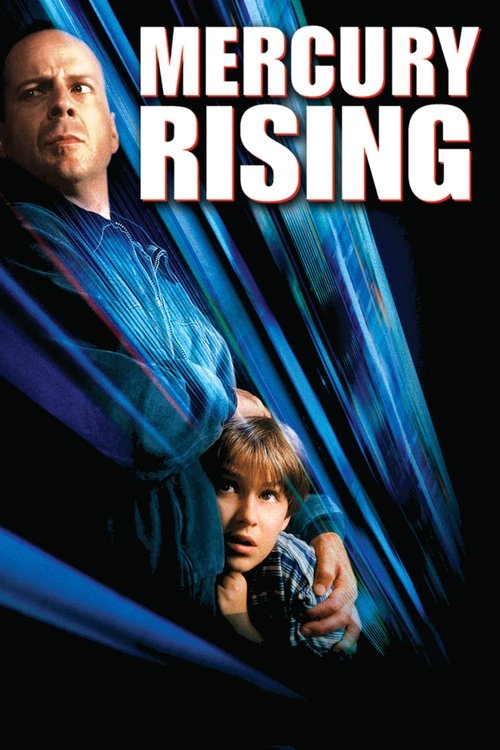
Mercury Rising (1998)
Directed by Harold Becker
No — Mercury Rising is not woke, scoring 15 out of 100 on our wokeness meter.
Mercury Rising arrives from 1998, a year when a studio thriller could still be assembled from a maverick agent, a shadowy government conspiracy, and a child in peril without anyone consulting a spreadsheet of demographic targets.
Consciousness Markers
The entire plot hinges on a nine-year-old autistic savant, and the film spends real time explaining his condition and having the hero learn to earn his trust — though it leans on the dated 'magical savant' trope rather than modern neurodivergence advocacy.
The cast is overwhelmingly white, with Chi McBride as the loyal agent sidekick and Kim Dickens as the female helper representing the only notable non-default presences; diversity is incidental rather than a stated aim.
There are brief didactic beats where a nurse explains autism to the audience, but the film is a formulaic action thriller rather than a sermon.
Kim Dickens' Stacey is a competent, sympathetic helper, but she exists to assist the male lead and the film has no feminist framework whatsoever.
No LGBTQ+ characters, themes, or subtext appear anywhere in the film.
Race is never addressed or thematized; the government conspiracy is entirely race-blind in its telling.
No environmental or climate content of any kind.
The villainy here is state overreach and NSA secrecy, not corporate greed or class critique; the film has no economic axe to grind.
No body-diversity or body-acceptance themes are present.
A fictional thriller with no historical claims to revise.
Why it received this score
Mercury Rising arrives from 1998, a year when a studio thriller could still be assembled from a maverick agent, a shadowy government conspiracy, and a child in peril without anyone consulting a spreadsheet of demographic targets. Bruce Willis plays Art Jeffries, an FBI man demoted to desk duty, who stumbles onto a scheme in which the National Security Agency has dispatched assassins to silence a nine-year-old boy. The boy solved a puzzle in a magazine and dialed a number that cracked the agency's unbreakable cipher. This is a plot, not a thesis. The film wants to be a chase, and mostly it is one.
The production does devote real screen time to Simon's autism. A hospital nurse sits Art down and explains the condition in language calibrated for a general audience, which is the closest the picture comes to a public service announcement. Simon is a savant of the dated variety, gifted at cryptanalysis and otherwise treated as a locked door the hero must learn to open with patience. Miko Hughes plays him with a stillness that survives the script's worst impulses. The film never argues for accommodation or inclusion. It needs a child whose mind works differently, and it takes a moment to say so plainly.
The antagonists are bureaucrats, not board members. There is no corporation to indict, no class grievance to air, no environmental subtext, and no interest in the racial or gendered dimensions of its own cast. Chi McBride and Kim Dickens appear as loyal helpers, competent and underused, present because the formula requires a friendly agent and a woman to mind the boy. The result is a joyless, competent thriller with a faint humanitarian streak and a Razzie for its star. The cultural weather here is 1998, and the forecast was cloudy.
Analysis generated by our Consciousness Algorithm
Part of


Synopsis
Renegade FBI agent Art Jeffries protects a nine-year-old autistic boy who has cracked the government's new "unbreakable" code.
Questions about Mercury Rising
Is Mercury Rising woke?
No — Mercury Rising is not woke, scoring 15 out of 100 on our wokeness meter. That earns it a verdict of Ultra Based.
Does Mercury Rising have any woke elements?
1 of the 10 markers register at 30 or above, led by Neurodivergence (45). On Neurodivergence: The entire plot hinges on a nine-year-old autistic savant, and the film spends real time explaining his condition and having the hero learn to earn his trust — though it leans on the dated 'magical savant' trope rather than modern neurodivergence advocacy.
How does Mercury Rising compare to other 1998 movies?
It ranks #31 of the 118 films from 1998 we've scored; their average is 12. The wokest is Show Me Love (60).
How is the Woke Score calculated?
An AI-assisted process researches the film and its reception, scores it 0–100 on ten markers, then combines those into one 0–100 Woke Score. It measures a specific set of 2020s cultural themes, not film quality.