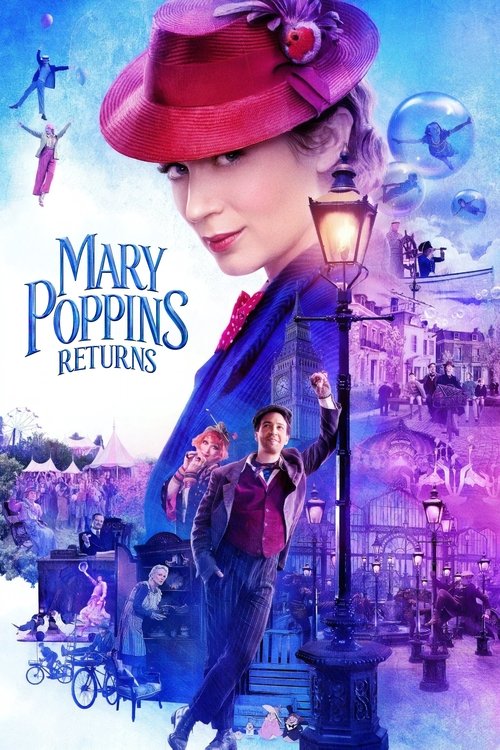
Mary Poppins Returns (2018)
Directed by Rob Marshall
No — Mary Poppins Returns is not especially woke, scoring 21 out of 100 on our wokeness meter.
Mary Poppins Returns arrives as a belated sequel, set in a Depression-era London where the Banks children have become adults with debts and grief.
Consciousness Markers
A period London musical that nonetheless casts Lin-Manuel Miranda as the co-lead lamplighter Jack, alongside Black performers Noma Dumezweni, Kobna Holdbrook-Smith, and Tarik Frimpong in supporting roles, giving the 1930s setting a noticeably multiethnic ensemble.
The villain is a corrupt bank chairman who forecloses on the family and destroys records, echoing the original's suspicion of bankers, though the critique targets individual greed rather than capitalism as a system.
Mary Poppins remains a commanding female lead and Jane Banks is reimagined as a union organizer, but the film's gender politics are largely inherited from the 1964 original rather than newly asserted.
The diverse casting is present but entirely unremarked upon; race is never a theme, subject, or point of commentary in the narrative.
The film is a gentle musical entertainment with a mild moral about family and not losing wonder; it preaches nothing and delivers no social sermon.
No LGBTQ+ characters, relationships, or subtext appear anywhere in the film.
No environmental or climate themes are present.
No body-positivity themes or messaging are present.
No neurodivergent characters or themes are depicted.
The Depression-era London setting is a nostalgic backdrop, not a revisionist reframing of history.
Why it received this score
Mary Poppins Returns arrives as a belated sequel, set in a Depression-era London where the Banks children have become adults with debts and grief. The film casts Lin-Manuel Miranda as Jack, the lamplighter, and places Black performers such as Noma Dumezweni, Kobna Holdbrook-Smith, and Tarik Frimpong in supporting roles. For a 1930s London musical, the ensemble is noticeably multiethnic. The film never remarks on this. Race is a visual fact, not a subject. That is the whole of its racial consciousness: a quiet, unremarked diversification that asks for no applause.
Mary remains a commanding female lead, and Jane Banks has been reimagined as a union organizer. Yet the gender politics feel inherited from 1964, not newly asserted. The villain is a corrupt bank chairman who forecloses on the family and destroys records. The film distrusts bankers, as its predecessor did, but the critique lands on individual greed. Capitalism as a system escapes the blade. There is no climate crusade, no body positivity, no neurodivergence, and no LGBTQ content. The film has no interest in those conversations. It is too busy with kites and balloons.
The movie is a gentle musical entertainment with a mild moral about family, grief, and not losing wonder. It lectures no one. It delivers no social sermon. The Depression-era setting is a nostalgic backdrop, not a revisionist reframing of history. The film offers charm, craftsmanship, and a light dusting of progressive casting. The cultural awareness is incidental. It never organizes itself into an argument. The result is a soufflé of a film: it rises, it falls, and it leaves no ideological residue. That is not a criticism. It is a classification.
Analysis generated by our Consciousness Algorithm
Part of


Synopsis
Mary Poppins returns to the Banks family and helps them evade grave dangers by taking them on magical, musical adventures.
Questions about Mary Poppins Returns
Is Mary Poppins Returns woke?
No — Mary Poppins Returns is not especially woke, scoring 21 out of 100 on our wokeness meter. That earns it a verdict of Based.
Does Mary Poppins Returns have any woke elements?
2 of the 10 markers register at 30 or above, led by Representation Casting (45) and Eat the Rich (30). On Representation Casting: A period London musical that nonetheless casts Lin-Manuel Miranda as the co-lead lamplighter Jack, alongside Black performers Noma Dumezweni, Kobna Holdbrook-Smith, and Tarik Frimpong in supporting roles, giving the 1930s setting a noticeably multiethnic ensemble.
How does Mary Poppins Returns compare to other 2018 movies?
It ranks #100 of the 325 films from 2018 we've scored; their average is 20. The wokest is Return (92).
How is the Woke Score calculated?
An AI-assisted process researches the film and its reception, scores it 0–100 on ten markers, then combines those into one 0–100 Woke Score. It measures a specific set of 2020s cultural themes, not film quality.