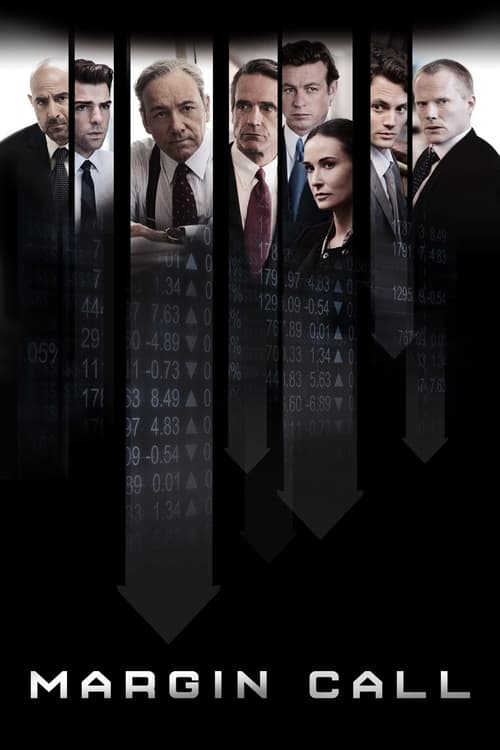
Margin Call (2011)
Directed by J.C. Chandor
No — Margin Call is not especially woke, scoring 21 out of 100 on our wokeness meter.
J.C. Chandor's debut assembles a boardroom of white men in expensive suits and lets them talk through one long night.
Consciousness Markers
The film is a sustained moral indictment of Wall Street: the fire sale of toxic assets, the scapegoating of subordinates, and Tuld's Darwinian speech about survival and recurring crises all critique the amorality of capital.
The script repeatedly has characters explain financial concepts 'in plain English' and closes on Tuld's philosophizing monologue, giving it a mild cautionary-tale didacticism, though it stays restrained and character-driven.
Demi Moore's Sarah Robertson is scapegoated by the male leadership despite having warned them, a faint gender-dynamic note, but the film never frames this as a feminist argument.
The ensemble is almost entirely white and male, with Demi Moore, Mary McDonnell, and Ashley Williams the only notable women; no meaningful racial diversity and no commentary on it.
No LGBTQ+ characters, themes, or subtext of any kind appear in the film.
Race is entirely absent as a subject; the cast and story contain no engagement with racial themes.
No environmental or climate content whatsoever; the crisis depicted is purely financial.
No body-image or body-positivity themes are present.
No neurodivergent characters or themes are depicted.
Though inspired by the 2008 crisis, the film invents a fictional unnamed firm and does not reframe or revise historical record in an ideological manner.
Why it received this score
J.C. Chandor's debut assembles a boardroom of white men in expensive suits and lets them talk through one long night. Demi Moore, Mary McDonnell, and Ashley Williams supply the entire female presence, and Moore's risk officer is duly selected for public sacrifice once the men need a name to hang on the disaster. The film notices this injustice without ever arguing it. Race does not surface as a subject at all, and the ledger of contemporary social concerns stays otherwise blank: no queer lives, no environmental anxiety, no body politics, no neurodivergent interiority. This is a film about money, and it keeps its gaze there.
Where it does carry moral weight is in its treatment of capital. The fire sale of worthless assets, the cheerful willingness to poison the market before the competitors can, Jeremy Irons delivering a Darwinian sermon about survival and the eternal return of crisis: the film builds a case that the system rewards amorality and calls it prudence. No solution is offered, no placard raised. It simply watches men choose their bonuses over the common good and lets the audience draw the conclusion.
The script does stop periodically to explain itself, a mild strain of sermonizing. Characters request plain-English summaries of instruments nobody in the room understands, and the closing monologue drifts toward philosophy. Still, the film prefers character to thesis, and it resists the urge to instruct us how to feel. The result is a cautionary tale delivered in a whisper. We are left with a firm that survives, a man burying his dog in his ex-wife's yard, and the quiet sense that nothing will be fixed.
Analysis generated by our Consciousness Algorithm


Synopsis
Set in the high-stakes world of the financial industry, involving the key players at an investment firm during one perilous 24-hour period in the early stages of the 2008 financial crisis. An entry-level analyst unlocks information that could prove to be the downfall of the firm.
Questions about Margin Call
Is Margin Call woke?
No — Margin Call is not especially woke, scoring 21 out of 100 on our wokeness meter. That earns it a verdict of Based.
Does Margin Call have any woke elements?
1 of the 10 markers register at 30 or above, led by Eat the Rich (55). On Eat the Rich: The film is a sustained moral indictment of Wall Street: the fire sale of toxic assets, the scapegoating of subordinates, and Tuld's Darwinian speech about survival and recurring crises all critique the amorality of capital.
How does Margin Call compare to other 2011 movies?
It ranks #28 of the 245 films from 2011 we've scored; their average is 11. The wokest is Paul (68).
How is the Woke Score calculated?
An AI-assisted process researches the film and its reception, scores it 0–100 on ten markers, then combines those into one 0–100 Woke Score. It measures a specific set of 2020s cultural themes, not film quality.