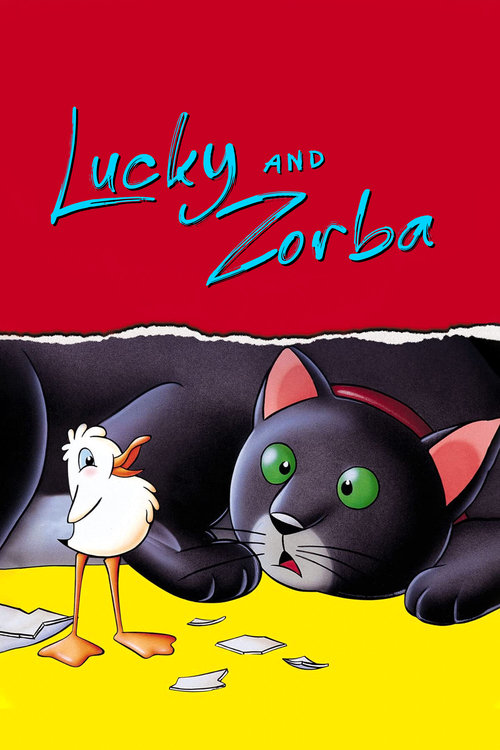
Lucky and Zorba (1998)
Directed by Enzo D'Alò
No — Lucky and Zorba is not especially woke, scoring 25 out of 100 on our wokeness meter.
Lucky and Zorba arrives from 1998, which is to say from a time when a children's film could kill its mother seagull in the first act and trust the audience to sit with it.
Consciousness Markers
A sinking oil tanker and its toxic spill drive the entire plot, killing the mother seagull and motivating the story; it is genuine environmental consciousness, though framed as pollution tragedy rather than a climate-change sermon.
The film carries gentle moral lessons about keeping promises, tolerance, and environmental care, but delivers them through story rather than preachy exposition.
The voice cast is entirely Italian performers with no emphasis on diverse or representative casting; characters are animals voiced without any identity-conscious framing.
No LGBTQ+ characters, themes, or subtext appear anywhere in this cross-species fable.
Female characters (Kengah, Bubulina, Nina) exist naturally in the story but the film advances no feminist thesis or gendered critique.
The cat-versus-rat conflict is a straightforward adventure plot device, not an allegory for racial or social justice.
The oil spill is treated as an environmental hazard, not as a critique of capitalism or corporate greed.
No body-image or body-acceptance themes are present.
No neurodivergent characters or themes appear.
The film is a fictional fable with no historical subject matter to revise.
Why it received this score
Lucky and Zorba arrives from 1998, which is to say from a time when a children's film could kill its mother seagull in the first act and trust the audience to sit with it. The plot is set in motion by a sinking oil tanker, and the black tide that follows does the work of a villain without ever being named as one. There is genuine environmental feeling here, a quiet horror at what we do to the water, though the film treats the spill as a tragedy rather than a policy failure. Nobody stands outside a refinery with a sign. The oil simply kills, and a cat inherits the consequences.
The cats of Hamburg (Italian cats, voiced by Italian performers, with no identity-conscious casting to speak of) keep their promises, bury the dead, and consult an encyclopedia to learn how to incubate an egg. The rats are rats, conniving and hungry, and their war with the felines is a war, not a metaphor for anything larger. The story offers moral instruction about loyalty and tolerance, but it earns these lessons through plot, through a cheese wheel used as a Trojan horse, through a kitten's jealousy and apology. It never stops to lecture. That restraint is the film's chief virtue and its chief limitation as a specimen of modern cultural consciousness.
There is a girl named Nina who helps at the end, and a female cat named Bubulina, and neither is asked to carry a thesis. The film has no interest in gendered critique, in racial allegory, in body acceptance, or in the interior lives of the neurodivergent. It is a fable about a bird who thinks she is a cat, and eventually learns she was a bird all along, and flies. We are left with the environmental melancholy and a mild, well-behaved moralism, delivered gently. A sommelier would call this vintage clean, unpretentious, and faintly dull. It pairs well with childhood.
Analysis generated by our Consciousness Algorithm
Synopsis
A seagull is caught by the black tide of a sinking petrol ship. She manages to fly inland and falls down in a garden by a cat. Moribund, she asks the cat to fulfill three promises: that when she lays her egg he must not eat it; that he must take care of it until it hatches; that he would teach the newborn how to fly.
Questions about Lucky and Zorba
Is Lucky and Zorba woke?
No — Lucky and Zorba is not especially woke, scoring 25 out of 100 on our wokeness meter. That earns it a verdict of Based.
Does Lucky and Zorba have any woke elements?
1 of the 10 markers register at 30 or above, led by Climate Crusade (35). On Climate Crusade: A sinking oil tanker and its toxic spill drive the entire plot, killing the mother seagull and motivating the story; it is genuine environmental consciousness, though framed as pollution tragedy rather than a climate-change sermon.
How does Lucky and Zorba compare to other 1998 movies?
It ranks #12 of the 118 films from 1998 we've scored; their average is 12. The wokest is Show Me Love (60).
How is the Woke Score calculated?
An AI-assisted process researches the film and its reception, scores it 0–100 on ten markers, then combines those into one 0–100 Woke Score. It measures a specific set of 2020s cultural themes, not film quality.