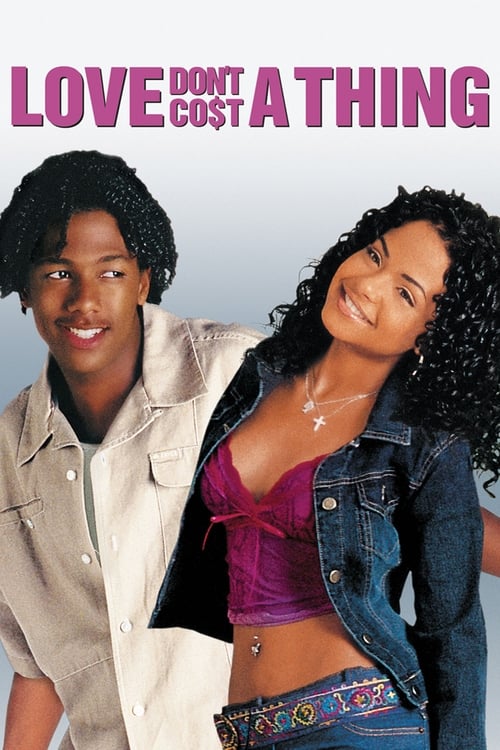
Love Don't Co$t a Thing (2003)
Directed by Troy Byer
No — Love Don't Co$t a Thing is not woke, scoring 14 out of 100 on our wokeness meter.
Released in 2003, "Love Don't Co$t a Thing" is a remake of 1987's "Can't Buy Me Love," directed by Troy Byer and built around Nick Cannon as Alvin Johnson, a pool-cleaning engine savant who drains his scholarship fund to repair a cheerleader's mother's Escalade and then accepts a two-week fake courtship as repayment.
Consciousness Markers
The film features a predominantly Black cast in a remake of a film with white leads, which could be seen as race-swapped casting, but it is a natural part of the film's setting rather than a modern diversity statement.
The film delivers a mild moral about authenticity and friendship, but it is not preachy or lecture-driven.
Directed by a woman, but the plot follows a male protagonist's journey and does not advance feminist themes.
The film mildly critiques materialism and the purchase of social status, but lacks any systemic anti-capitalist message.
No LGBTQ+ themes or characters are present.
The film does not explore racial issues or consciousness despite its Black cast.
No environmental or climate-related themes.
No body positivity themes.
The protagonist is a nerd but not depicted as neurodivergent.
No historical revisionism.
Why it received this score
Released in 2003, "Love Don't Co$t a Thing" is a remake of 1987's "Can't Buy Me Love," directed by Troy Byer and built around Nick Cannon as Alvin Johnson, a pool-cleaning engine savant who drains his scholarship fund to repair a cheerleader's mother's Escalade and then accepts a two-week fake courtship as repayment. The cast is predominantly Black, and the film reassigns roles originated by white performers without a syllable of comment. In 2003 that reads as ordinary commercial casting, a Long Beach high school that happens to look like Long Beach. The picture takes no credit for it and asks for none.
The film's stated concern is the price of popularity. Alvin buys a fifteen-hundred-dollar makeover, abandons his friends, flirts with Paris's vapid circle, and learns, via a rebuilt engine and a forgiving father, that authenticity outranks status. This is a critique of personal shallowness, not of the machinery that manufactures it. Nobody mentions the economy. The moral arrives gently, usually through Steve Harvey's avuncular Clarence, and it never hardens into a sermon. Light guidance, not instruction.
Byer is a woman in the director's chair, which counts for something in a genre that rarely offered the seat, but the camera belongs to Alvin from first frame to last. Paris is a prize with a secret love of music. There is no queer presence, no climate anxiety, no body politics, and Alvin's nerdiness is a social station, not a diagnosis. What remains is a dated, amiable teen comedy that predates the vocabulary it would now be asked to speak, and seems quietly relieved to have missed it.
Analysis generated by our Consciousness Algorithm


Synopsis
A high school outcast pays a cheerleader to pose as his girlfriend so he can be considered cool.
Questions about Love Don't Co$t a Thing
Is Love Don't Co$t a Thing woke?
No — Love Don't Co$t a Thing is not woke, scoring 14 out of 100 on our wokeness meter. That earns it a verdict of Ultra Based.
Does Love Don't Co$t a Thing have any woke elements?
Very few. None of the 10 markers reaches 30, the level where a marker counts as present; the highest is Representation Casting at 25.
How does Love Don't Co$t a Thing compare to other 2003 movies?
It ranks #46 of the 150 films from 2003 we've scored; their average is 12. The wokest is Mona Lisa Smile (60).
How is the Woke Score calculated?
An AI-assisted process researches the film and its reception, scores it 0–100 on ten markers, then combines those into one 0–100 Woke Score. It measures a specific set of 2020s cultural themes, not film quality.