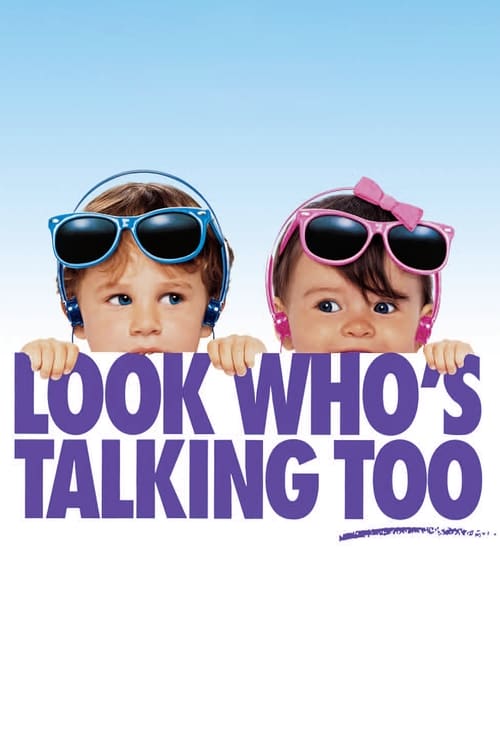
Look Who's Talking Too (1990)
Directed by Amy Heckerling
No — Look Who's Talking Too is not woke, scoring 0 out of 100 on our wokeness meter.
Look Who's Talking Too arrives in 1990 as the second installment of a franchise that had, one year earlier, discovered that babies with adult voices could turn a profit.
Consciousness Markers
The cast is typical for a 1990 mainstream comedy; minority actors appear in supporting voice roles without any deliberate diversity or representation commentary.
No LGBTQ+ characters, themes, or subtext are present.
Despite a female director, the film's plot reinforces traditional family and gender roles without any feminist agenda.
Race is not a theme; characters are not defined or discussed in terms of racial identity or systemic issues.
No environmental or climate-related themes appear.
The film is a commercial sequel with no critique of capitalism or wealth inequality.
No body-positive messaging or challenges to beauty standards are present.
No neurodivergent characters or themes are depicted.
The film is a contemporary family comedy with no historical revisionism.
The film does not lecture or preach on social issues; it is a broad comedy.
Why it received this score
Look Who's Talking Too arrives in 1990 as the second installment of a franchise that had, one year earlier, discovered that babies with adult voices could turn a profit. Amy Heckerling directs, and she co-wrote the script with Neal Israel. The result is eighty-one minutes of potty training, sibling resentment, and a talking toilet voiced by Mel Brooks. The critics of the day were unkind. Gene Siskel mourned the loss of the original's romance. Others reached for words like witless and vulgar. The film grossed $120.9 million worldwide anyway, which tells us something about the audience, and perhaps about the species.
The picture concerns Mikey, a toddler voiced by Bruce Willis, adjusting to a new sister named Julie, voiced by Roseanne Barr. There is a potty, a gun-toting uncle, a robber, a kitchen fire, and a closing family barbecue. The narrative resolves when everyone agrees that grown-ups make no sense. It is a broad comedy of the sort that has no interest in instructing anyone about anything. No character undergoes a reckoning with systemic injustice. Nobody discusses identity, power, or the environment. The film's entire moral universe can be summarized as: do not touch the hot stuff.
Two Golden Raspberry nominations followed, for Gilbert Gottfried and Roseanne Barr, which feels about right. We are left with a document of its moment, a commercial sequel assembled with evident haste and no discernible sermon. Heckerling would go on to sharper work. Here she presides over a product that wants only to be liked, and largely fails at that. The classification is straightforward. This is a film without a message, which is its own kind of distinction in any era, and certainly in this one.
Analysis generated by our Consciousness Algorithm


Synopsis
Mollie and James are together and raising a family, which now consists of an older Mikey and his baby sister, Julie. Tension between the siblings arises, and as well with Mollie and James when Mollie's brother Stuart moves in. Mikey is also learning how to use the toilet for the first time.
Questions about Look Who's Talking Too
Is Look Who's Talking Too woke?
No — Look Who's Talking Too is not woke, scoring 0 out of 100 on our wokeness meter. That earns it a verdict of Ultra Based.
Does Look Who's Talking Too have any woke elements?
No. All 10 markers score zero.
How does Look Who's Talking Too compare to other 1990 movies?
It ranks #54 of the 68 films from 1990 we've scored; their average is 9. The wokest is Nightbreed (60).
Is Look Who's Talking Too the most woke Look Who's Talking movie?
No. It ranks #3 of the 3 Look Who's Talking films we've scored; the wokest is Look Who's Talking (15).