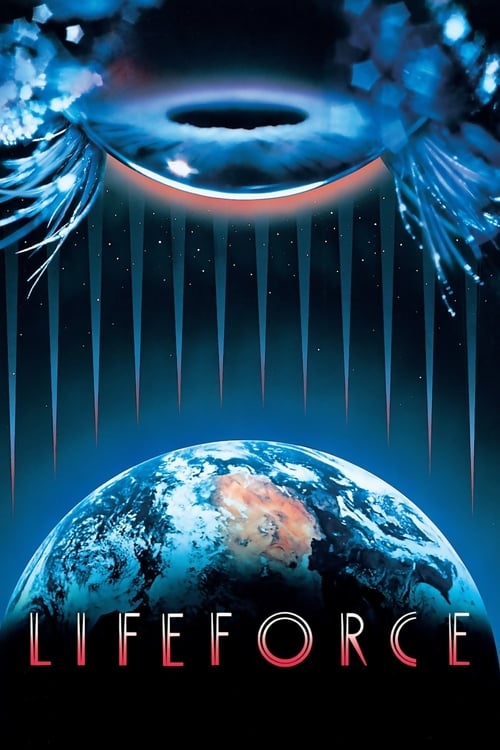
Lifeforce (1985)
Directed by Tobe Hooper
No — Lifeforce is not woke, scoring 0 out of 100 on our wokeness meter.
Tobe Hooper took twenty-five million dollars from Cannon Films and made a 70mm Hammer picture about naked space vampires parked inside Halley's Comet.
Consciousness Markers
The cast is almost entirely white British and American actors, with no meaningful racial or ethnic diversity; the central female alien is presented as a nude spectacle rather than representation.
No LGBTQ+ characters, relationships, or themes appear in the film.
The female space vampire is a powerful antagonist, but the film treats her primarily as an object of extended nudity and exploitation rather than advancing a feminist perspective.
The film does not engage with race, racism, or racial identity in any substantive way.
Halley's Comet and an apocalyptic London feature in the plot, but the film has no environmental or climate-advocacy message.
There is no critique of capitalism, wealth inequality, or corporate power; the threat is extraterrestrial, not economic.
The film's extensive nudity and the production's efforts to minimize the actress's body hair reflect exploitation rather than body-positive themes.
No neurodivergent characters or themes are present.
The film reinterprets vampire legends as alien visitations tied to Halley's Comet, but this is fictional mythology, not a revisionist historical narrative.
The film is a horror-action spectacle and does not pause to deliver social or political lectures.
Why it received this score
Tobe Hooper took twenty-five million dollars from Cannon Films and made a 70mm Hammer picture about naked space vampires parked inside Halley's Comet. The plot concerns a joint British and American shuttle crew, a glass case full of humanoid bodies, and the subsequent draining of London's life force through St Paul's Cathedral. It is an odd, humid, frequently incoherent object, and the studio eventually trimmed it down and retitled it because The Space Vampires sounded too much like the exploitation product it plainly was.
The film's cultural inventory is easy to audit and comes up empty. Its cast is a wall of white British and American faces. The female vampire, played by an eighteen-year-old Mathilda May, functions as an extended nude set piece; the makeup department was instructed to remove her body hair so the character would read as less naked, which is a sentence about labor and exploitation, not empowerment. There is no engagement with race, no queer subtext, no economic grievance, no environmental sermon. The apocalypse arrives by comet and by alien appetite. Nobody delivers a speech about the way we live now. The screenplay has no interest in instructing anyone.
Craft and strangeness remain. The umbrella ship, the model London reduced to rubble, the column of cigar smoke and retroreflective tape standing in for ascending energy: these are the work of people building a haunted house, not a civics lesson. Colin Wilson disliked the result and quipped that at least there was plenty of full-frontal nudity. He was correct on both counts. Hooper admitted the picture lacked a screenplay. It also lacked a thesis, a platform, and a message, which in 1985 was simply how a genre film behaved. The classification is unambiguous: a zero, earned honestly, with no agenda to speak of and no interest in acquiring one.
Analysis generated by our Consciousness Algorithm


Synopsis
A race of space vampires arrives in London and infects the populace, commencing an apocalyptic descent into chaos.
Questions about Lifeforce
Is Lifeforce woke?
No — Lifeforce is not woke, scoring 0 out of 100 on our wokeness meter. That earns it a verdict of Ultra Based.
Does Lifeforce have any woke elements?
No. All 10 markers score zero.
How does Lifeforce compare to other 1985 movies?
It ranks #51 of the 68 films from 1985 we've scored; their average is 8. The wokest is The Color Purple (62).
How is the Woke Score calculated?
An AI-assisted process researches the film and its reception, scores it 0–100 on ten markers, then combines those into one 0–100 Woke Score. It measures a specific set of 2020s cultural themes, not film quality.