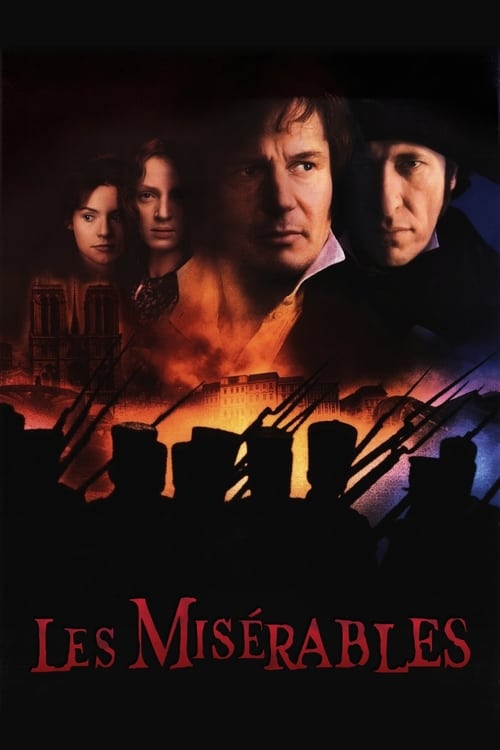
Les Misérables (1998)
Directed by Bille August
No — Les Misérables is not woke, scoring 13 out of 100 on our wokeness meter.
Bille August's 1998 adaptation of Victor Hugo's novel arrives with the full weight of the canon behind it and the good sense not to make a fuss about it.
Consciousness Markers
The story indicts economic injustice — Valjean imprisoned for stealing bread, Fantine fired and driven to prostitution for having a child out of wedlock, and the Thénardiers' greedy extortion — but these are 19th-century humanist social critiques, not modern 'eat the rich' rhetoric.
Fantine is a sympathetic single mother victimized by her employer and the Thénardiers, and this adaptation notably makes Cosette more independent, challenging Valjean's control; however these are faithful novel elements rather than a modern feminist agenda.
The film carries the moral weight of Hugo's novel — mercy versus justice, redemption — but delivers it through drama rather than modern preachiness or direct audience lecturing.
The principal cast (Liam Neeson, Geoffrey Rush, Uma Thurman, Claire Danes) is entirely white, and the film makes no effort toward diverse or color-conscious casting.
There are no LGBTQ+ characters, themes, or subtext anywhere in the narrative.
The film engages no racial themes or commentary; its social critique is entirely about class and poverty in 19th-century France.
No environmental or climate-related content whatsoever.
No body positivity themes are present.
No neurodivergent characters or themes are depicted.
This is a faithful period adaptation of a classic novel, not a revisionist reframing of historical events.
Why it received this score
Bille August's 1998 adaptation of Victor Hugo's novel arrives with the full weight of the canon behind it and the good sense not to make a fuss about it. Liam Neeson suffers handsomely as Jean Valjean, Geoffrey Rush glowers as Javert, and the whole affair proceeds with the grim tidiness of a heritage production that has wandered onto the Continent. The cast is uniformly white, which for a story set in 19th century France is neither a scandal nor an oversight, merely the default of the era's casting conventions. There is no romantic subtext to excavate, no identities to celebrate, no bodies to affirm. The film is interested in mercy, guilt, and bread, in roughly that order.
Where the material brushes against contemporary sensibilities, it does so by accident of inheritance. Fantine is fired for bearing a child out of wedlock and driven to prostitution by the Thénardiers' extortion, which plays as an indictment of economic cruelty, though Hugo wrote it in 1862 and meant it as one. The film's Cosette is noticeably more independent than the novel's, suggesting she leave the cloister and challenging Valjean's grip on her life. This is a small liberty, taken for narrative briskness, not doctrine. The Thénardiers take money for a child they treat as a servant, and we are meant to find this monstrous, which we do.
The moral architecture is sturdy and unmodern. Valjean lets Javert go, Javert cannot reconcile the law with the man, and the Seine settles the matter. Nobody turns to the camera to explain what we should feel. The film trusts the story to do its work, and largely it does. We leave with the quiet satisfaction of having consumed something respectable.
Analysis generated by our Consciousness Algorithm


Synopsis
In 19th century France, Jean Valjean, a man imprisoned for stealing bread, must flee a relentless policeman named Javert. The pursuit consumes both men's lives, and soon Valjean finds himself in the midst of the student revolutions in France.
Questions about Les Misérables
Is Les Misérables woke?
No — Les Misérables is not woke, scoring 13 out of 100 on our wokeness meter. That earns it a verdict of Ultra Based.
Does Les Misérables have any woke elements?
Very few. None of the 10 markers reaches 30, the level where a marker counts as present; the highest is Eat the Rich at 22.
How does Les Misérables compare to other 1998 movies?
It ranks #35 of the 118 films from 1998 we've scored; their average is 12. The wokest is Show Me Love (60).
How is the Woke Score calculated?
An AI-assisted process researches the film and its reception, scores it 0–100 on ten markers, then combines those into one 0–100 Woke Score. It measures a specific set of 2020s cultural themes, not film quality.