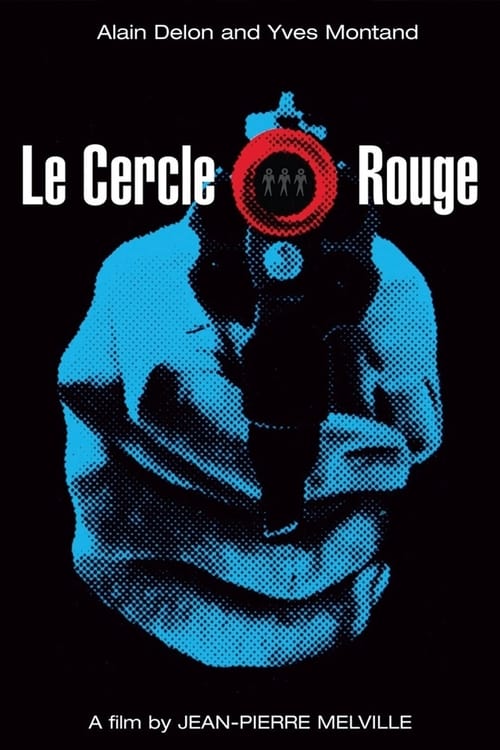
Le Cercle Rouge (1970)
Directed by Jean-Pierre Melville
No — Le Cercle Rouge is not woke, scoring 0 out of 100 on our wokeness meter.
Jean-Pierre Melville released Le Cercle Rouge in 1970, and it has spent the half century since declining to join any conversation we are currently having.
Consciousness Markers
The cast is uniformly white European, and the film makes no comment on or effort toward diverse representation.
No LGBTQ+ characters, themes, or subtext appear in the film.
Women appear only as peripheral figures (a girlfriend, a flower girl, a cigarette girl); the film is a masculine heist procedural with no feminist agenda.
The film engages no racial themes or commentary whatsoever.
No environmental or climate content is present.
The jewel heist is a genre exercise in criminal professionalism, not a critique of wealth or capitalism.
No body-positivity themes or messaging.
No neurodivergence themes; Jansen's alcoholism is a character flaw, not a neurodivergence narrative.
Not a historical film and offers no revisionist historical framing.
Melville's film is famously understated, with a half-hour near-silent heist; it preaches nothing.
Why it received this score
Jean-Pierre Melville released Le Cercle Rouge in 1970, and it has spent the half century since declining to join any conversation we are currently having. Three men converge on Paris: a freshly paroled thief, an escaped murderer, and an alcoholic ex-policeman who can shoot. Melville opens with an epigraph attributed to the Buddha, which he invented outright, because atmosphere was the only authority he recognized. The film concerns procedure, silence, and the inevitability of the red circle. It concerns nothing else.
The cast is uniformly white and the film's interests are uniformly masculine. Women appear in three capacities: a girlfriend left behind, a flower girl, a cigarette girl. None of them speaks at any length. Nobody on screen remarks on this arrangement, and Melville plainly found it unremarkable. The heist runs nearly thirty minutes with almost no dialogue, a stretch of filmmaking so committed to withholding that a viewer may check whether the sound has failed. Yves Montand's Jansen drinks because he is a drunk, not because the screenplay wishes to teach us something about affliction.
We are left with a clean sheet. No casting decision announces a correction. No subplot arrives to amend the record or explain how society ought to be arranged. The police commissioner is weary, the criminals are professionals, and the ending is a field of dead men and recovered jewels. This is a museum piece from an era when a crime film was permitted to be merely excellent. The classification is simple, and the tasting note is dry, austere, and free of any sermon.
Analysis generated by our Consciousness Algorithm


Synopsis
When French criminal Corey gets released from prison, he resolves to never return. He is quickly pulled back into the underworld, however, after a chance encounter with escaped murderer Vogel. Along with former policeman and current alcoholic Jansen, they plot an intricate jewel heist. All the while, quirky Police Commissioner Mattei, who was the one to lose custody of Vogel, is determined to find him.
Questions about Le Cercle Rouge
Is Le Cercle Rouge woke?
No — Le Cercle Rouge is not woke, scoring 0 out of 100 on our wokeness meter. That earns it a verdict of Ultra Based.
Does Le Cercle Rouge have any woke elements?
No. All 10 markers score zero.
How does Le Cercle Rouge compare to other 1970 movies?
It ranks #21 of the 23 films from 1970 we've scored; their average is 8. The wokest is Little Big Man (38).
How is the Woke Score calculated?
An AI-assisted process researches the film and its reception, scores it 0–100 on ten markers, then combines those into one 0–100 Woke Score. It measures a specific set of 2020s cultural themes, not film quality.