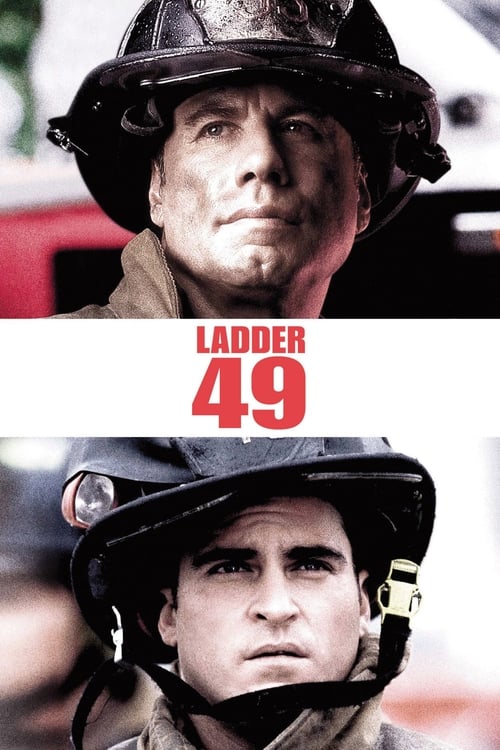
Ladder 49 (2004)
Directed by Jay Russell
No — Ladder 49 is not woke, scoring 6 out of 100 on our wokeness meter.
Ladder 49 arrives from 2004, a year when a studio could still release a firefighter picture without apology and without a thesis.
Consciousness Markers
The cast includes Morris Chestnut and Jay Hernandez in supporting firefighter roles, providing some demographic variety, but the film makes no comment on their presence and centers two white leads.
No LGBTQ+ characters, themes, or subtext of any kind appear in the film.
The wife is defined almost entirely by her anxiety over her husband's dangerous job and her role as the domestic anchor; the film reinforces traditional gender roles without critique.
Race is never addressed, examined, or made thematically relevant; the diverse firehouse is presented as unremarkable background.
No environmental or climate themes are present; fires are treated purely as occupational hazards.
The film has no economic critique; it is a straightforward tribute to public service and blue-collar heroism.
No body positivity themes or messaging appear.
No neurodivergent characters or themes are present.
The film is a fictional narrative and makes no historical revisionist claims.
The film's earnestness is aimed at valorizing firefighters as heroes, not at delivering any modern social-justice sermon.
Why it received this score
Ladder 49 arrives from 2004, a year when a studio could still release a firefighter picture without apology and without a thesis. Jay Russell's film follows Jack Morrison (Joaquin Phoenix) from probationary recruit to decorated veteran, cutting between his slow entrapment inside a Baltimore grain warehouse and the memories that carried him there. John Travolta plays the captain who mentored him and who must eventually order the men back down the stairs. The ambitions here are modest and the execution is sincere. The film wants us to admire these people. It does not want to argue with us about anything else.
The domestic passages carry the heaviest load and the most conventional assumptions. Jacinda Barrett's wife exists to worry, to wait by the phone, to talk her husband out of a desk job so he can keep running into buildings. Nothing in the film questions this arrangement or glances sideways at it. The firehouse itself is integrated, with Morris Chestnut and Jay Hernandez among the crew, and the film treats that fact as unremarkable municipal reality. No character explains it. No subplot interrogates it. No lesson is extracted. This is representation as furniture, present and unlit.
What remains is a tribute. The movie idolizes its subjects, as the critics complained at the time, and it does so in the plainest terms available: sacrifice, brotherhood, the flag-draped procession. No sermon about power arrives. No environmental lament. No revision of anything. The earnestness points at the fire service and stops there. Roger Ebert gave it three and a half stars for its attention to human detail, and the aggregate score sat nearer forty percent. Both verdicts are defensible. For our purposes, the film is a museum piece from a quieter cultural decade, and it should be filed accordingly, near the back, with the other relics that never learned to lecture.
Note: this review is accompanied by thematic tags: none apply (not an Oscar winner, not a sequel or remake, not based on true events, not adapted from a book, not a superhero property, and it opened at number two behind Shark Tale). The film is a 2004 Hollywood studio picture and is scored as such, with a low overall cultural-instruction index driven entirely by the absence of any modern markers. The only detectable signal is a mildly diverse supporting cast, which the film neither comments on nor develops, and which therefore registers as a faint blip and nothing more. Everything else sits at zero, where it belongs.
{"thematic_tags": []}
Analysis generated by our Consciousness Algorithm


Synopsis
Under the watchful eye of his mentor, Captain Mike Kennedy, probationary firefighter Jack Morrison matures into a seasoned veteran at a Baltimore fire station. However, Jack has reached a crossroads as the sacrifices he's made have put him in harm's way innumerable times and significantly impacted his relationship with his wife and kids.
Questions about Ladder 49
Is Ladder 49 woke?
No — Ladder 49 is not woke, scoring 6 out of 100 on our wokeness meter. That earns it a verdict of Ultra Based.
Does Ladder 49 have any woke elements?
Very few. None of the 10 markers reaches 30, the level where a marker counts as present; the highest is Representation Casting at 15.
How does Ladder 49 compare to other 2004 movies?
It ranks #104 of the 178 films from 2004 we've scored; their average is 12. The wokest is Tropical Malady (62).
How is the Woke Score calculated?
An AI-assisted process researches the film and its reception, scores it 0–100 on ten markers, then combines those into one 0–100 Woke Score. It measures a specific set of 2020s cultural themes, not film quality.