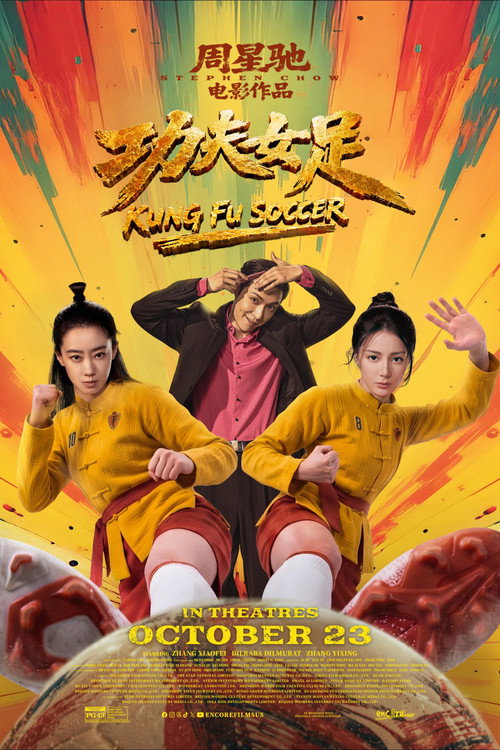
Kung Fu Soccer (2026)
Directed by Stephen Chow
No — Kung Fu Soccer is not especially woke, scoring 22 out of 100 on our wokeness meter.
Stephen Chow's return to feature filmmaking after seven years arrives in the form of a spiritual companion to Shaolin Soccer, this time relocating the supernatural athleticism to a women's team and the accompanying cultural conversation to considerably more turbulent waters.
Consciousness Markers
The film fields an entirely female ensemble as its heroes, with a cast drawn from across Chinese ethnic backgrounds including Dilraba Dilmurat, a prominent Uyghur actress. The gender composition is intrinsic to the premise rather than grafted on, but it is impossible to discuss the casting without noting that 'all-women team' is the entire point of the film's existence.
The film nominally celebrates women in sport, addressing ageism, financial precarity, and social media scrutiny faced by working women athletes. However, critics at ScreenAnarchy and the South China Morning Post noted that the comedy simultaneously mocks female vanity, ridicules the lead for being single in her late thirties, and has rival teams weaponize sex appeal against referees, producing a feminist reading that is, at best, contested.
The film sparked genuine international controversy over its caricature of a fictional Korean women's team depicted as cosmetics-obsessed and prone to theatrical weeping. Chinese media defended this as equal-opportunity national stereotyping, with Japanese, Indian, and Australian teams receiving similarly broad treatment, which places the film closer to classic Chow slapstick than to any identifiable racial justice framework.
The working-class financial hardship of the Emei team is present as background texture, lending the underdog narrative some economic grounding. It does not develop into a critique of capital or systemic economic structures.
The underdog-women-in-sport premise carries an implicit motivational charge, but the film delivers its themes through spectacle and slapstick rather than speechifying. Armond White specifically praised it for avoiding the sermonizing quality of Western progressive sports films.
No LGBTQ+ characters, themes, or subtext are present in the film or reported in any coverage of it.
No climate themes, environmental messaging, or ecological subtext appear in the film or its surrounding discourse.
No body positivity themes or messaging are present. The film's comedy around female appearance leans, if anything, in the opposite direction.
No neurodivergent characters or themes are present in the film or referenced in any available coverage.
The film operates in a wholly fantastical register with no engagement with historical events or revisionist reframing of the past.
Why it received this score
Stephen Chow's return to feature filmmaking after seven years arrives in the form of a spiritual companion to Shaolin Soccer, this time relocating the supernatural athleticism to a women's team and the accompanying cultural conversation to considerably more turbulent waters. The Emei Women's Football Team is underdogs, working-class, and female, a combination that in 2026 carries certain expectations. Chow, to his modest credit, declines to meet most of them. The film celebrates its heroines through the only language he has ever trusted: exaggerated physical comedy, escalating absurdity, and the particular warmth of watching people who have been dismissed discover that they are, in fact, extraordinary. It is not a manifesto. It is a sports movie with wire work.
The gender politics, however, refuse to stay tidy. Critics who arrived hoping for a clean empowerment narrative found the film also happy to mock its lead character's unmarried status at thirty-something, to deploy rival female teams as creatures of vanity and theatrical weeping, and to mine female appearance for laughs with the same cheerful indifference it brings to everything else. Whether this constitutes feminist filmmaking or its opposite depends almost entirely on what you were hoping to find. The film does not appear to have an opinion on the matter. The South Korean controversy over the "Ewha" team's portrayal, condemned by academics in Seoul and defended by Chinese netizens as consistent equal-opportunity caricature, adds a layer of geopolitical texture that Chow almost certainly did not intend to make the centerpiece of his promotional campaign.
The AI-generated effects, reportedly consuming nearly half of a CN¥380 million budget, prompted their own parallel discourse about artistic integrity and commercialization, which is the kind of conversation that tends to follow a beloved filmmaker into a release and color every frame. The film lands somewhere between a genuine celebration of women's sport and a nostalgia delivery mechanism assembled with considerable computational assistance. Its progressive credentials are real but partial, its retrograde tendencies equally real and equally partial. This is a film that wants to cheer for women and also wants to make jokes at their expense, and it sees no contradiction in that position whatsoever.
Analysis generated by our Consciousness Algorithm
Synopsis
Dismissed as underdogs before they even step onto the pitch, the Emei Women's Football Team enters the prestigious Supreme Invincible Cup determined to prove everyone wrong. Led by captain Shuangshuang, star striker Yulong, and mentor Xu Feng, the team combines martial arts mastery with football skill in a thrilling quest for victory. Against mounting challenges and impossible odds, they fight to make their mark and chase their championship dream.
Questions about Kung Fu Soccer
Is Kung Fu Soccer woke?
No — Kung Fu Soccer is not especially woke, scoring 22 out of 100 on our wokeness meter. That earns it a verdict of Based.
Does Kung Fu Soccer have any woke elements?
2 of the 10 markers register at 30 or above, led by Representation Casting (55) and Feminist Agenda (42). On Representation Casting: The film fields an entirely female ensemble as its heroes, with a cast drawn from across Chinese ethnic backgrounds including Dilraba Dilmurat, a prominent Uyghur actress.
How does Kung Fu Soccer compare to other 2026 movies?
It ranks #288 of the 800 films from 2026 we've scored; their average is 23. The wokest is Between Us (89).
How is the Woke Score calculated?
An AI-assisted process researches the film and its reception, scores it 0–100 on ten markers, then combines those into one 0–100 Woke Score. It measures a specific set of 2020s cultural themes, not film quality.