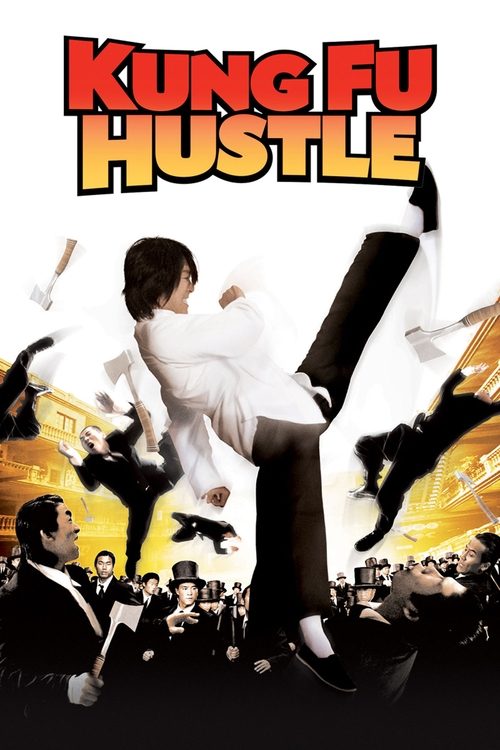
Kung Fu Hustle (2004)
Directed by Stephen Chow
No — Kung Fu Hustle is not woke, scoring 6 out of 100 on our wokeness meter.
Kung Fu Hustle arrived in 2004, a Stephen Chow martial arts comedy that treats the 1940s Shanghai of its imagination as a playground for cartoon physics and Buddhist Palm.
Consciousness Markers
The Landlady is a powerful, fearsome martial artist who dominates her husband, but the film remains a male-centric hero's journey without explicit feminist critique.
The cast is entirely Chinese, which is natural for a Chinese-language film set in Shanghai, not a modern diversity-casting statement.
There is no substantive LGBTQ+ theme; a minor gag about pretending to be gay is not positive representation.
No engagement with racial justice or identity politics; the film is a Chinese martial arts fantasy.
No environmental or climate themes.
The conflict is between gangsters and slum dwellers, not a critique of capitalism or wealth inequality.
The film uses obesity for comedy (Bone) and the Landlady's size for intimidation, not body-positive messaging.
Fong is mute, but her condition is a plot device for innocence, not an exploration of neurodivergence.
Fictional story set in 1940s Shanghai; no historical revisionism.
The film is an anarchic comedy that entertains rather than lectures.
Why it received this score
Kung Fu Hustle arrived in 2004, a Stephen Chow martial arts comedy that treats the 1940s Shanghai of its imagination as a playground for cartoon physics and Buddhist Palm. The cast is entirely Chinese, which registers here as the natural condition of a Chinese-language film set in a Chinese city, not as a statement of any kind. There is no climate anxiety in Pigsty Alley, no critique of the wealth the Axe Gang accumulates, no engagement with racial justice. The villains are gangsters. The heroes are tenants. The conflict is between them. That is the whole of the political content, and it is enough for the film, which has other business.
The Landlady (Yuen Qiu) is the closest thing to a modern sensibility on offer. She screams a Lion's Roar that flattens men, and she keeps her husband in a state of visible submission. Yet the story belongs to Sing, a man who must recover a childhood dream and become the hero he once failed to be. The women orbit this arc. Fong is mute, and her silence exists to signal innocence and to hand the protagonist a lollipop he can smash in his lowest moment. Bone is fat, and his weight is the joke. This is comedy of a pre-2010 vintage, unbothered by the sensitivities that would later be applied to such material.
Nothing in the film lectures. It is anarchic, joyful, and committed only to the pleasure of watching retired action stars defy gravity. There is a gag about pretending to be gay, deployed as a punchline and nothing more. There is no history to revise, no body to affirm, no mind to explain. The vagrant sells pamphlets to the end. We are left to classify a film that simply wants to entertain us, and does.
Analysis generated by our Consciousness Algorithm


Synopsis
It's the 1940s, and the notorious Axe Gang terrorizes Shanghai. Small-time criminals Sing and Bone hope to join, but they only manage to make lots of very dangerous enemies. Fortunately for them, kung fu masters and hidden strength can be found in unlikely places. Now they just have to take on the entire Axe Gang.
Questions about Kung Fu Hustle
Is Kung Fu Hustle woke?
No — Kung Fu Hustle is not woke, scoring 6 out of 100 on our wokeness meter. That earns it a verdict of Ultra Based.
Does Kung Fu Hustle have any woke elements?
Very few. None of the 10 markers reaches 30, the level where a marker counts as present; the highest is Feminist Agenda at 15.
How does Kung Fu Hustle compare to other 2004 movies?
It ranks #104 of the 178 films from 2004 we've scored; their average is 12. The wokest is Tropical Malady (62).
How is the Woke Score calculated?
An AI-assisted process researches the film and its reception, scores it 0–100 on ten markers, then combines those into one 0–100 Woke Score. It measures a specific set of 2020s cultural themes, not film quality.