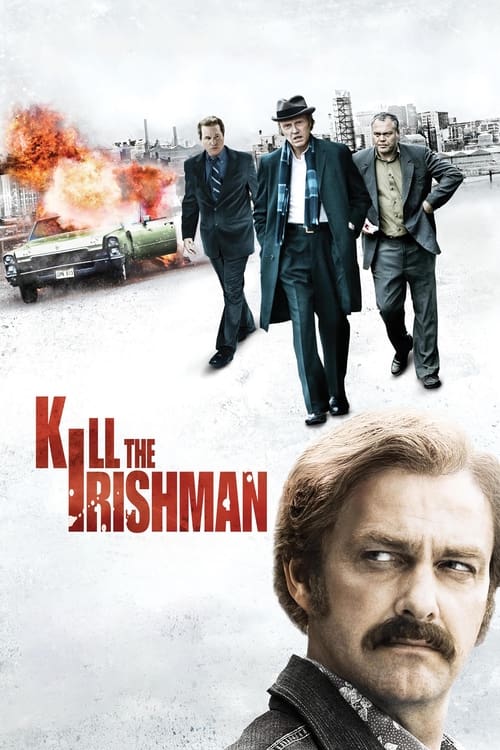
Kill the Irishman (2011)
Directed by Jonathan Hensleigh
No — Kill the Irishman is not woke, scoring 2 out of 100 on our wokeness meter.
Kill the Irishman arrives with the tired confidence of a genre exercise that knows precisely which Scorsese film it is imitating.
Consciousness Markers
The cast is overwhelmingly white and male, with women (Linda Cardellini, Fionnula Flanagan) relegated to peripheral roles. The Irish-versus-Italian ethnic friction is period texture, not modern representation casting.
Union corruption and mob economics are depicted as personal greed and betrayal, not as a systemic eat-the-rich indictment.
A closing post-script notes that Greene's murder crippled the Mafia, and the filmmakers insisted crime doesn't pay, but the moralizing is faint and genre-standard.
Women exist only as the long-suffering wife who leaves and a childhood nun; the film is a boys' club of mob enforcers with no feminist framing.
The film's conflict is ethnic (Irish vs. Italian mobsters) but treated as turf-war tribalism rather than any modern racial-justice consciousness.
No LGBTQ+ characters, themes, or subtext of any kind appear in this mob drama.
No environmental or climate themes whatsoever; the only explosions are car bombs.
No body-positivity themes; the film is populated by hard-bitten tough guys.
No neurodivergent characters or themes are present.
The film is a straightforward biographical account of Danny Greene, not a revisionist reframing of history for ideological purposes.
Why it received this score
Kill the Irishman arrives with the tired confidence of a genre exercise that knows precisely which Scorsese film it is imitating. Danny Greene, a Cleveland longshoreman turned union president turned mob enforcer, bombs his way through a turf war with the Italian Mafia across the summer of 1976. Thirty-six explosions. Ray Stevenson glowers with conviction. Christopher Walken and Vincent D'Onofrio collect paychecks. The picture is adapted from Rick Porrello's book and treats its subject as straight biography. It never poses a question that a car bomb cannot answer.
The social ledger here is thin. Linda Cardellini appears as the wife who eventually leaves, Fionnula Flanagan as the childhood nun, and the rest is a boys' club of enforcers with no interest in feminist framing. The Irish against Italian friction is turf tribalism, not racial consciousness. There is no climate concern beyond the carbon footprint of the pyrotechnics. Union corruption registers as personal greed and betrayal, never as a systemic indictment of capital. The cast is uniformly white and weather-beaten, and nobody pauses to interrogate his relationship with his own body. Neurodivergence does not come up. History is presented as it happened, or as the producers preferred to remember it.
A closing title card notes that Greene's murder crippled the Mafia nationwide, and the filmmakers have stressed that crime does not pay. The sermon is brief and standard issue. This is a film of period texture and old-fashioned tough-guy mythology, released in 2011 with the cultural awareness of 1990. It means no harm. It also means very little else.
Analysis generated by our Consciousness Algorithm


Synopsis
Over the summer of 1976, thirty-six bombs detonate in the heart of Cleveland while a turf war raged between Irish mobster Danny Greene and the Italian mafia. Based on a true story, Kill the Irishman chronicles Greene's heroic rise from a tough Cleveland neighborhood to become an enforcer in the local mob.
Questions about Kill the Irishman
Is Kill the Irishman woke?
No — Kill the Irishman is not woke, scoring 2 out of 100 on our wokeness meter. That earns it a verdict of Ultra Based.
Does Kill the Irishman have any woke elements?
Very few. None of the 10 markers reaches 30, the level where a marker counts as present; the highest is Eat the Rich at 5.
How does Kill the Irishman compare to other 2011 movies?
It ranks #205 of the 245 films from 2011 we've scored; their average is 11. The wokest is Paul (68).
How is the Woke Score calculated?
An AI-assisted process researches the film and its reception, scores it 0–100 on ten markers, then combines those into one 0–100 Woke Score. It measures a specific set of 2020s cultural themes, not film quality.