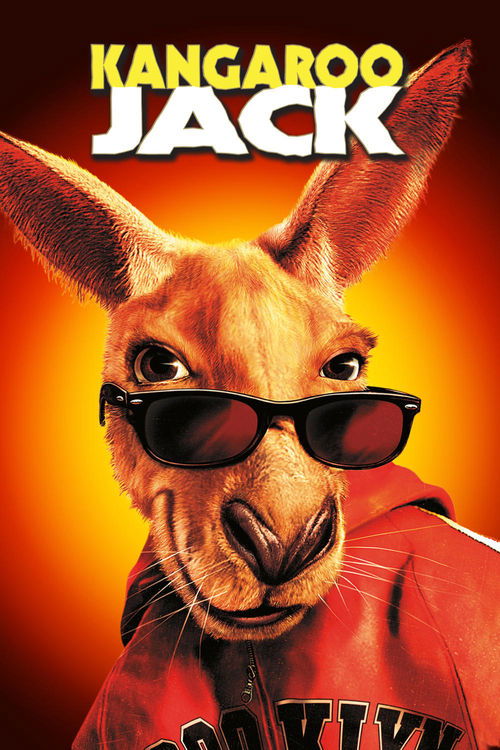
Kangaroo Jack (2003)
Directed by David McNally
No — Kangaroo Jack is not woke, scoring 6 out of 100 on our wokeness meter.
Kangaroo Jack began life as Down and Under, an R-rated mob comedy in the Midnight Run mold, until negative test screenings sent the producers scrambling.
Consciousness Markers
Anthony Anderson is a co-lead as Louis, but his presence is a natural buddy-comedy pairing with no commentary on race or casting intent. A pre-2010 studio comedy with a Black second lead earns modest credit only.
Estella Warren's Jessie is a capable Outback wildlife guide who decks Charlie after he harasses her, but the film plays the harassment for laughs and offers no feminist thesis.
No LGBTQ+ characters, themes, or subtext of any kind.
No engagement with race, racism, or racial identity; the mob plot and kangaroo chase are entirely race-blind.
Jessie works for the Outback Wildlife Foundation, but this is set dressing for a chase comedy, not an environmental or climate message.
Sal's mob skimming 80% of the salon's profits is gangster extortion, not a critique of capitalism or wealth inequality.
No body-positive themes or messaging; the humor leans on slapstick and crude gags instead.
No neurodivergent characters or themes are present.
No historical revisionism; the film is a contemporary fictional caper with no historical subject matter.
A broad, dumb PG animal comedy with no moralizing, messaging, or fourth-wall sermonizing beyond the kangaroo's closing gag.
Why it received this score
Kangaroo Jack began life as Down and Under, an R-rated mob comedy in the Midnight Run mold, until negative test screenings sent the producers scrambling. What reached theaters in January 2003 was a PG animal picture assembled from reshoots, redubs, and a CGI kangaroo, with Jerry O'Connell and Anthony Anderson chased across the Outback by a marsupial wearing a lucky jacket. Christopher Walken and Michael Shannon appear, presumably as a favor, or a debt.
The film's cultural footprint is faint. Anderson's Louis is a genuine co-lead, but the pairing is standard buddy-comedy arithmetic with no comment on race or casting intent. Estella Warren's Jessie works for the Outback Wildlife Foundation and knocks Charlie unconscious after he harasses her, a moment that lands as slapstick rather than statement. The organization itself is set dressing for a chase. Sal's mob takes eighty percent of a hair salon's profits, which is extortion, not an argument about capital. There is no body-positive messaging, no neurodivergent character, no historical revision, and no fourth-wall sermonizing, save a rapping kangaroo in a dream sequence who taunts Charlie about his blood. The desert, the dingoes, and the sandstorm exist to inconvenience two men from Canarsie, nothing more.
This is a pre-2010 studio comedy and behaves accordingly. Its progressive gestures amount to a Black second lead and a woman who can throw a punch, neither of which the script bothers to examine. The film won a Kids' Choice Award for Favorite Fart in a Movie, and that remains its most honest claim to cultural relevance.
Analysis generated by our Consciousness Algorithm


Synopsis
Two childhood friends — a New York hairstylist and a wanna-be musician — get mixed-up with the mob and are forced to deliver $50,000 to Australia, but things go all wrong when the money is lost to a wild kangaroo.
Questions about Kangaroo Jack
Is Kangaroo Jack woke?
No — Kangaroo Jack is not woke, scoring 6 out of 100 on our wokeness meter. That earns it a verdict of Ultra Based.
Does Kangaroo Jack have any woke elements?
Very few. None of the 10 markers reaches 30, the level where a marker counts as present; the highest is Representation Casting at 15.
How does Kangaroo Jack compare to other 2003 movies?
It ranks #93 of the 150 films from 2003 we've scored; their average is 12. The wokest is Mona Lisa Smile (60).
How is the Woke Score calculated?
An AI-assisted process researches the film and its reception, scores it 0–100 on ten markers, then combines those into one 0–100 Woke Score. It measures a specific set of 2020s cultural themes, not film quality.