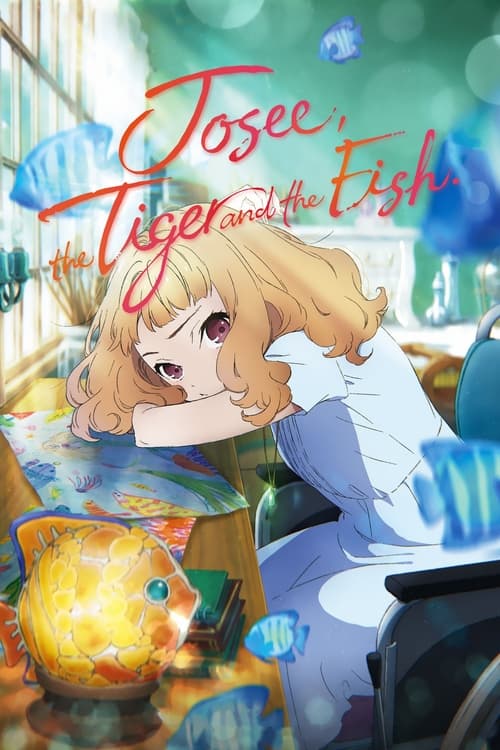
Josee, the Tiger and the Fish (2020)
Directed by Kotaro Tamura
No — Josee, the Tiger and the Fish is not woke, scoring 12 out of 100 on our wokeness meter.
Josee, the Tiger and the Fish arrives from Bones with a wheelchair, a stack of picture books, and the quiet determination of a production committee that has read its source material and decided to be kind.
Consciousness Markers
The film centers a paraplegic woman who is loved and portrayed as desirable and capable, offering disability-positive representation, though it does not explicitly engage with body-positivity activism.
Josee is a female protagonist with artistic ambitions and growing independence, but the narrative remains a conventional romance rather than a feminist critique.
The film delivers an uplifting message about disability and independence, but it does so through story rather than preachy exposition.
The cast is entirely Japanese and no actors with disabilities were cast in the lead role; the film's representation is in its character writing, not its casting.
No LGBTQ+ characters, relationships, or themes appear in the film.
The film is set in a homogeneous Japanese context and does not engage with racial identity or systemic racism.
No environmental or climate-related themes are present.
The story focuses on personal relationships and disability, with no critique of capitalism or wealth inequality.
No neurodivergent characters or themes are depicted.
The film is a contemporary fictional romance and does not revise historical narratives.
Why it received this score
Josee, the Tiger and the Fish arrives from Bones with a wheelchair, a stack of picture books, and the quiet determination of a production committee that has read its source material and decided to be kind. The film follows Tsuneo, a marine biology student with dreams of Mexico, and Josee, a paraplegic artist whose imagination extends well beyond her chair. Their courtship is a conventional thing: a meet-cute involving a runaway wheelchair on a steep hill, a grandmother who dies at the convenient hour, a rival who exists mainly to deliver encouragement. It is a romance, executed with the polished sentimentality of a studio that knows its way around polished sentimentality.
Where the film shows a modest social awareness is in its treatment of Josee herself. She is desired. She is difficult. She is an artist, and the camera never flinches from her chair. That is a genuine courtesy toward disabled viewers, though the film stops well short of activism: nobody lectures about accessibility, and the narrative prefers a happy ending to an argument. Josee's independence gets a hearing, and she does acquire a job, a craft, and a future, which counts as a mild feminist drift. The film is careful, however, to keep her ambitions tethered to a man's encouragement, and her arc resolves in the traditional position of the beloved.
Everything else is absent. The cast is uniformly Japanese, the setting is a homogeneous Osaka, and no LGBTQ+ characters, climate anxieties, wealth inequality, or neurodivergent storylines intrude on the proceedings. The film has one message, that disabled people deserve love and work, and it delivers that message through story instead of sermon, which is the polite way to do it. The result is a warm, well-made romance that will not trouble anyone's politics. It is the cinematic equivalent of a nice cup of tea, served by someone who has thought carefully about the cup, and about nothing else in the pantry. A sommelier would call it clean, pleasant, and entirely without ambition beyond the glass in front of it. We score it accordingly, and we do so without malice, because malice would require the film to have provoked something more than mild approval. It did not, and it never intended to, and there is a certain integrity in that refusal to reach beyond the frame of a storybook ending. The tiger remains in its cage, well fed, and the fish swims on, unbothered by the tide of history. We move on to the next screening with our notes barely marked, which is itself a note of sorts, filed under the category of films that are exactly what they claim to be and nothing further. The classification stands. The evening was not wasted. It was merely spent, quietly, in the company of a chair, a girl, and a boy who learns to walk again for her, which is either devotion or a screenplay, and here it is both, and here it ends, and here we close the notebook and reach for the next one, because the sacred duty of classification recognizes no holidays and no sentiment, only the steady, thankless labor of the count. The count, in this case, is low. The film is fine. The film is fine, and that is all it is, and we record it as such before the lights come up and the credits roll over a song we will not remember by Tuesday. We are not made of stone. We simply have a job to do, and the job does not care whether the cup of tea was nice, only whether it was tea, and whether anything was poured into it besides water and leaves. Nothing was. We note the absence, we note the warmth, we file the report, and we go home, and tomorrow there will be another film, and another, and another, until the notebook fills and the pen runs dry and the classification of all things reaches its quiet, inevitable, untelevised conclusion. That is the work. That is always the work. Good night, and good luck to the tiger, wherever they keep him.
Analysis generated by our Consciousness Algorithm


Synopsis
With dreams of diving abroad, Tsuneo gets a job assisting Josee, an artist whose imagination takes her far beyond her wheelchair. But when the tide turns against them, they push each other to places they never thought possible, and inspire a love fit for a storybook.
Questions about Josee, the Tiger and the Fish
Is Josee, the Tiger and the Fish woke?
No — Josee, the Tiger and the Fish is not woke, scoring 12 out of 100 on our wokeness meter. That earns it a verdict of Ultra Based.
Does Josee, the Tiger and the Fish have any woke elements?
Very few. None of the 10 markers reaches 30, the level where a marker counts as present; the highest is Body Positivity at 25.
How does Josee, the Tiger and the Fish compare to other 2020 movies?
It ranks #126 of the 227 films from 2020 we've scored; their average is 21. The wokest is One Night in Miami... (83).
How is the Woke Score calculated?
An AI-assisted process researches the film and its reception, scores it 0–100 on ten markers, then combines those into one 0–100 Woke Score. It measures a specific set of 2020s cultural themes, not film quality.